

13 If Truncated Wave Functions of Excited State Energy Saddle Points Are. . .
477
Substitute from Eq. 13.1 the unknown quantities E n + U = E[φ n ] + L:
F [φ n ] = E [φ n ] + 2L;
(13.5)
now F[φ n ] is expressed in terms of only the lower exact eigenfunctions ψ i < n in
paraboloid L, inverted upward. But all ψ i < n are unknown; suppose, however, that
we already have computed normalized approximants φ i < n for all ψ i < n . Then make
a continuation of F[φ n ] from ψ i < n to φ i < n .
Expand each φ i < n in the {ψ i } basis, and obtain to leading order in coefficients
φ i |φ n = i|φ n + n|φ i + · · ·
φ i | H |φ n = E i i|φ n + E n n|φ i + · · · .
(13.6)
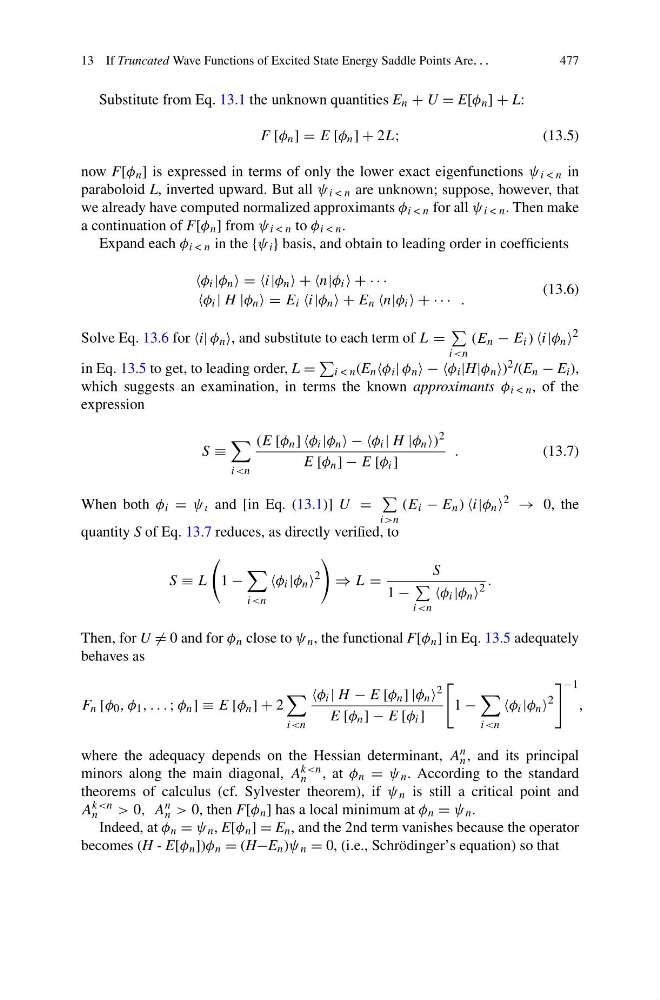
Solve Eq. 13.6 for i| φ n , and substitute to each term of L =
i
in Eq. 13.5 to get, to leading order, L =
i < n (E n φ i | φ n − −φ i |H|φ n ) 2 /(E n − E i ),
which suggests an examination, in terms the known approximants φ i < n , of the
expression
S ≡
i
E [φ n ] − E [φ i ]
.
(13.7)
When both φ i = ψ ι and [in Eq. (13.1)] U =
i>n
(E i − E n ) i|φ n 2 → 0, the
quantity S of Eq. 13.7 reduces, as directly verified, to
S ≡ L
1 −
i
2
⇒ L =
S
1 −
i
Then, for U = 0 and for φ n close to ψ n , the functional F[φ n ] in Eq. 13.5 adequately
behaves as
F n [φ 0 , φ 1 , . . . ; φ n ] ≡ E [φ n ] + 2
i
E [φ n ] − E [φ i ]
1 −
i
2
−1
,
where the adequacy depends on the Hessian determinant, A n
n , and its principal
minors along the main diagonal, A k
theorems of calculus (cf. Sylvester theorem), if ψ n is still a critical point and
A k
> 0, A n
n > 0, then F[φ n ] has a local minimum at φ n = ψ n .
Indeed, at φ n = ψ n , E[φ n ] = E n , and the 2nd term vanishes because the operator
becomes (H - E[φ n ])φ n = (H−E n )ψ n = 0, (i.e., Schrödinger’s equation) so that
477
Substitute from Eq. 13.1 the unknown quantities E n + U = E[φ n ] + L:
F [φ n ] = E [φ n ] + 2L;
(13.5)
now F[φ n ] is expressed in terms of only the lower exact eigenfunctions ψ i < n in
paraboloid L, inverted upward. But all ψ i < n are unknown; suppose, however, that
we already have computed normalized approximants φ i < n for all ψ i < n . Then make
a continuation of F[φ n ] from ψ i < n to φ i < n .
Expand each φ i < n in the {ψ i } basis, and obtain to leading order in coefficients
φ i |φ n = i|φ n + n|φ i + · · ·
φ i | H |φ n = E i i|φ n + E n n|φ i + · · · .
(13.6)
Solve Eq. 13.6 for i| φ n , and substitute to each term of L =
i
in Eq. 13.5 to get, to leading order, L =
i < n (E n φ i | φ n − −φ i |H|φ n ) 2 /(E n − E i ),
which suggests an examination, in terms the known approximants φ i < n , of the
expression
S ≡
i
E [φ n ] − E [φ i ]
.
(13.7)
When both φ i = ψ ι and [in Eq. (13.1)] U =
i>n
(E i − E n ) i|φ n 2 → 0, the
quantity S of Eq. 13.7 reduces, as directly verified, to
S ≡ L
1 −
i
2
⇒ L =
S
1 −
i
Then, for U = 0 and for φ n close to ψ n , the functional F[φ n ] in Eq. 13.5 adequately
behaves as
F n [φ 0 , φ 1 , . . . ; φ n ] ≡ E [φ n ] + 2
i
E [φ n ] − E [φ i ]
1 −
i
2
−1
,
where the adequacy depends on the Hessian determinant, A n
n , and its principal
minors along the main diagonal, A k
theorems of calculus (cf. Sylvester theorem), if ψ n is still a critical point and
A k
> 0, A n
n > 0, then F[φ n ] has a local minimum at φ n = ψ n .
Indeed, at φ n = ψ n , E[φ n ] = E n , and the 2nd term vanishes because the operator
becomes (H - E[φ n ])φ n = (H−E n )ψ n = 0, (i.e., Schrödinger’s equation) so that