

13 If Truncated Wave Functions of Excited State Energy Saddle Points Are. . .
475
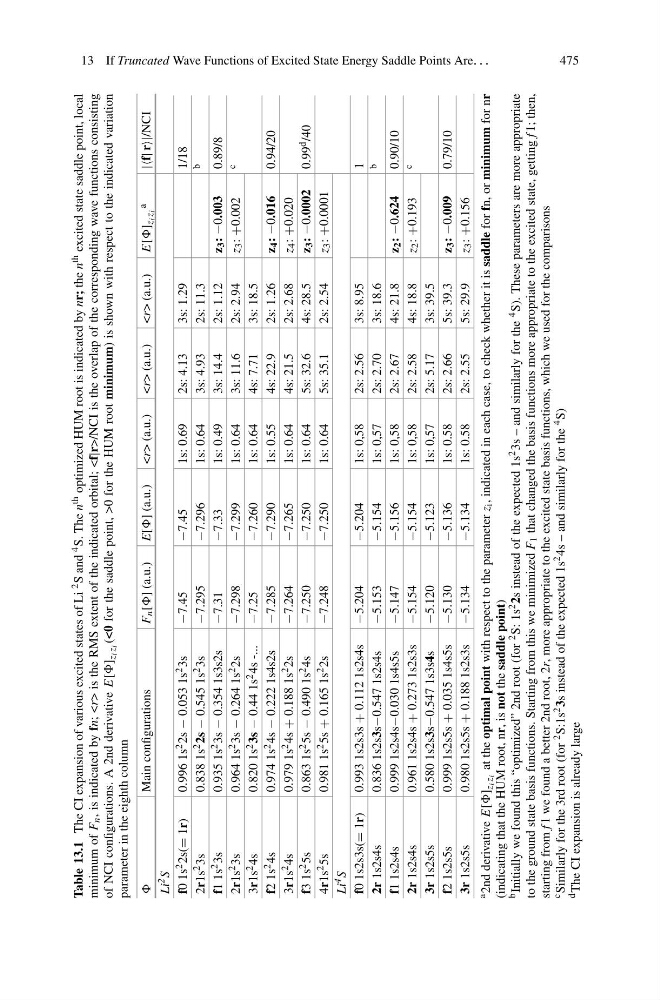
Table 13.1
The CI expansion of various excited states of Li 2
S and 4
S. The n th
optimized HUM root is indicated by nr;
the n th
excited state saddle point, local
minimum of F
n , is indicated by fn;
is the RMS extent of the indicated orbital; /NCI is the overlap of the corresponding wave functions consisting
of NCI configurations. A 2nd derivative E[]
z
i z
i
(<0 for the saddle point, >0 for the HUM root minimum)
is shown with respect to the indicated variation
parameter in the eighth column
Main configurations
F
n [] (a.u.)
E[]
(a.u.)
(a.u.)
(a.u.)
(a.u.)
E[]
z
i z
i
a
||f| r|/NCI
Li 2
S
f0
1s 2
2s(= 1r)
0.996 1s 2
2s
− 0.053 1s 2
3s
−7.45
−7.45
1s: 0.69
2s: 4.13
3s: 1.29
1/18
2r1s 2
3s
0.838 1s 2
2s
− 0.545 1s 2
3s
−7.295
−7.296
1s: 0.64
3s: 4.93
2s: 11.3
b
f1
1s 2
3s
0.935 1s 2
3s
− 0.354 1s3s2s
−7.31
−7.33
1s: 0.49
3s: 14.4
2s: 1.12
z
3 :
−0.003
0.89/8
2r1s 2
3s
0.964 1s 2
3s
− 0.264 1s 2
2s
−7.298
−7.299
1s: 0.64
3s: 11.6
2s: 2.94
z
3 :
+0.002
c
3r1s 2
4s
0.820 1s 2
3s
− 0.44 1s 2
4s -...
−7.25
−7.260
1s: 0.64
4s: 7.71
3s: 18.5
f2
1s 2
4s
0.974 1s 2
4s
− 0.222 1s4s2s
−7.285
−7.290
1s: 0.55
4s: 22.9
2s: 1.26
z
4 :
−0.016
0.94/20
3r1s 2
4s
0.979 1s 2
4s
+ 0.188 1s 2
2s
−7.264
−7.265
1s: 0.64
4s: 21.5
2s: 2.68
z
4 :
+0.020
f3
1s 2
5s
0.863 1s 2
5s
− 0.490 1s 2
4s
−7.250
−7.250
1s: 0.64
5s: 32.6
4s: 28.5
z
3 :
−0.0002
0.99 d
/40
4r1s 2
5s
0.981 1s 2
5s
+ 0.165 1s 2
2s
−7.248
−7.250
1s: 0.64
5s: 35.1
2s: 2.54
z
3 :
+0.0001
Li 4
S
f0
1s2s3s(= 1r)
0.993 1s2s3s
+ 0.112 1s2s4s
−5.204
−5.204
1s: 0,58
2s: 2.56
3s: 8.95
1
2r
1s2s4s
0.836 1s2s3s−0.547 1s2s4s
−5.153
−5.154
1s: 0,57
2s: 2.70
3s: 18.6
b
f1
1s2s4s
0.999 1s2s4s−0.030 1s4s5s
−5.147
−5.156
1s: 0,58
2s: 2.67
4s: 21.8
z
2 :
−0.624
0.90/10
2r
1s2s4s
0.961 1s2s4s
+ 0.273 1s2s3s
−5.154
−5.154
1s: 0,58
2s: 2.58
4s: 18.8
z
2 :
+0.193
c
3r
1s2s5s
0.580 1s2s3s−0.547 1s3s4s
−5.120
−5.123
1s: 0,57
2s: 5.17
3s: 39.5
f2
1s2s5s
0.999 1s2s5s
+ 0.035 1s4s5s
−5.130
−5.136
1s: 0.58
2s: 2.66
5s: 39.3
z
3 :
−0.009
0.79/10
3r
1s2s5s
0.980 1s2s5s
+ 0.188 1s2s3s
−5.134
−5.134
1s: 0.58
2s: 2.55
5s: 29.9
z
3 :
+0.156
a
2nd derivative E[]
z
i z
i
at the optimal point
with respect to the parameter z
i , indicated in each case, to check whether it is saddle
for fn,
or minimum
for nr
(indicating that the HUM root, nr, is not
the saddle point)
b
Initially we found this “optimized” 2nd root (for 2
S: 1s 2
2s
instead of the expected 1s 2
3s – and similarly for the 4
S). These parameters are more appropriate
to the ground state basis functions. Starting from this we minimized F
1 that changed the basis functions more appropriate to the excited state, getting f
1; then,
starting from f
1 we found a better 2nd root, 2r, more appropriate to the excited state basis functions, which we used for the comparisons
c
Similarly for the 3rd root (for 2
S:1s 2
3s
instead of the expected 1s 2
4s – and similarly for the 4
S)
d
The CI expansion is already large
475
Table 13.1
The CI expansion of various excited states of Li 2
S and 4
S. The n th
optimized HUM root is indicated by nr;
the n th
excited state saddle point, local
minimum of F
n , is indicated by fn;
of NCI configurations. A 2nd derivative E[]
z
i z
i
(<0 for the saddle point, >0 for the HUM root minimum)
is shown with respect to the indicated variation
parameter in the eighth column
Main configurations
F
n [] (a.u.)
E[]
(a.u.)
E[]
z
i z
i
a
||f| r|/NCI
Li 2
S
f0
1s 2
2s(= 1r)
0.996 1s 2
2s
− 0.053 1s 2
3s
−7.45
−7.45
1s: 0.69
2s: 4.13
3s: 1.29
1/18
2r1s 2
3s
0.838 1s 2
2s
− 0.545 1s 2
3s
−7.295
−7.296
1s: 0.64
3s: 4.93
2s: 11.3
b
f1
1s 2
3s
0.935 1s 2
3s
− 0.354 1s3s2s
−7.31
−7.33
1s: 0.49
3s: 14.4
2s: 1.12
z
3 :
−0.003
0.89/8
2r1s 2
3s
0.964 1s 2
3s
− 0.264 1s 2
2s
−7.298
−7.299
1s: 0.64
3s: 11.6
2s: 2.94
z
3 :
+0.002
c
3r1s 2
4s
0.820 1s 2
3s
− 0.44 1s 2
4s -...
−7.25
−7.260
1s: 0.64
4s: 7.71
3s: 18.5
f2
1s 2
4s
0.974 1s 2
4s
− 0.222 1s4s2s
−7.285
−7.290
1s: 0.55
4s: 22.9
2s: 1.26
z
4 :
−0.016
0.94/20
3r1s 2
4s
0.979 1s 2
4s
+ 0.188 1s 2
2s
−7.264
−7.265
1s: 0.64
4s: 21.5
2s: 2.68
z
4 :
+0.020
f3
1s 2
5s
0.863 1s 2
5s
− 0.490 1s 2
4s
−7.250
−7.250
1s: 0.64
5s: 32.6
4s: 28.5
z
3 :
−0.0002
0.99 d
/40
4r1s 2
5s
0.981 1s 2
5s
+ 0.165 1s 2
2s
−7.248
−7.250
1s: 0.64
5s: 35.1
2s: 2.54
z
3 :
+0.0001
Li 4
S
f0
1s2s3s(= 1r)
0.993 1s2s3s
+ 0.112 1s2s4s
−5.204
−5.204
1s: 0,58
2s: 2.56
3s: 8.95
1
2r
1s2s4s
0.836 1s2s3s−0.547 1s2s4s
−5.153
−5.154
1s: 0,57
2s: 2.70
3s: 18.6
b
f1
1s2s4s
0.999 1s2s4s−0.030 1s4s5s
−5.147
−5.156
1s: 0,58
2s: 2.67
4s: 21.8
z
2 :
−0.624
0.90/10
2r
1s2s4s
0.961 1s2s4s
+ 0.273 1s2s3s
−5.154
−5.154
1s: 0,58
2s: 2.58
4s: 18.8
z
2 :
+0.193
c
3r
1s2s5s
0.580 1s2s3s−0.547 1s3s4s
−5.120
−5.123
1s: 0,57
2s: 5.17
3s: 39.5
f2
1s2s5s
0.999 1s2s5s
+ 0.035 1s4s5s
−5.130
−5.136
1s: 0.58
2s: 2.66
5s: 39.3
z
3 :
−0.009
0.79/10
3r
1s2s5s
0.980 1s2s5s
+ 0.188 1s2s3s
−5.134
−5.134
1s: 0.58
2s: 2.55
5s: 29.9
z
3 :
+0.156
a
2nd derivative E[]
z
i z
i
at the optimal point
with respect to the parameter z
i , indicated in each case, to check whether it is saddle
for fn,
or minimum
for nr
(indicating that the HUM root, nr, is not
the saddle point)
b
Initially we found this “optimized” 2nd root (for 2
S: 1s 2
2s
instead of the expected 1s 2
3s – and similarly for the 4
S). These parameters are more appropriate
to the ground state basis functions. Starting from this we minimized F
1 that changed the basis functions more appropriate to the excited state, getting f
1; then,
starting from f
1 we found a better 2nd root, 2r, more appropriate to the excited state basis functions, which we used for the comparisons
c
Similarly for the 3rd root (for 2
S:1s 2
3s
instead of the expected 1s 2
4s – and similarly for the 4
S)
d
The CI expansion is already large