

454
H. Kobayashi
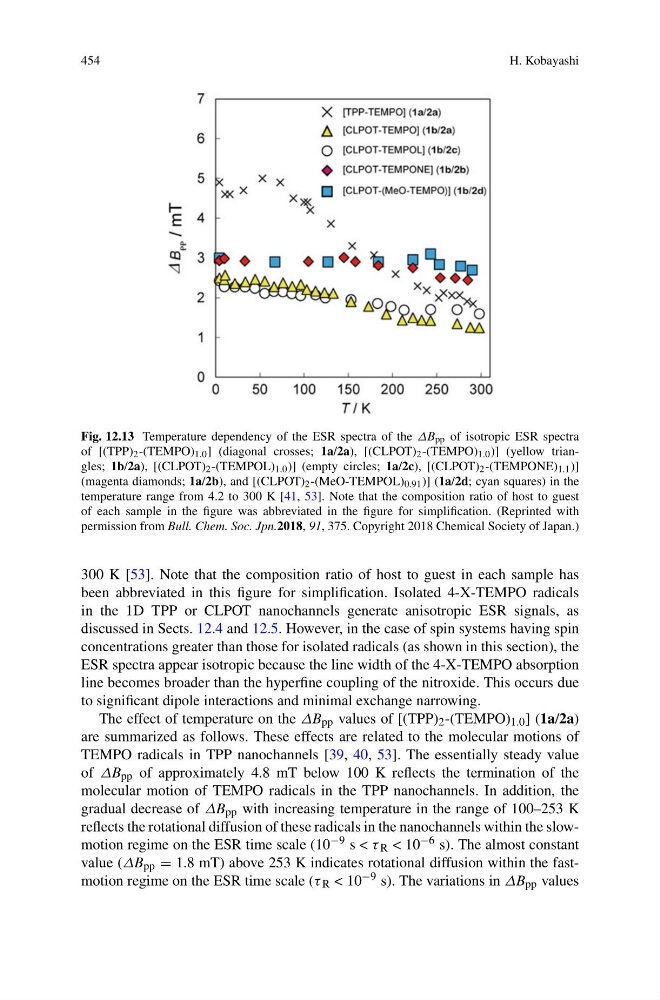
Fig. 12.13 Temperature dependency of the ESR spectra of the ΔB pp of isotropic ESR spectra
of [(TPP) 2 -(TEMPO) 1.0 ] (diagonal crosses; 1a/2a), [(CLPOT) 2 -(TEMPO) 1.0 )] (yellow triangles; 1b/2a), [(CLPOT) 2 -(TEMPOL) 1.0 )] (empty circles; 1a/2c), [(CLPOT) 2 -(TEMPONE) 1.1 )]
(magenta diamonds; 1a/2b), and [(CLPOT) 2 -(MeO-TEMPOL) 0.91 )] (1a/2d; cyan squares) in the
temperature range from 4.2 to 300 K [41, 53]. Note that the composition ratio of host to guest
of each sample in the figure was abbreviated in the figure for simplification. (Reprinted with
permission from Bull. Chem. Soc. Jpn.2018, 91, 375. Copyright 2018 Chemical Society of Japan.)
300 K [53]. Note that the composition ratio of host to guest in each sample has
been abbreviated in this figure for simplification. Isolated 4-X-TEMPO radicals
in the 1D TPP or CLPOT nanochannels generate anisotropic ESR signals, as
discussed in Sects. 12.4 and 12.5. However, in the case of spin systems having spin
concentrations greater than those for isolated radicals (as shown in this section), the
ESR spectra appear isotropic because the line width of the 4-X-TEMPO absorption
line becomes broader than the hyperfine coupling of the nitroxide. This occurs due
to significant dipole interactions and minimal exchange narrowing.
The effect of temperature on the ΔB pp values of [(TPP) 2 -(TEMPO) 1.0 ] (1a/2a)
are summarized as follows. These effects are related to the molecular motions of
TEMPO radicals in TPP nanochannels [39, 40, 53]. The essentially steady value
of ΔB pp of approximately 4.8 mT below 100 K reflects the termination of the
molecular motion of TEMPO radicals in the TPP nanochannels. In addition, the
gradual decrease of ΔB pp with increasing temperature in the range of 100–253 K
reflects the rotational diffusion of these radicals in the nanochannels within the slowmotion regime on the ESR time scale (10 −9 s < τ R < 10 −6 s). The almost constant
value (ΔB pp = 1.8 mT) above 253 K indicates rotational diffusion within the fastmotion regime on the ESR time scale (τ R < 10 −9 s). The variations in ΔB pp values
H. Kobayashi
Fig. 12.13 Temperature dependency of the ESR spectra of the ΔB pp of isotropic ESR spectra
of [(TPP) 2 -(TEMPO) 1.0 ] (diagonal crosses; 1a/2a), [(CLPOT) 2 -(TEMPO) 1.0 )] (yellow triangles; 1b/2a), [(CLPOT) 2 -(TEMPOL) 1.0 )] (empty circles; 1a/2c), [(CLPOT) 2 -(TEMPONE) 1.1 )]
(magenta diamonds; 1a/2b), and [(CLPOT) 2 -(MeO-TEMPOL) 0.91 )] (1a/2d; cyan squares) in the
temperature range from 4.2 to 300 K [41, 53]. Note that the composition ratio of host to guest
of each sample in the figure was abbreviated in the figure for simplification. (Reprinted with
permission from Bull. Chem. Soc. Jpn.2018, 91, 375. Copyright 2018 Chemical Society of Japan.)
300 K [53]. Note that the composition ratio of host to guest in each sample has
been abbreviated in this figure for simplification. Isolated 4-X-TEMPO radicals
in the 1D TPP or CLPOT nanochannels generate anisotropic ESR signals, as
discussed in Sects. 12.4 and 12.5. However, in the case of spin systems having spin
concentrations greater than those for isolated radicals (as shown in this section), the
ESR spectra appear isotropic because the line width of the 4-X-TEMPO absorption
line becomes broader than the hyperfine coupling of the nitroxide. This occurs due
to significant dipole interactions and minimal exchange narrowing.
The effect of temperature on the ΔB pp values of [(TPP) 2 -(TEMPO) 1.0 ] (1a/2a)
are summarized as follows. These effects are related to the molecular motions of
TEMPO radicals in TPP nanochannels [39, 40, 53]. The essentially steady value
of ΔB pp of approximately 4.8 mT below 100 K reflects the termination of the
molecular motion of TEMPO radicals in the TPP nanochannels. In addition, the
gradual decrease of ΔB pp with increasing temperature in the range of 100–253 K
reflects the rotational diffusion of these radicals in the nanochannels within the slowmotion regime on the ESR time scale (10 −9 s < τ R < 10 −6 s). The almost constant
value (ΔB pp = 1.8 mT) above 253 K indicates rotational diffusion within the fastmotion regime on the ESR time scale (τ R < 10 −9 s). The variations in ΔB pp values