

444
H. Kobayashi
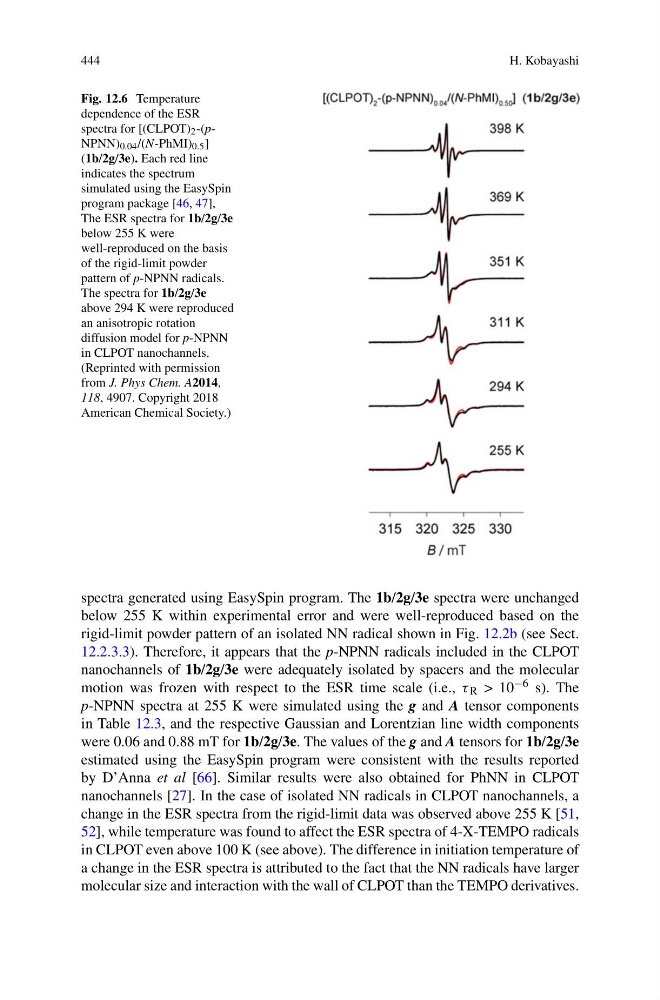
Fig. 12.6 Temperature
dependence of the ESR
spectra for [(CLPOT) 2 -(pNPNN) 0.04 /(N-PhMI) 0.5 ]
(1b/2g/3e). Each red line
indicates the spectrum
simulated using the EasySpin
program package [46, 47],
The ESR spectra for 1b/2g/3e
below 255 K were
well-reproduced on the basis
of the rigid-limit powder
pattern of p-NPNN radicals.
The spectra for 1b/2g/3e
above 294 K were reproduced
an anisotropic rotation
diffusion model for p-NPNN
in CLPOT nanochannels.
(Reprinted with permission
from J. Phys Chem. A2014,
118, 4907. Copyright 2018
American Chemical Society.)
spectra generated using EasySpin program. The 1b/2g/3e spectra were unchanged
below 255 K within experimental error and were well-reproduced based on the
rigid-limit powder pattern of an isolated NN radical shown in Fig. 12.2b (see Sect.
12.2.3.3). Therefore, it appears that the p-NPNN radicals included in the CLPOT
nanochannels of 1b/2g/3e were adequately isolated by spacers and the molecular
motion was frozen with respect to the ESR time scale (i.e., τ R > 10 −6 s). The
p-NPNN spectra at 255 K were simulated using the g and A tensor components
in Table 12.3, and the respective Gaussian and Lorentzian line width components
were 0.06 and 0.88 mT for 1b/2g/3e. The values of the g and A tensors for 1b/2g/3e
estimated using the EasySpin program were consistent with the results reported
by D’Anna et al [66]. Similar results were also obtained for PhNN in CLPOT
nanochannels [27]. In the case of isolated NN radicals in CLPOT nanochannels, a
change in the ESR spectra from the rigid-limit data was observed above 255 K [51,
52], while temperature was found to affect the ESR spectra of 4-X-TEMPO radicals
in CLPOT even above 100 K (see above). The difference in initiation temperature of
a change in the ESR spectra is attributed to the fact that the NN radicals have larger
molecular size and interaction with the wall of CLPOT than the TEMPO derivatives.
H. Kobayashi
Fig. 12.6 Temperature
dependence of the ESR
spectra for [(CLPOT) 2 -(pNPNN) 0.04 /(N-PhMI) 0.5 ]
(1b/2g/3e). Each red line
indicates the spectrum
simulated using the EasySpin
program package [46, 47],
The ESR spectra for 1b/2g/3e
below 255 K were
well-reproduced on the basis
of the rigid-limit powder
pattern of p-NPNN radicals.
The spectra for 1b/2g/3e
above 294 K were reproduced
an anisotropic rotation
diffusion model for p-NPNN
in CLPOT nanochannels.
(Reprinted with permission
from J. Phys Chem. A2014,
118, 4907. Copyright 2018
American Chemical Society.)
spectra generated using EasySpin program. The 1b/2g/3e spectra were unchanged
below 255 K within experimental error and were well-reproduced based on the
rigid-limit powder pattern of an isolated NN radical shown in Fig. 12.2b (see Sect.
12.2.3.3). Therefore, it appears that the p-NPNN radicals included in the CLPOT
nanochannels of 1b/2g/3e were adequately isolated by spacers and the molecular
motion was frozen with respect to the ESR time scale (i.e., τ R > 10 −6 s). The
p-NPNN spectra at 255 K were simulated using the g and A tensor components
in Table 12.3, and the respective Gaussian and Lorentzian line width components
were 0.06 and 0.88 mT for 1b/2g/3e. The values of the g and A tensors for 1b/2g/3e
estimated using the EasySpin program were consistent with the results reported
by D’Anna et al [66]. Similar results were also obtained for PhNN in CLPOT
nanochannels [27]. In the case of isolated NN radicals in CLPOT nanochannels, a
change in the ESR spectra from the rigid-limit data was observed above 255 K [51,
52], while temperature was found to affect the ESR spectra of 4-X-TEMPO radicals
in CLPOT even above 100 K (see above). The difference in initiation temperature of
a change in the ESR spectra is attributed to the fact that the NN radicals have larger
molecular size and interaction with the wall of CLPOT than the TEMPO derivatives.