

12 Inter-spin Interactions of Organic Radical Chains in Organic 1D. . .
439
diffusion of 4-X-TEMPO molecules; see Sect. 12.2.3.4). As an example, in 1a/2a
below 112 K, the rotational diffusion of TEMPO molecules in TPP nanochannels is
thought to cease, such that the nitroxide groups of TEMPO molecules at different
sites are likely disordered [39]. Nevertheless, the relative error associated with the
estimations of M 2 using the simple model described in reference [39] and the more
precise model taking into account the disorder of nitroxide groups noted above is
at most 10%. Similar results are obtained for 1b/2a–d [44]. Therefore, the simple
model based on reference [39], in which the positions of the electron spins of 4X-TEMPO molecules in the 1D nanochannels are assumed to coincide with the
centers of gravity of 4-X-TEMPO molecules, is thought to be suitable as a means of
reducing the computational demands when determining M 2 .
12.2.5 Dietz’s Method for Determination of ESR Line Profiles
and Inter-spin Interactions
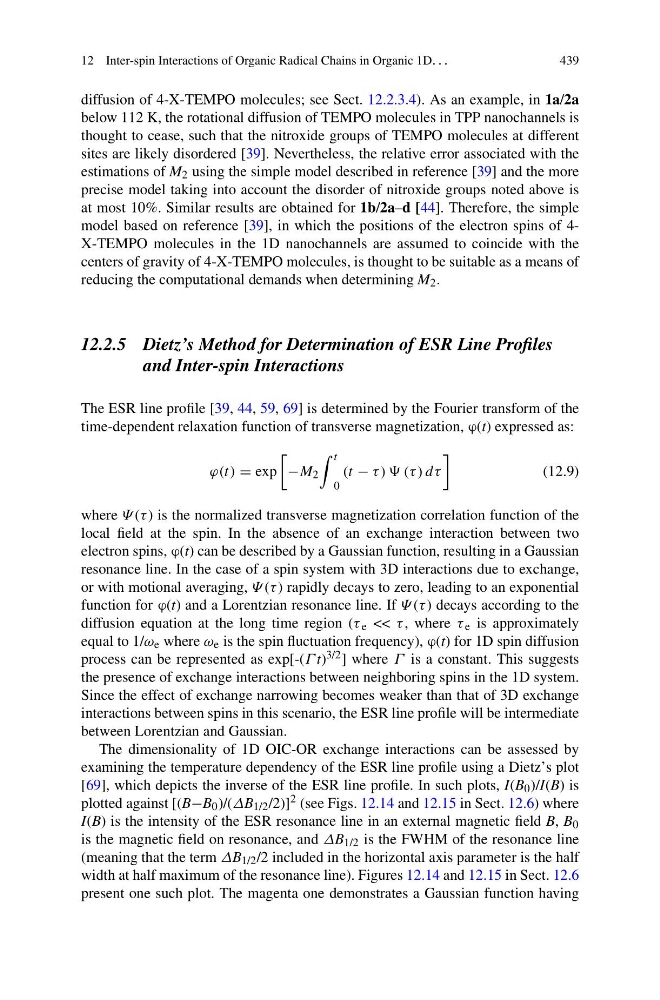
The ESR line profile [39, 44, 59, 69] is determined by the Fourier transform of the
time-dependent relaxation function of transverse magnetization, ϕ(t) expressed as:
ϕ(t) = exp
−M 2
t
0
(t − τ ) (τ ) dτ
(12.9)
where Ψ (τ ) is the normalized transverse magnetization correlation function of the
local field at the spin. In the absence of an exchange interaction between two
electron spins, ϕ(t) can be described by a Gaussian function, resulting in a Gaussian
resonance line. In the case of a spin system with 3D interactions due to exchange,
or with motional averaging, Ψ (τ ) rapidly decays to zero, leading to an exponential
function for ϕ(t) and a Lorentzian resonance line. If Ψ (τ ) decays according to the
diffusion equation at the long time region (τ e << τ , where τ e is approximately
equal to 1/ω e where ω e is the spin fluctuation frequency), ϕ(t) for 1D spin diffusion
process can be represented as exp[-(Γ t) 3/2 ] where Γ is a constant. This suggests
the presence of exchange interactions between neighboring spins in the 1D system.
Since the effect of exchange narrowing becomes weaker than that of 3D exchange
interactions between spins in this scenario, the ESR line profile will be intermediate
between Lorentzian and Gaussian.
The dimensionality of 1D OIC-OR exchange interactions can be assessed by
examining the temperature dependency of the ESR line profile using a Dietz’s plot
[69], which depicts the inverse of the ESR line profile. In such plots, I(B 0 )/I(B) is
plotted against [(B−B 0 )/(ΔB 1/2 /2)] 2 (see Figs. 12.14 and 12.15 in Sect. 12.6) where
I(B) is the intensity of the ESR resonance line in an external magnetic field B, B 0
is the magnetic field on resonance, and ΔB 1/2 is the FWHM of the resonance line
(meaning that the term ΔB 1/2 /2 included in the horizontal axis parameter is the half
width at half maximum of the resonance line). Figures 12.14 and 12.15 in Sect. 12.6
present one such plot. The magenta one demonstrates a Gaussian function having
439
diffusion of 4-X-TEMPO molecules; see Sect. 12.2.3.4). As an example, in 1a/2a
below 112 K, the rotational diffusion of TEMPO molecules in TPP nanochannels is
thought to cease, such that the nitroxide groups of TEMPO molecules at different
sites are likely disordered [39]. Nevertheless, the relative error associated with the
estimations of M 2 using the simple model described in reference [39] and the more
precise model taking into account the disorder of nitroxide groups noted above is
at most 10%. Similar results are obtained for 1b/2a–d [44]. Therefore, the simple
model based on reference [39], in which the positions of the electron spins of 4X-TEMPO molecules in the 1D nanochannels are assumed to coincide with the
centers of gravity of 4-X-TEMPO molecules, is thought to be suitable as a means of
reducing the computational demands when determining M 2 .
12.2.5 Dietz’s Method for Determination of ESR Line Profiles
and Inter-spin Interactions
The ESR line profile [39, 44, 59, 69] is determined by the Fourier transform of the
time-dependent relaxation function of transverse magnetization, ϕ(t) expressed as:
ϕ(t) = exp
−M 2
t
0
(t − τ ) (τ ) dτ
(12.9)
where Ψ (τ ) is the normalized transverse magnetization correlation function of the
local field at the spin. In the absence of an exchange interaction between two
electron spins, ϕ(t) can be described by a Gaussian function, resulting in a Gaussian
resonance line. In the case of a spin system with 3D interactions due to exchange,
or with motional averaging, Ψ (τ ) rapidly decays to zero, leading to an exponential
function for ϕ(t) and a Lorentzian resonance line. If Ψ (τ ) decays according to the
diffusion equation at the long time region (τ e << τ , where τ e is approximately
equal to 1/ω e where ω e is the spin fluctuation frequency), ϕ(t) for 1D spin diffusion
process can be represented as exp[-(Γ t) 3/2 ] where Γ is a constant. This suggests
the presence of exchange interactions between neighboring spins in the 1D system.
Since the effect of exchange narrowing becomes weaker than that of 3D exchange
interactions between spins in this scenario, the ESR line profile will be intermediate
between Lorentzian and Gaussian.
The dimensionality of 1D OIC-OR exchange interactions can be assessed by
examining the temperature dependency of the ESR line profile using a Dietz’s plot
[69], which depicts the inverse of the ESR line profile. In such plots, I(B 0 )/I(B) is
plotted against [(B−B 0 )/(ΔB 1/2 /2)] 2 (see Figs. 12.14 and 12.15 in Sect. 12.6) where
I(B) is the intensity of the ESR resonance line in an external magnetic field B, B 0
is the magnetic field on resonance, and ΔB 1/2 is the FWHM of the resonance line
(meaning that the term ΔB 1/2 /2 included in the horizontal axis parameter is the half
width at half maximum of the resonance line). Figures 12.14 and 12.15 in Sect. 12.6
present one such plot. The magenta one demonstrates a Gaussian function having