

30
T. Onishi
(a)
(c)
(d)
K1
K2
F1
Mg1
F2
F3
Mg2
Mg4
Mg3
(b)
K1
F1
Mg1
F2
F3
Mg2
Mg4
Mg3
K1
K2
Mg1
F2
F3
Mg2
Mg4
Mg3
H
K1
Mg1
F2
F3
Mg2
Mg4
Mg3
H
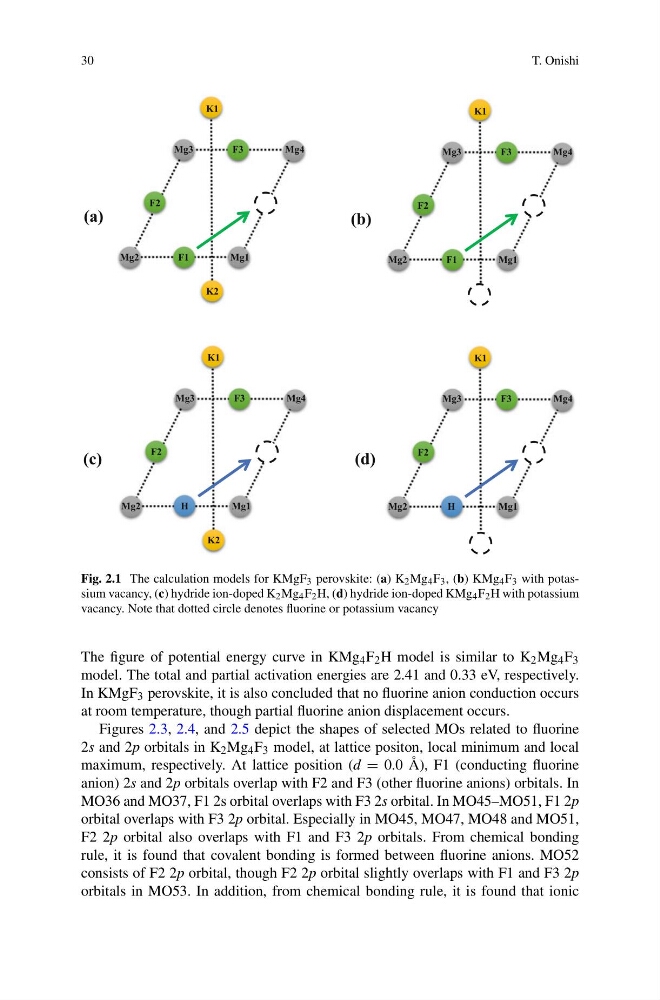
Fig. 2.1 The calculation models for KMgF 3 perovskite: (a) K 2 Mg 4 F 3 , (b) KMg 4 F 3 with potassium vacancy, (c) hydride ion-doped K 2 Mg 4 F 2 H, (d) hydride ion-doped KMg 4 F 2 H with potassium
vacancy. Note that dotted circle denotes fluorine or potassium vacancy
The figure of potential energy curve in KMg 4 F 2 H model is similar to K 2 Mg 4 F 3
model. The total and partial activation energies are 2.41 and 0.33 eV, respectively.
In KMgF 3 perovskite, it is also concluded that no fluorine anion conduction occurs
at room temperature, though partial fluorine anion displacement occurs.
Figures 2.3, 2.4, and 2.5 depict the shapes of selected MOs related to fluorine
2s and 2p orbitals in K 2 Mg 4 F 3 model, at lattice positon, local minimum and local
maximum, respectively. At lattice position (d = 0.0 Å), F1 (conducting fluorine
anion) 2s and 2p orbitals overlap with F2 and F3 (other fluorine anions) orbitals. In
MO36 and MO37, F1 2s orbital overlaps with F3 2s orbital. In MO45–MO51, F1 2p
orbital overlaps with F3 2p orbital. Especially in MO45, MO47, MO48 and MO51,
F2 2p orbital also overlaps with F1 and F3 2p orbitals. From chemical bonding
rule, it is found that covalent bonding is formed between fluorine anions. MO52
consists of F2 2p orbital, though F2 2p orbital slightly overlaps with F1 and F3 2p
orbitals in MO53. In addition, from chemical bonding rule, it is found that ionic
T. Onishi
(a)
(c)
(d)
K1
K2
F1
Mg1
F2
F3
Mg2
Mg4
Mg3
(b)
K1
F1
Mg1
F2
F3
Mg2
Mg4
Mg3
K1
K2
Mg1
F2
F3
Mg2
Mg4
Mg3
H
K1
Mg1
F2
F3
Mg2
Mg4
Mg3
H
Fig. 2.1 The calculation models for KMgF 3 perovskite: (a) K 2 Mg 4 F 3 , (b) KMg 4 F 3 with potassium vacancy, (c) hydride ion-doped K 2 Mg 4 F 2 H, (d) hydride ion-doped KMg 4 F 2 H with potassium
vacancy. Note that dotted circle denotes fluorine or potassium vacancy
The figure of potential energy curve in KMg 4 F 2 H model is similar to K 2 Mg 4 F 3
model. The total and partial activation energies are 2.41 and 0.33 eV, respectively.
In KMgF 3 perovskite, it is also concluded that no fluorine anion conduction occurs
at room temperature, though partial fluorine anion displacement occurs.
Figures 2.3, 2.4, and 2.5 depict the shapes of selected MOs related to fluorine
2s and 2p orbitals in K 2 Mg 4 F 3 model, at lattice positon, local minimum and local
maximum, respectively. At lattice position (d = 0.0 Å), F1 (conducting fluorine
anion) 2s and 2p orbitals overlap with F2 and F3 (other fluorine anions) orbitals. In
MO36 and MO37, F1 2s orbital overlaps with F3 2s orbital. In MO45–MO51, F1 2p
orbital overlaps with F3 2p orbital. Especially in MO45, MO47, MO48 and MO51,
F2 2p orbital also overlaps with F1 and F3 2p orbitals. From chemical bonding
rule, it is found that covalent bonding is formed between fluorine anions. MO52
consists of F2 2p orbital, though F2 2p orbital slightly overlaps with F1 and F3 2p
orbitals in MO53. In addition, from chemical bonding rule, it is found that ionic