

370
Y. Kobayashi and H. Kobayashi
Fourier transform infrared absorption (FT-IR) spectra were measured using a
JASCO FT/IR-6200 spectrometer. X-ray photoelectron spectroscopy (XPS) measurements were performed by use of a KRATOS AXIS-165x spectrometer with
an Mg Kα radiation source in which photoelectrons were collected in the surfacenormal direction. SEM measurements were carried out using a JOEL JSM-6335F
microscope.
9.2.3 Results and Discussion
9.2.3.1 Reaction of Si Nanopowder with Strong Alkaline Solutions
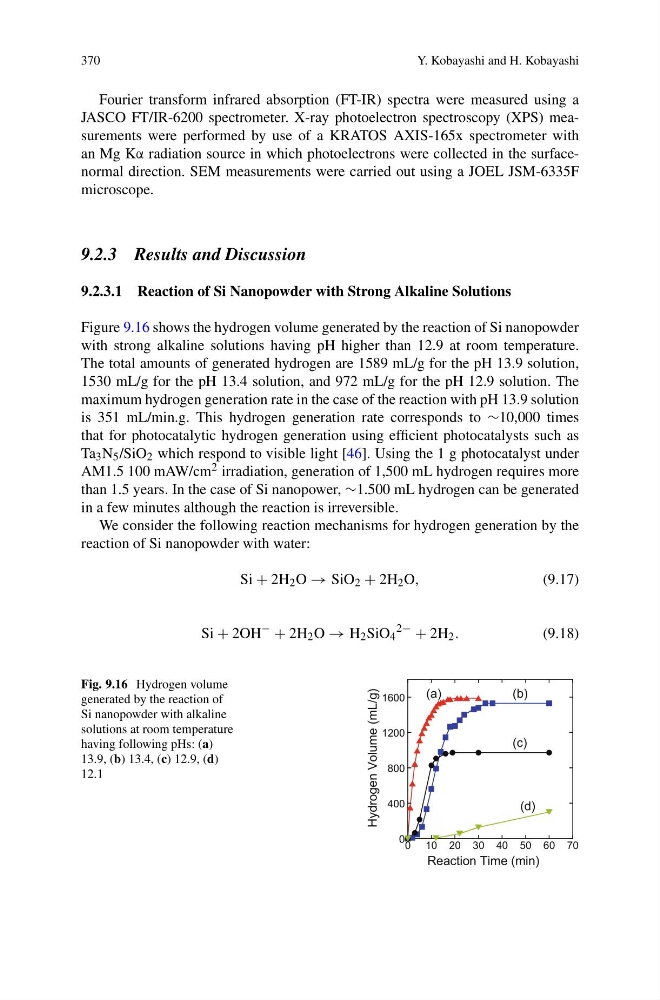
Figure 9.16 shows the hydrogen volume generated by the reaction of Si nanopowder
with strong alkaline solutions having pH higher than 12.9 at room temperature.
The total amounts of generated hydrogen are 1589 mL/g for the pH 13.9 solution,
1530 mL/g for the pH 13.4 solution, and 972 mL/g for the pH 12.9 solution. The
maximum hydrogen generation rate in the case of the reaction with pH 13.9 solution
is 351 mL/min.g. This hydrogen generation rate corresponds to ∼10,000 times
that for photocatalytic hydrogen generation using efficient photocatalysts such as
Ta 3 N 5 /SiO 2 which respond to visible light [46]. Using the 1 g photocatalyst under
AM1.5 100 mAW/cm 2 irradiation, generation of 1,500 mL hydrogen requires more
than 1.5 years. In the case of Si nanopower, ∼1.500 mL hydrogen can be generated
in a few minutes although the reaction is irreversible.
We consider the following reaction mechanisms for hydrogen generation by the
reaction of Si nanopowder with water:
Si + 2H 2 O → SiO 2 + 2H 2 O,
(9.17)
Si + 2OH
−
+ 2H 2 O → H 2 SiO 4
2−
+ 2H 2 .
(9.18)
Fig. 9.16 Hydrogen volume
generated by the reaction of
Si nanopowder with alkaline
solutions at room temperature
having following pHs: (a)
13.9, (b) 13.4, (c) 12.9, (d)
12.1
0
400
800
1200
1600
0 10 20 30 40 50 60 70
Hydrogen Volume (mL/g)
Reaction Time (min)
(a)
(b)
(c)
(d)
Y. Kobayashi and H. Kobayashi
Fourier transform infrared absorption (FT-IR) spectra were measured using a
JASCO FT/IR-6200 spectrometer. X-ray photoelectron spectroscopy (XPS) measurements were performed by use of a KRATOS AXIS-165x spectrometer with
an Mg Kα radiation source in which photoelectrons were collected in the surfacenormal direction. SEM measurements were carried out using a JOEL JSM-6335F
microscope.
9.2.3 Results and Discussion
9.2.3.1 Reaction of Si Nanopowder with Strong Alkaline Solutions
Figure 9.16 shows the hydrogen volume generated by the reaction of Si nanopowder
with strong alkaline solutions having pH higher than 12.9 at room temperature.
The total amounts of generated hydrogen are 1589 mL/g for the pH 13.9 solution,
1530 mL/g for the pH 13.4 solution, and 972 mL/g for the pH 12.9 solution. The
maximum hydrogen generation rate in the case of the reaction with pH 13.9 solution
is 351 mL/min.g. This hydrogen generation rate corresponds to ∼10,000 times
that for photocatalytic hydrogen generation using efficient photocatalysts such as
Ta 3 N 5 /SiO 2 which respond to visible light [46]. Using the 1 g photocatalyst under
AM1.5 100 mAW/cm 2 irradiation, generation of 1,500 mL hydrogen requires more
than 1.5 years. In the case of Si nanopower, ∼1.500 mL hydrogen can be generated
in a few minutes although the reaction is irreversible.
We consider the following reaction mechanisms for hydrogen generation by the
reaction of Si nanopowder with water:
Si + 2H 2 O → SiO 2 + 2H 2 O,
(9.17)
Si + 2OH
−
+ 2H 2 O → H 2 SiO 4
2−
+ 2H 2 .
(9.18)
Fig. 9.16 Hydrogen volume
generated by the reaction of
Si nanopowder with alkaline
solutions at room temperature
having following pHs: (a)
13.9, (b) 13.4, (c) 12.9, (d)
12.1
0
400
800
1200
1600
0 10 20 30 40 50 60 70
Hydrogen Volume (mL/g)
Reaction Time (min)
(a)
(b)
(c)
(d)