

368
Y. Kobayashi and H. Kobayashi
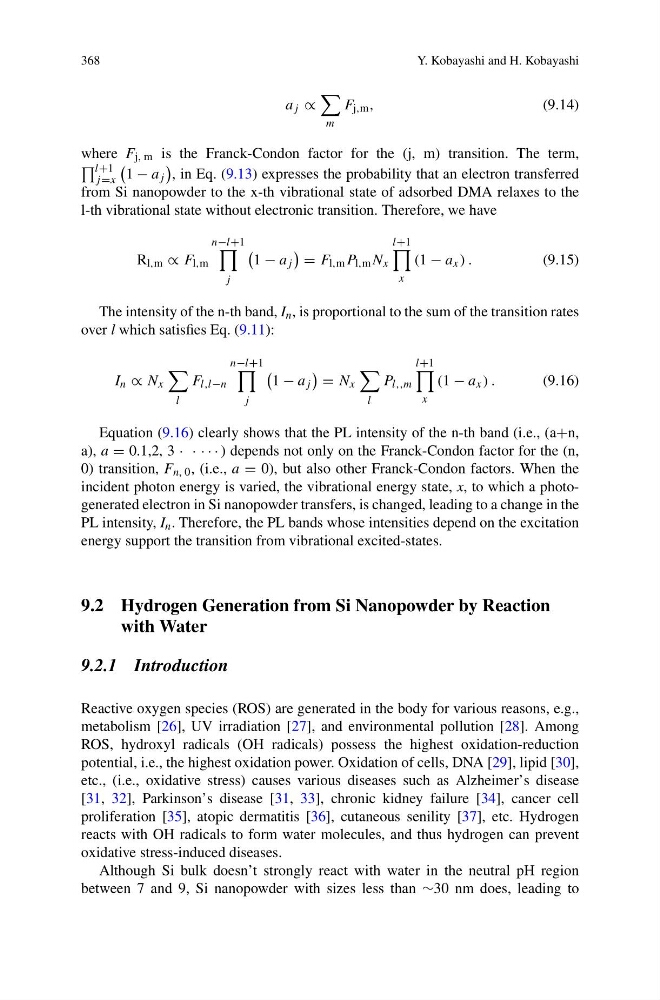
a j ∝
m
F j,m ,
(9.14)
where F j, m is the Franck-Condon factor for the (j, m) transition. The term,
l+1
j =x
1 − a j
, in Eq. (9.13) expresses the probability that an electron transferred
from Si nanopowder to the x-th vibrational state of adsorbed DMA relaxes to the
l-th vibrational state without electronic transition. Therefore, we have
R l,m ∝ F l,m
n−l+1
j
1 − a j
= F l,m P l,m N x
l+1
x
(1 − a x ) .
(9.15)
The intensity of the n-th band, I n , is proportional to the sum of the transition rates
over l which satisfies Eq. (9.11):
I n ∝ N x
l
F l,l−n
n−l+1
j
1 − a j
= N x
l
P l,,m
l+1
x
(1 − a x ) .
(9.16)
Equation (9.16) clearly shows that the PL intensity of the n-th band (i.e., (a+n,
a), a = 0.1,2, 3 · · · · · ) depends not only on the Franck-Condon factor for the (n,
0) transition, F n, 0 , (i.e., a = 0), but also other Franck-Condon factors. When the
incident photon energy is varied, the vibrational energy state, x, to which a photogenerated electron in Si nanopowder transfers, is changed, leading to a change in the
PL intensity, I n . Therefore, the PL bands whose intensities depend on the excitation
energy support the transition from vibrational excited-states.
9.2 Hydrogen Generation from Si Nanopowder by Reaction
with Water
9.2.1 Introduction
Reactive oxygen species (ROS) are generated in the body for various reasons, e.g.,
metabolism [26], UV irradiation [27], and environmental pollution [28]. Among
ROS, hydroxyl radicals (OH radicals) possess the highest oxidation-reduction
potential, i.e., the highest oxidation power. Oxidation of cells, DNA [29], lipid [30],
etc., (i.e., oxidative stress) causes various diseases such as Alzheimer’s disease
[31, 32], Parkinson’s disease [31, 33], chronic kidney failure [34], cancer cell
proliferation [35], atopic dermatitis [36], cutaneous senility [37], etc. Hydrogen
reacts with OH radicals to form water molecules, and thus hydrogen can prevent
oxidative stress-induced diseases.
Although Si bulk doesn’t strongly react with water in the neutral pH region
between 7 and 9, Si nanopowder with sizes less than ∼30 nm does, leading to
Y. Kobayashi and H. Kobayashi
a j ∝
m
F j,m ,
(9.14)
where F j, m is the Franck-Condon factor for the (j, m) transition. The term,
l+1
j =x
1 − a j
, in Eq. (9.13) expresses the probability that an electron transferred
from Si nanopowder to the x-th vibrational state of adsorbed DMA relaxes to the
l-th vibrational state without electronic transition. Therefore, we have
R l,m ∝ F l,m
n−l+1
j
1 − a j
= F l,m P l,m N x
l+1
x
(1 − a x ) .
(9.15)
The intensity of the n-th band, I n , is proportional to the sum of the transition rates
over l which satisfies Eq. (9.11):
I n ∝ N x
l
F l,l−n
n−l+1
j
1 − a j
= N x
l
P l,,m
l+1
x
(1 − a x ) .
(9.16)
Equation (9.16) clearly shows that the PL intensity of the n-th band (i.e., (a+n,
a), a = 0.1,2, 3 · · · · · ) depends not only on the Franck-Condon factor for the (n,
0) transition, F n, 0 , (i.e., a = 0), but also other Franck-Condon factors. When the
incident photon energy is varied, the vibrational energy state, x, to which a photogenerated electron in Si nanopowder transfers, is changed, leading to a change in the
PL intensity, I n . Therefore, the PL bands whose intensities depend on the excitation
energy support the transition from vibrational excited-states.
9.2 Hydrogen Generation from Si Nanopowder by Reaction
with Water
9.2.1 Introduction
Reactive oxygen species (ROS) are generated in the body for various reasons, e.g.,
metabolism [26], UV irradiation [27], and environmental pollution [28]. Among
ROS, hydroxyl radicals (OH radicals) possess the highest oxidation-reduction
potential, i.e., the highest oxidation power. Oxidation of cells, DNA [29], lipid [30],
etc., (i.e., oxidative stress) causes various diseases such as Alzheimer’s disease
[31, 32], Parkinson’s disease [31, 33], chronic kidney failure [34], cancer cell
proliferation [35], atopic dermatitis [36], cutaneous senility [37], etc. Hydrogen
reacts with OH radicals to form water molecules, and thus hydrogen can prevent
oxidative stress-induced diseases.
Although Si bulk doesn’t strongly react with water in the neutral pH region
between 7 and 9, Si nanopowder with sizes less than ∼30 nm does, leading to