

366
Y. Kobayashi and H. Kobayashi
Energy
0
1
2
v=3
0
1
2
v=3
valence
band
conduction
band
S 1
S 0
(a)
0
1
2
v=3
valence
band
conduction
band
S 1
S 0
(b)
0
1
2
v=3
DMA
Si nanopowder
DMA
Si nanopowder
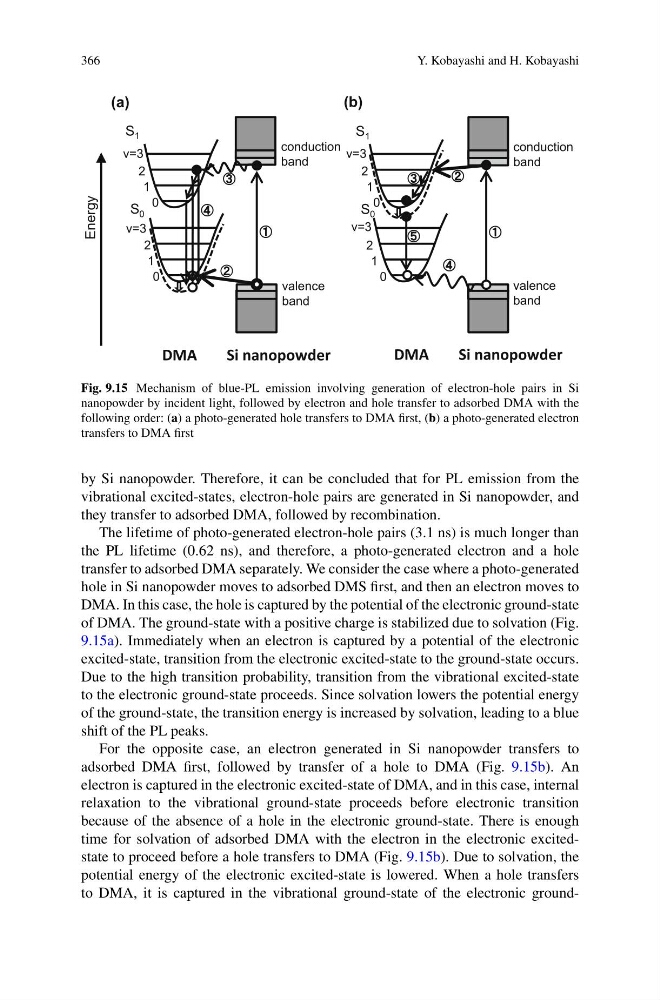
Fig. 9.15 Mechanism of blue-PL emission involving generation of electron-hole pairs in Si
nanopowder by incident light, followed by electron and hole transfer to adsorbed DMA with the
following order: (a) a photo-generated hole transfers to DMA first, (b) a photo-generated electron
transfers to DMA first
by Si nanopowder. Therefore, it can be concluded that for PL emission from the
vibrational excited-states, electron-hole pairs are generated in Si nanopowder, and
they transfer to adsorbed DMA, followed by recombination.
The lifetime of photo-generated electron-hole pairs (3.1 ns) is much longer than
the PL lifetime (0.62 ns), and therefore, a photo-generated electron and a hole
transfer to adsorbed DMA separately. We consider the case where a photo-generated
hole in Si nanopowder moves to adsorbed DMS first, and then an electron moves to
DMA. In this case, the hole is captured by the potential of the electronic ground-state
of DMA. The ground-state with a positive charge is stabilized due to solvation (Fig.
9.15a). Immediately when an electron is captured by a potential of the electronic
excited-state, transition from the electronic excited-state to the ground-state occurs.
Due to the high transition probability, transition from the vibrational excited-state
to the electronic ground-state proceeds. Since solvation lowers the potential energy
of the ground-state, the transition energy is increased by solvation, leading to a blue
shift of the PL peaks.
For the opposite case, an electron generated in Si nanopowder transfers to
adsorbed DMA first, followed by transfer of a hole to DMA (Fig. 9.15b). An
electron is captured in the electronic excited-state of DMA, and in this case, internal
relaxation to the vibrational ground-state proceeds before electronic transition
because of the absence of a hole in the electronic ground-state. There is enough
time for solvation of adsorbed DMA with the electron in the electronic excitedstate to proceed before a hole transfers to DMA (Fig. 9.15b). Due to solvation, the
potential energy of the electronic excited-state is lowered. When a hole transfers
to DMA, it is captured in the vibrational ground-state of the electronic ground-
Y. Kobayashi and H. Kobayashi
Energy
0
1
2
v=3
0
1
2
v=3
valence
band
conduction
band
S 1
S 0
(a)
0
1
2
v=3
valence
band
conduction
band
S 1
S 0
(b)
0
1
2
v=3
DMA
Si nanopowder
DMA
Si nanopowder
Fig. 9.15 Mechanism of blue-PL emission involving generation of electron-hole pairs in Si
nanopowder by incident light, followed by electron and hole transfer to adsorbed DMA with the
following order: (a) a photo-generated hole transfers to DMA first, (b) a photo-generated electron
transfers to DMA first
by Si nanopowder. Therefore, it can be concluded that for PL emission from the
vibrational excited-states, electron-hole pairs are generated in Si nanopowder, and
they transfer to adsorbed DMA, followed by recombination.
The lifetime of photo-generated electron-hole pairs (3.1 ns) is much longer than
the PL lifetime (0.62 ns), and therefore, a photo-generated electron and a hole
transfer to adsorbed DMA separately. We consider the case where a photo-generated
hole in Si nanopowder moves to adsorbed DMS first, and then an electron moves to
DMA. In this case, the hole is captured by the potential of the electronic ground-state
of DMA. The ground-state with a positive charge is stabilized due to solvation (Fig.
9.15a). Immediately when an electron is captured by a potential of the electronic
excited-state, transition from the electronic excited-state to the ground-state occurs.
Due to the high transition probability, transition from the vibrational excited-state
to the electronic ground-state proceeds. Since solvation lowers the potential energy
of the ground-state, the transition energy is increased by solvation, leading to a blue
shift of the PL peaks.
For the opposite case, an electron generated in Si nanopowder transfers to
adsorbed DMA first, followed by transfer of a hole to DMA (Fig. 9.15b). An
electron is captured in the electronic excited-state of DMA, and in this case, internal
relaxation to the vibrational ground-state proceeds before electronic transition
because of the absence of a hole in the electronic ground-state. There is enough
time for solvation of adsorbed DMA with the electron in the electronic excitedstate to proceed before a hole transfers to DMA (Fig. 9.15b). Due to solvation, the
potential energy of the electronic excited-state is lowered. When a hole transfers
to DMA, it is captured in the vibrational ground-state of the electronic ground-