

342
T. Masubuchi and A. Nakajima
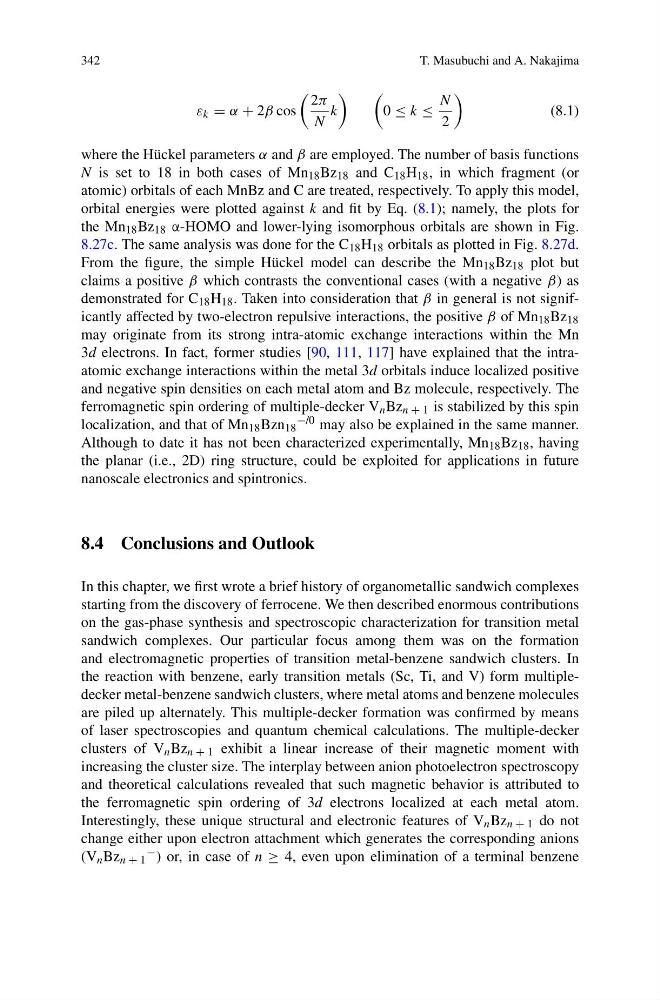
ε k = α + 2β cos
2π
N
k
0 ≤ k ≤
N
2
(8.1)
where the Hückel parameters α and β are employed. The number of basis functions
N is set to 18 in both cases of Mn 18 Bz 18 and C 18 H 18 , in which fragment (or
atomic) orbitals of each MnBz and C are treated, respectively. To apply this model,
orbital energies were plotted against k and fit by Eq. (8.1); namely, the plots for
the Mn 18 Bz 18 α-HOMO and lower-lying isomorphous orbitals are shown in Fig.
8.27c. The same analysis was done for the C 18 H 18 orbitals as plotted in Fig. 8.27d.
From the figure, the simple Hückel model can describe the Mn 18 Bz 18 plot but
claims a positive β which contrasts the conventional cases (with a negative β) as
demonstrated for C 18 H 18 . Taken into consideration that β in general is not significantly affected by two-electron repulsive interactions, the positive β of Mn 18 Bz 18
may originate from its strong intra-atomic exchange interactions within the Mn
3d electrons. In fact, former studies [90, 111, 117] have explained that the intraatomic exchange interactions within the metal 3d orbitals induce localized positive
and negative spin densities on each metal atom and Bz molecule, respectively. The
ferromagnetic spin ordering of multiple-decker V n Bz n + 1 is stabilized by this spin
localization, and that of Mn 18 Bzn 18
−/0 may also be explained in the same manner.
Although to date it has not been characterized experimentally, Mn 18 Bz 18 , having
the planar (i.e., 2D) ring structure, could be exploited for applications in future
nanoscale electronics and spintronics.
8.4 Conclusions and Outlook
In this chapter, we first wrote a brief history of organometallic sandwich complexes
starting from the discovery of ferrocene. We then described enormous contributions
on the gas-phase synthesis and spectroscopic characterization for transition metal
sandwich complexes. Our particular focus among them was on the formation
and electromagnetic properties of transition metal-benzene sandwich clusters. In
the reaction with benzene, early transition metals (Sc, Ti, and V) form multipledecker metal-benzene sandwich clusters, where metal atoms and benzene molecules
are piled up alternately. This multiple-decker formation was confirmed by means
of laser spectroscopies and quantum chemical calculations. The multiple-decker
clusters of V n Bz n + 1 exhibit a linear increase of their magnetic moment with
increasing the cluster size. The interplay between anion photoelectron spectroscopy
and theoretical calculations revealed that such magnetic behavior is attributed to
the ferromagnetic spin ordering of 3d electrons localized at each metal atom.
Interestingly, these unique structural and electronic features of V n Bz n + 1 do not
change either upon electron attachment which generates the corresponding anions
(V n Bz n + 1
− ) or, in case of n ≥ 4, even upon elimination of a terminal benzene
T. Masubuchi and A. Nakajima
ε k = α + 2β cos
2π
N
k
0 ≤ k ≤
N
2
(8.1)
where the Hückel parameters α and β are employed. The number of basis functions
N is set to 18 in both cases of Mn 18 Bz 18 and C 18 H 18 , in which fragment (or
atomic) orbitals of each MnBz and C are treated, respectively. To apply this model,
orbital energies were plotted against k and fit by Eq. (8.1); namely, the plots for
the Mn 18 Bz 18 α-HOMO and lower-lying isomorphous orbitals are shown in Fig.
8.27c. The same analysis was done for the C 18 H 18 orbitals as plotted in Fig. 8.27d.
From the figure, the simple Hückel model can describe the Mn 18 Bz 18 plot but
claims a positive β which contrasts the conventional cases (with a negative β) as
demonstrated for C 18 H 18 . Taken into consideration that β in general is not significantly affected by two-electron repulsive interactions, the positive β of Mn 18 Bz 18
may originate from its strong intra-atomic exchange interactions within the Mn
3d electrons. In fact, former studies [90, 111, 117] have explained that the intraatomic exchange interactions within the metal 3d orbitals induce localized positive
and negative spin densities on each metal atom and Bz molecule, respectively. The
ferromagnetic spin ordering of multiple-decker V n Bz n + 1 is stabilized by this spin
localization, and that of Mn 18 Bzn 18
−/0 may also be explained in the same manner.
Although to date it has not been characterized experimentally, Mn 18 Bz 18 , having
the planar (i.e., 2D) ring structure, could be exploited for applications in future
nanoscale electronics and spintronics.
8.4 Conclusions and Outlook
In this chapter, we first wrote a brief history of organometallic sandwich complexes
starting from the discovery of ferrocene. We then described enormous contributions
on the gas-phase synthesis and spectroscopic characterization for transition metal
sandwich complexes. Our particular focus among them was on the formation
and electromagnetic properties of transition metal-benzene sandwich clusters. In
the reaction with benzene, early transition metals (Sc, Ti, and V) form multipledecker metal-benzene sandwich clusters, where metal atoms and benzene molecules
are piled up alternately. This multiple-decker formation was confirmed by means
of laser spectroscopies and quantum chemical calculations. The multiple-decker
clusters of V n Bz n + 1 exhibit a linear increase of their magnetic moment with
increasing the cluster size. The interplay between anion photoelectron spectroscopy
and theoretical calculations revealed that such magnetic behavior is attributed to
the ferromagnetic spin ordering of 3d electrons localized at each metal atom.
Interestingly, these unique structural and electronic features of V n Bz n + 1 do not
change either upon electron attachment which generates the corresponding anions
(V n Bz n + 1
− ) or, in case of n ≥ 4, even upon elimination of a terminal benzene