

340
T. Masubuchi and A. Nakajima
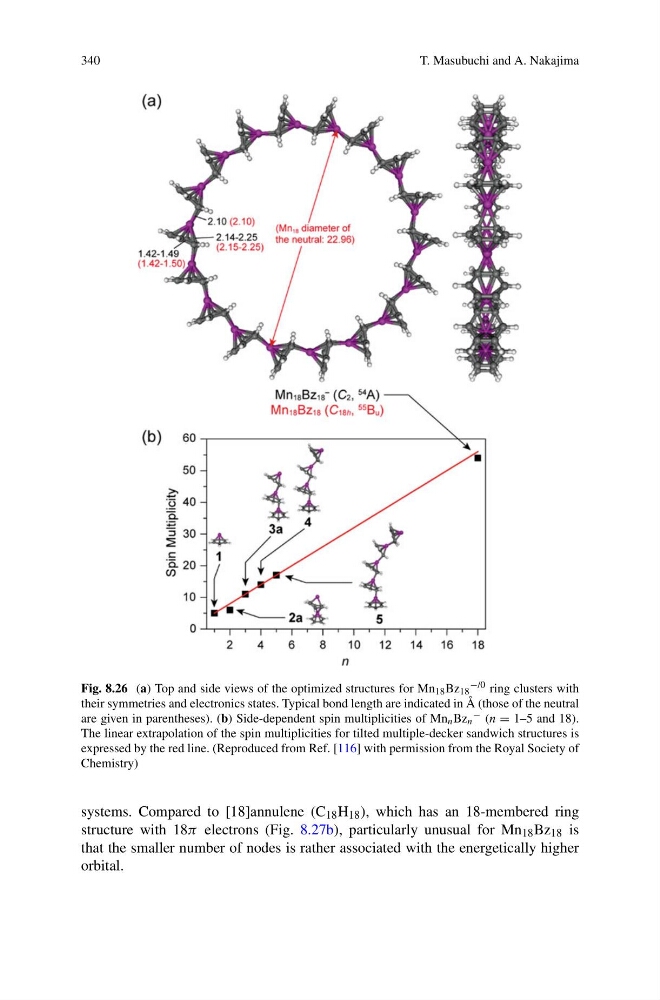
Fig. 8.26 (a) Top and side views of the optimized structures for Mn 18 Bz 18
−/0 ring clusters with
their symmetries and electronics states. Typical bond length are indicated in Å (those of the neutral
are given in parentheses). (b) Side-dependent spin multiplicities of Mn n Bz n
− (n = 1–5 and 18).
The linear extrapolation of the spin multiplicities for tilted multiple-decker sandwich structures is
expressed by the red line. (Reproduced from Ref. [116] with permission from the Royal Society of
Chemistry)
systems. Compared to [18]annulene (C 18 H 18 ), which has an 18-membered ring
structure with 18π electrons (Fig. 8.27b), particularly unusual for Mn 18 Bz 18 is
that the smaller number of nodes is rather associated with the energetically higher
orbital.
T. Masubuchi and A. Nakajima
Fig. 8.26 (a) Top and side views of the optimized structures for Mn 18 Bz 18
−/0 ring clusters with
their symmetries and electronics states. Typical bond length are indicated in Å (those of the neutral
are given in parentheses). (b) Side-dependent spin multiplicities of Mn n Bz n
− (n = 1–5 and 18).
The linear extrapolation of the spin multiplicities for tilted multiple-decker sandwich structures is
expressed by the red line. (Reproduced from Ref. [116] with permission from the Royal Society of
Chemistry)
systems. Compared to [18]annulene (C 18 H 18 ), which has an 18-membered ring
structure with 18π electrons (Fig. 8.27b), particularly unusual for Mn 18 Bz 18 is
that the smaller number of nodes is rather associated with the energetically higher
orbital.