

334
T. Masubuchi and A. Nakajima
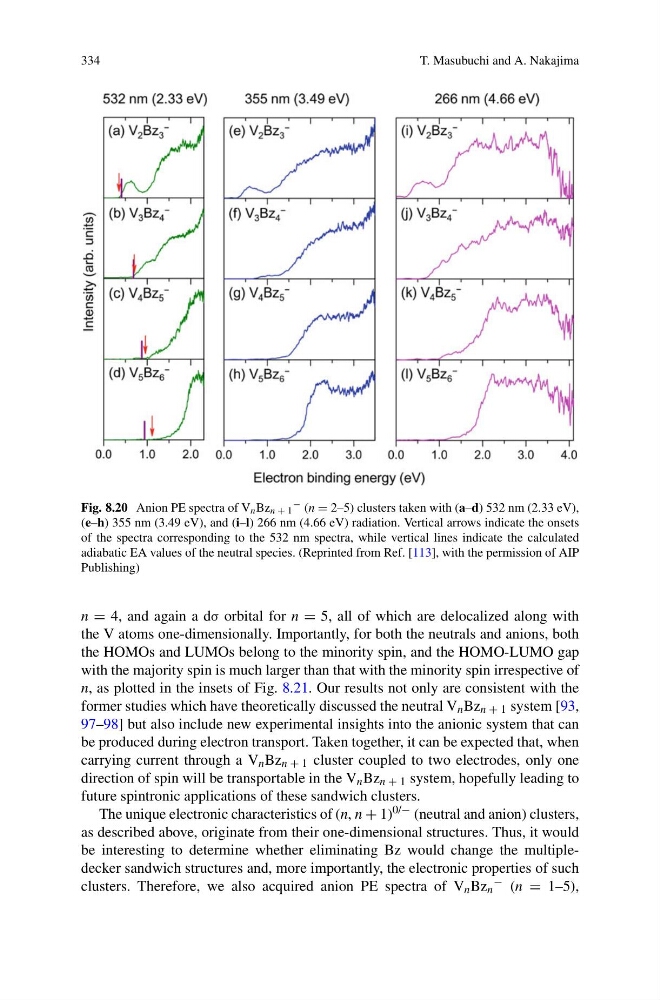
Fig. 8.20 Anion PE spectra of V n Bz n + 1
− (n = 2–5) clusters taken with (a–d) 532 nm (2.33 eV),
(e–h) 355 nm (3.49 eV), and (i–l) 266 nm (4.66 eV) radiation. Vertical arrows indicate the onsets
of the spectra corresponding to the 532 nm spectra, while vertical lines indicate the calculated
adiabatic EA values of the neutral species. (Reprinted from Ref. [113], with the permission of AIP
Publishing)
n = 4, and again a dσ orbital for n = 5, all of which are delocalized along with
the V atoms one-dimensionally. Importantly, for both the neutrals and anions, both
the HOMOs and LUMOs belong to the minority spin, and the HOMO-LUMO gap
with the majority spin is much larger than that with the minority spin irrespective of
n, as plotted in the insets of Fig. 8.21. Our results not only are consistent with the
former studies which have theoretically discussed the neutral V n Bz n + 1 system [93,
97–98] but also include new experimental insights into the anionic system that can
be produced during electron transport. Taken together, it can be expected that, when
carrying current through a V n Bz n + 1 cluster coupled to two electrodes, only one
direction of spin will be transportable in the V n Bz n + 1 system, hopefully leading to
future spintronic applications of these sandwich clusters.
The unique electronic characteristics of (n, n + 1) 0/− (neutral and anion) clusters,
as described above, originate from their one-dimensional structures. Thus, it would
be interesting to determine whether eliminating Bz would change the multipledecker sandwich structures and, more importantly, the electronic properties of such
clusters. Therefore, we also acquired anion PE spectra of V n Bz n
− (n = 1–5),
T. Masubuchi and A. Nakajima
Fig. 8.20 Anion PE spectra of V n Bz n + 1
− (n = 2–5) clusters taken with (a–d) 532 nm (2.33 eV),
(e–h) 355 nm (3.49 eV), and (i–l) 266 nm (4.66 eV) radiation. Vertical arrows indicate the onsets
of the spectra corresponding to the 532 nm spectra, while vertical lines indicate the calculated
adiabatic EA values of the neutral species. (Reprinted from Ref. [113], with the permission of AIP
Publishing)
n = 4, and again a dσ orbital for n = 5, all of which are delocalized along with
the V atoms one-dimensionally. Importantly, for both the neutrals and anions, both
the HOMOs and LUMOs belong to the minority spin, and the HOMO-LUMO gap
with the majority spin is much larger than that with the minority spin irrespective of
n, as plotted in the insets of Fig. 8.21. Our results not only are consistent with the
former studies which have theoretically discussed the neutral V n Bz n + 1 system [93,
97–98] but also include new experimental insights into the anionic system that can
be produced during electron transport. Taken together, it can be expected that, when
carrying current through a V n Bz n + 1 cluster coupled to two electrodes, only one
direction of spin will be transportable in the V n Bz n + 1 system, hopefully leading to
future spintronic applications of these sandwich clusters.
The unique electronic characteristics of (n, n + 1) 0/− (neutral and anion) clusters,
as described above, originate from their one-dimensional structures. Thus, it would
be interesting to determine whether eliminating Bz would change the multipledecker sandwich structures and, more importantly, the electronic properties of such
clusters. Therefore, we also acquired anion PE spectra of V n Bz n
− (n = 1–5),