

7 Computational and Experimental Analysis of Carbon Functional Nanomaterials
295
emit at red-shifted wavelength of ∼551 and 872 nm, respectively. The observed
results are well related to experimental results reported by Kim et al. supporting
the observed blue- and red-shift emission based on the armchair- and zigzag-edged
configuration of GQDs [142]. Furthermore, the pyridinic and pyrrolic N-doping on
GQDs causes slight blue shift of emission wavelength in a concentration-dependent
behavior. Previously, Jin et al. reported the band gap tuning of GQDs through the
charge effect of functional groups using DFT analysis with the atomic orbital-based
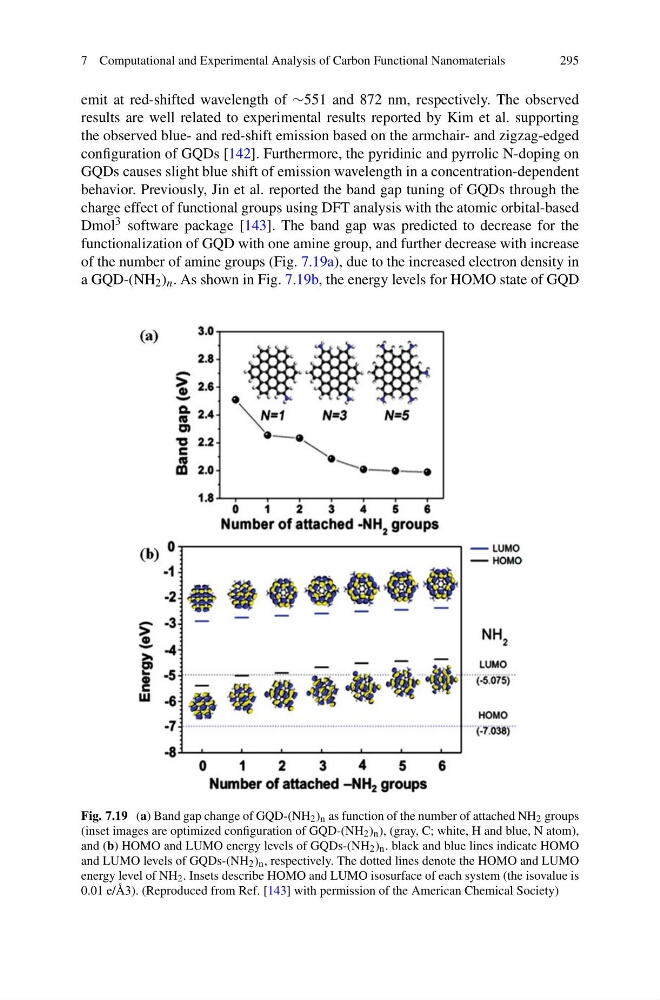
Dmol 3 software package [143]. The band gap was predicted to decrease for the
functionalization of GQD with one amine group, and further decrease with increase
of the number of amine groups (Fig. 7.19a), due to the increased electron density in
a GQD-(NH 2 ) n . As shown in Fig. 7.19b, the energy levels for HOMO state of GQD
Fig. 7.19 (a) Band gap change of GQD-(NH 2 ) n as function of the number of attached NH 2 groups
(inset images are optimized configuration of GQD-(NH 2 ) n ), (gray, C; white, H and blue, N atom),
and (b) HOMO and LUMO energy levels of GQDs-(NH 2 ) n . black and blue lines indicate HOMO
and LUMO levels of GQDs-(NH 2 ) n , respectively. The dotted lines denote the HOMO and LUMO
energy level of NH 2 . Insets describe HOMO and LUMO isosurface of each system (the isovalue is
0.01 e/Å3). (Reproduced from Ref. [143] with permission of the American Chemical Society)
295
emit at red-shifted wavelength of ∼551 and 872 nm, respectively. The observed
results are well related to experimental results reported by Kim et al. supporting
the observed blue- and red-shift emission based on the armchair- and zigzag-edged
configuration of GQDs [142]. Furthermore, the pyridinic and pyrrolic N-doping on
GQDs causes slight blue shift of emission wavelength in a concentration-dependent
behavior. Previously, Jin et al. reported the band gap tuning of GQDs through the
charge effect of functional groups using DFT analysis with the atomic orbital-based
Dmol 3 software package [143]. The band gap was predicted to decrease for the
functionalization of GQD with one amine group, and further decrease with increase
of the number of amine groups (Fig. 7.19a), due to the increased electron density in
a GQD-(NH 2 ) n . As shown in Fig. 7.19b, the energy levels for HOMO state of GQD
Fig. 7.19 (a) Band gap change of GQD-(NH 2 ) n as function of the number of attached NH 2 groups
(inset images are optimized configuration of GQD-(NH 2 ) n ), (gray, C; white, H and blue, N atom),
and (b) HOMO and LUMO energy levels of GQDs-(NH 2 ) n . black and blue lines indicate HOMO
and LUMO levels of GQDs-(NH 2 ) n , respectively. The dotted lines denote the HOMO and LUMO
energy level of NH 2 . Insets describe HOMO and LUMO isosurface of each system (the isovalue is
0.01 e/Å3). (Reproduced from Ref. [143] with permission of the American Chemical Society)