

7 Computational and Experimental Analysis of Carbon Functional Nanomaterials
293
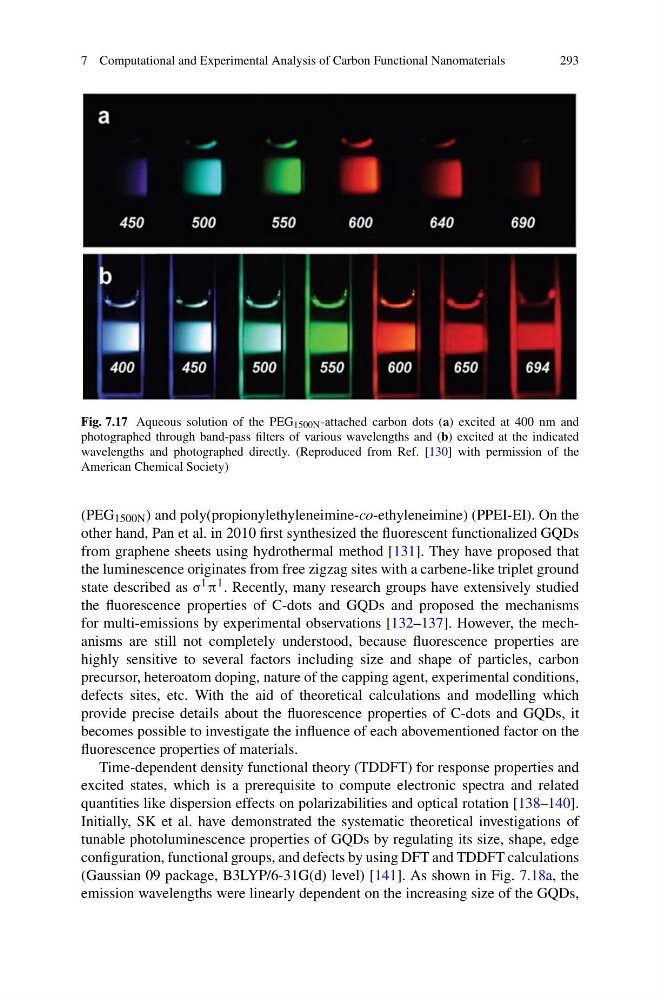
Fig. 7.17 Aqueous solution of the PEG 1500N -attached carbon dots (a) excited at 400 nm and
photographed through band-pass filters of various wavelengths and (b) excited at the indicated
wavelengths and photographed directly. (Reproduced from Ref. [130] with permission of the
American Chemical Society)
(PEG 1500N ) and poly(propionylethyleneimine-co-ethyleneimine) (PPEI-EI). On the
other hand, Pan et al. in 2010 first synthesized the fluorescent functionalized GQDs
from graphene sheets using hydrothermal method [131]. They have proposed that
the luminescence originates from free zigzag sites with a carbene-like triplet ground
state described as σ 1 π 1 . Recently, many research groups have extensively studied
the fluorescence properties of C-dots and GQDs and proposed the mechanisms
for multi-emissions by experimental observations [132–137]. However, the mechanisms are still not completely understood, because fluorescence properties are
highly sensitive to several factors including size and shape of particles, carbon
precursor, heteroatom doping, nature of the capping agent, experimental conditions,
defects sites, etc. With the aid of theoretical calculations and modelling which
provide precise details about the fluorescence properties of C-dots and GQDs, it
becomes possible to investigate the influence of each abovementioned factor on the
fluorescence properties of materials.
Time-dependent density functional theory (TDDFT) for response properties and
excited states, which is a prerequisite to compute electronic spectra and related
quantities like dispersion effects on polarizabilities and optical rotation [138–140].
Initially, SK et al. have demonstrated the systematic theoretical investigations of
tunable photoluminescence properties of GQDs by regulating its size, shape, edge
configuration, functional groups, and defects by using DFT and TDDFT calculations
(Gaussian 09 package, B3LYP/6-31G(d) level) [141]. As shown in Fig. 7.18a, the
emission wavelengths were linearly dependent on the increasing size of the GQDs,
293
Fig. 7.17 Aqueous solution of the PEG 1500N -attached carbon dots (a) excited at 400 nm and
photographed through band-pass filters of various wavelengths and (b) excited at the indicated
wavelengths and photographed directly. (Reproduced from Ref. [130] with permission of the
American Chemical Society)
(PEG 1500N ) and poly(propionylethyleneimine-co-ethyleneimine) (PPEI-EI). On the
other hand, Pan et al. in 2010 first synthesized the fluorescent functionalized GQDs
from graphene sheets using hydrothermal method [131]. They have proposed that
the luminescence originates from free zigzag sites with a carbene-like triplet ground
state described as σ 1 π 1 . Recently, many research groups have extensively studied
the fluorescence properties of C-dots and GQDs and proposed the mechanisms
for multi-emissions by experimental observations [132–137]. However, the mechanisms are still not completely understood, because fluorescence properties are
highly sensitive to several factors including size and shape of particles, carbon
precursor, heteroatom doping, nature of the capping agent, experimental conditions,
defects sites, etc. With the aid of theoretical calculations and modelling which
provide precise details about the fluorescence properties of C-dots and GQDs, it
becomes possible to investigate the influence of each abovementioned factor on the
fluorescence properties of materials.
Time-dependent density functional theory (TDDFT) for response properties and
excited states, which is a prerequisite to compute electronic spectra and related
quantities like dispersion effects on polarizabilities and optical rotation [138–140].
Initially, SK et al. have demonstrated the systematic theoretical investigations of
tunable photoluminescence properties of GQDs by regulating its size, shape, edge
configuration, functional groups, and defects by using DFT and TDDFT calculations
(Gaussian 09 package, B3LYP/6-31G(d) level) [141]. As shown in Fig. 7.18a, the
emission wavelengths were linearly dependent on the increasing size of the GQDs,