

262
A. V. Pomogaeva and A. Y. Timoshkin
of the energy gap to a desirable value within 1–7 eV range. These features make
these compounds promising targets for the practical applications.
6.5 Future Directions
Since the Ga-N-based rod-shaped compounds possess intriguing electronic properties for their practical use, the reliability of their synthesis and isolation becomes
the key issue for the future experimental works. It is highly desirable to selectively
synthesize arrays of pre-oriented Ga-N-based oligomers. One of the approaches to
achieve this goal may be the atomic layer deposition (ALD) technique. In contrast
to CVD, in ALD the deposition reaction is split in two steps, and the precursor
materials are introduced into the reaction volume separately, step by step [193,
194]. During each reaction step, one new layer of group 13 or group 15 atoms is
formed; the repetition of reaction cycles using subsequent introduction of GaMe 3
and ammonia precursors leads to gallium nitride [195, 196]. After each cycle, the
reaction vessel is purged by inert gas to remove unreacted compounds and avoid the
stoichiometry loss.
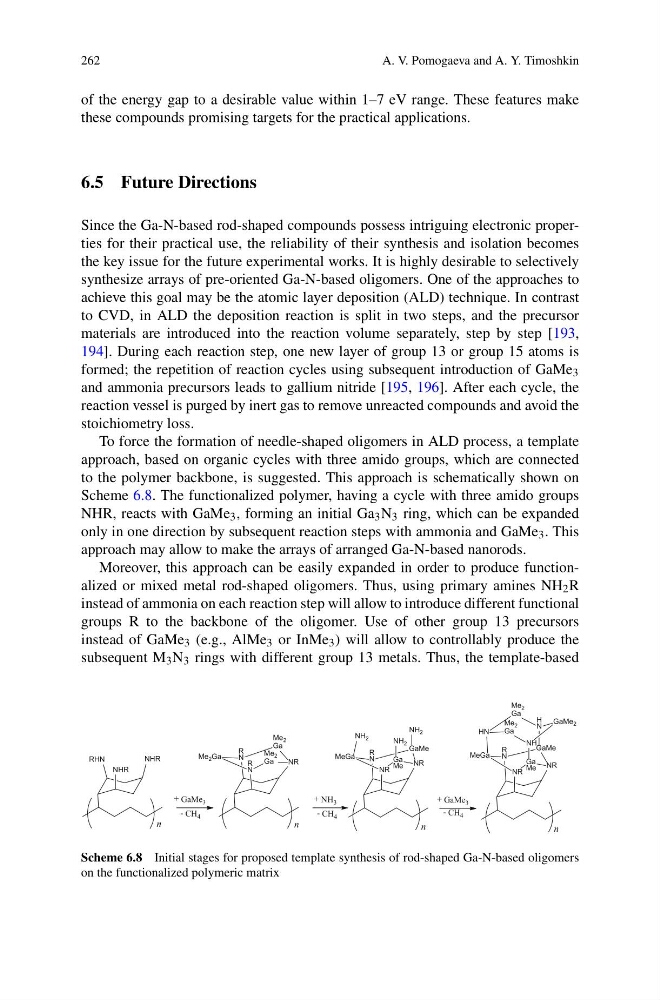
To force the formation of needle-shaped oligomers in ALD process, a template
approach, based on organic cycles with three amido groups, which are connected
to the polymer backbone, is suggested. This approach is schematically shown on
Scheme 6.8. The functionalized polymer, having a cycle with three amido groups
NHR, reacts with GaMe 3 , forming an initial Ga 3 N 3 ring, which can be expanded
only in one direction by subsequent reaction steps with ammonia and GaMe 3 . This
approach may allow to make the arrays of arranged Ga-N-based nanorods.
Moreover, this approach can be easily expanded in order to produce functionalized or mixed metal rod-shaped oligomers. Thus, using primary amines NH 2 R
instead of ammonia on each reaction step will allow to introduce different functional
groups R to the backbone of the oligomer. Use of other group 13 precursors
instead of GaMe 3 (e.g., AlMe 3 or InMe 3 ) will allow to controllably produce the
subsequent M 3 N 3 rings with different group 13 metals. Thus, the template-based
+ GaMe 3
- CH 4
RHN
NHR
NHR
n
R
N R
N
NR
n
Me 2 Ga
Me 2
Ga
Me 2
Ga
+ NH 3
- CH 4
R
N
NR
NR
n
MeGa
Ga
Me
GaMe
NH 2
NH 2
NH 2
+ GaMe 3
- CH 4
R
N
NR
NR
n
MeGa
Ga
Me
GaMe
HN
H
N
NH
Me 2
Ga
GaMe 2
Me 2
Ga
Scheme 6.8 Initial stages for proposed template synthesis of rod-shaped Ga-N-based oligomers
on the functionalized polymeric matrix
A. V. Pomogaeva and A. Y. Timoshkin
of the energy gap to a desirable value within 1–7 eV range. These features make
these compounds promising targets for the practical applications.
6.5 Future Directions
Since the Ga-N-based rod-shaped compounds possess intriguing electronic properties for their practical use, the reliability of their synthesis and isolation becomes
the key issue for the future experimental works. It is highly desirable to selectively
synthesize arrays of pre-oriented Ga-N-based oligomers. One of the approaches to
achieve this goal may be the atomic layer deposition (ALD) technique. In contrast
to CVD, in ALD the deposition reaction is split in two steps, and the precursor
materials are introduced into the reaction volume separately, step by step [193,
194]. During each reaction step, one new layer of group 13 or group 15 atoms is
formed; the repetition of reaction cycles using subsequent introduction of GaMe 3
and ammonia precursors leads to gallium nitride [195, 196]. After each cycle, the
reaction vessel is purged by inert gas to remove unreacted compounds and avoid the
stoichiometry loss.
To force the formation of needle-shaped oligomers in ALD process, a template
approach, based on organic cycles with three amido groups, which are connected
to the polymer backbone, is suggested. This approach is schematically shown on
Scheme 6.8. The functionalized polymer, having a cycle with three amido groups
NHR, reacts with GaMe 3 , forming an initial Ga 3 N 3 ring, which can be expanded
only in one direction by subsequent reaction steps with ammonia and GaMe 3 . This
approach may allow to make the arrays of arranged Ga-N-based nanorods.
Moreover, this approach can be easily expanded in order to produce functionalized or mixed metal rod-shaped oligomers. Thus, using primary amines NH 2 R
instead of ammonia on each reaction step will allow to introduce different functional
groups R to the backbone of the oligomer. Use of other group 13 precursors
instead of GaMe 3 (e.g., AlMe 3 or InMe 3 ) will allow to controllably produce the
subsequent M 3 N 3 rings with different group 13 metals. Thus, the template-based
+ GaMe 3
- CH 4
RHN
NHR
NHR
n
R
N R
N
NR
n
Me 2 Ga
Me 2
Ga
Me 2
Ga
+ NH 3
- CH 4
R
N
NR
NR
n
MeGa
Ga
Me
GaMe
NH 2
NH 2
NH 2
+ GaMe 3
- CH 4
R
N
NR
NR
n
MeGa
Ga
Me
GaMe
HN
H
N
NH
Me 2
Ga
GaMe 2
Me 2
Ga
Scheme 6.8 Initial stages for proposed template synthesis of rod-shaped Ga-N-based oligomers
on the functionalized polymeric matrix