

6 Group 13–15 Needle-Shaped Oligomers and Nanorods: Structures. . .
259
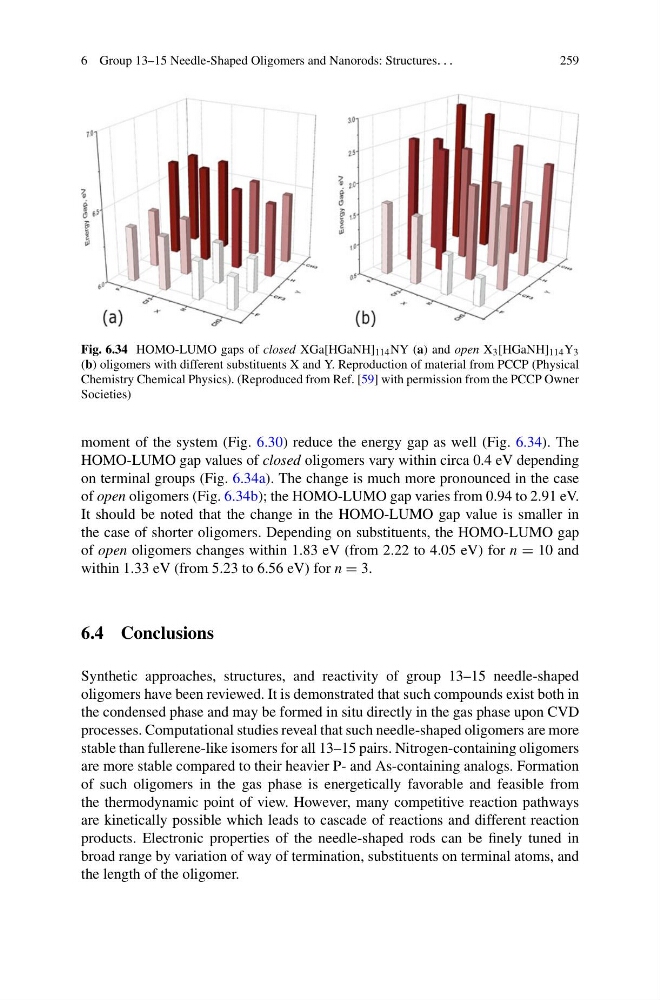
Fig. 6.34 HOMO-LUMO gaps of closed XGa[HGaNH] 114 NY (a) and open X 3 [HGaNH] 114 Y 3
(b) oligomers with different substituents X and Y. Reproduction of material from PCCP (Physical
Chemistry Chemical Physics). (Reproduced from Ref. [59] with permission from the PCCP Owner
Societies)
moment of the system (Fig. 6.30) reduce the energy gap as well (Fig. 6.34). The
HOMO-LUMO gap values of closed oligomers vary within circa 0.4 eV depending
on terminal groups (Fig. 6.34a). The change is much more pronounced in the case
of open oligomers (Fig. 6.34b); the HOMO-LUMO gap varies from 0.94 to 2.91 eV.
It should be noted that the change in the HOMO-LUMO gap value is smaller in
the case of shorter oligomers. Depending on substituents, the HOMO-LUMO gap
of open oligomers changes within 1.83 eV (from 2.22 to 4.05 eV) for n = 10 and
within 1.33 eV (from 5.23 to 6.56 eV) for n = 3.
6.4 Conclusions
Synthetic approaches, structures, and reactivity of group 13–15 needle-shaped
oligomers have been reviewed. It is demonstrated that such compounds exist both in
the condensed phase and may be formed in situ directly in the gas phase upon CVD
processes. Computational studies reveal that such needle-shaped oligomers are more
stable than fullerene-like isomers for all 13–15 pairs. Nitrogen-containing oligomers
are more stable compared to their heavier P- and As-containing analogs. Formation
of such oligomers in the gas phase is energetically favorable and feasible from
the thermodynamic point of view. However, many competitive reaction pathways
are kinetically possible which leads to cascade of reactions and different reaction
products. Electronic properties of the needle-shaped rods can be finely tuned in
broad range by variation of way of termination, substituents on terminal atoms, and
the length of the oligomer.
259
Fig. 6.34 HOMO-LUMO gaps of closed XGa[HGaNH] 114 NY (a) and open X 3 [HGaNH] 114 Y 3
(b) oligomers with different substituents X and Y. Reproduction of material from PCCP (Physical
Chemistry Chemical Physics). (Reproduced from Ref. [59] with permission from the PCCP Owner
Societies)
moment of the system (Fig. 6.30) reduce the energy gap as well (Fig. 6.34). The
HOMO-LUMO gap values of closed oligomers vary within circa 0.4 eV depending
on terminal groups (Fig. 6.34a). The change is much more pronounced in the case
of open oligomers (Fig. 6.34b); the HOMO-LUMO gap varies from 0.94 to 2.91 eV.
It should be noted that the change in the HOMO-LUMO gap value is smaller in
the case of shorter oligomers. Depending on substituents, the HOMO-LUMO gap
of open oligomers changes within 1.83 eV (from 2.22 to 4.05 eV) for n = 10 and
within 1.33 eV (from 5.23 to 6.56 eV) for n = 3.
6.4 Conclusions
Synthetic approaches, structures, and reactivity of group 13–15 needle-shaped
oligomers have been reviewed. It is demonstrated that such compounds exist both in
the condensed phase and may be formed in situ directly in the gas phase upon CVD
processes. Computational studies reveal that such needle-shaped oligomers are more
stable than fullerene-like isomers for all 13–15 pairs. Nitrogen-containing oligomers
are more stable compared to their heavier P- and As-containing analogs. Formation
of such oligomers in the gas phase is energetically favorable and feasible from
the thermodynamic point of view. However, many competitive reaction pathways
are kinetically possible which leads to cascade of reactions and different reaction
products. Electronic properties of the needle-shaped rods can be finely tuned in
broad range by variation of way of termination, substituents on terminal atoms, and
the length of the oligomer.