

252
A. V. Pomogaeva and A. Y. Timoshkin
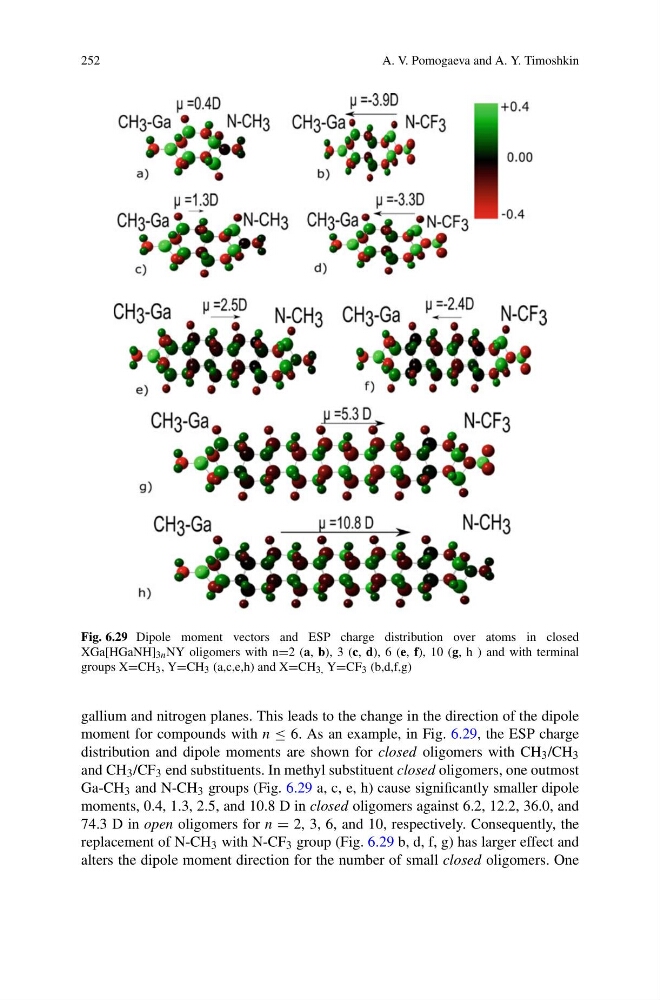
Fig. 6.29 Dipole moment vectors and ESP charge distribution over atoms in closed
XGa[HGaNH] 3n NY oligomers with n=2 (a, b), 3 (c, d), 6 (e, f), 10 (g, h ) and with terminal
groups X=CH 3 , Y=CH 3 (a,c,e,h) and X=CH 3, Y=CF 3 (b,d,f,g)
gallium and nitrogen planes. This leads to the change in the direction of the dipole
moment for compounds with n ≤ 6. As an example, in Fig. 6.29, the ESP charge
distribution and dipole moments are shown for closed oligomers with CH 3 /CH 3
and CH 3 /CF 3 end substituents. In methyl substituent closed oligomers, one outmost
Ga-CH 3 and N-CH 3 groups (Fig. 6.29 a, c, e, h) cause significantly smaller dipole
moments, 0.4, 1.3, 2.5, and 10.8 D in closed oligomers against 6.2, 12.2, 36.0, and
74.3 D in open oligomers for n = 2, 3, 6, and 10, respectively. Consequently, the
replacement of N-CH 3 with N-CF 3 group (Fig. 6.29 b, d, f, g) has larger effect and
alters the dipole moment direction for the number of small closed oligomers. One
A. V. Pomogaeva and A. Y. Timoshkin
Fig. 6.29 Dipole moment vectors and ESP charge distribution over atoms in closed
XGa[HGaNH] 3n NY oligomers with n=2 (a, b), 3 (c, d), 6 (e, f), 10 (g, h ) and with terminal
groups X=CH 3 , Y=CH 3 (a,c,e,h) and X=CH 3, Y=CF 3 (b,d,f,g)
gallium and nitrogen planes. This leads to the change in the direction of the dipole
moment for compounds with n ≤ 6. As an example, in Fig. 6.29, the ESP charge
distribution and dipole moments are shown for closed oligomers with CH 3 /CH 3
and CH 3 /CF 3 end substituents. In methyl substituent closed oligomers, one outmost
Ga-CH 3 and N-CH 3 groups (Fig. 6.29 a, c, e, h) cause significantly smaller dipole
moments, 0.4, 1.3, 2.5, and 10.8 D in closed oligomers against 6.2, 12.2, 36.0, and
74.3 D in open oligomers for n = 2, 3, 6, and 10, respectively. Consequently, the
replacement of N-CH 3 with N-CF 3 group (Fig. 6.29 b, d, f, g) has larger effect and
alters the dipole moment direction for the number of small closed oligomers. One