

6 Group 13–15 Needle-Shaped Oligomers and Nanorods: Structures. . .
243
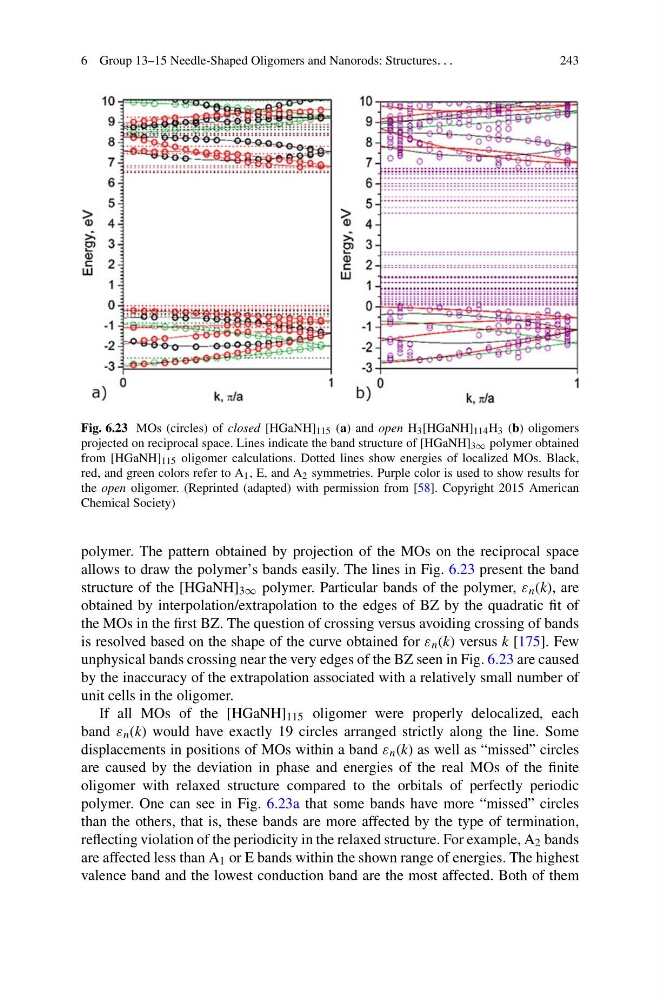
Fig. 6.23 MOs (circles) of closed [HGaNH] 115 (a) and open H 3 [HGaNH] 114 H 3 (b) oligomers
projected on reciprocal space. Lines indicate the band structure of [HGaNH] 3∞ polymer obtained
from [HGaNH] 115 oligomer calculations. Dotted lines show energies of localized MOs. Black,
red, and green colors refer to A 1 , E, and A 2 symmetries. Purple color is used to show results for
the open oligomer. (Reprinted (adapted) with permission from [58]. Copyright 2015 American
Chemical Society)
polymer. The pattern obtained by projection of the MOs on the reciprocal space
allows to draw the polymer’s bands easily. The lines in Fig. 6.23 present the band
structure of the [HGaNH] 3∞ polymer. Particular bands of the polymer, ε n (k), are
obtained by interpolation/extrapolation to the edges of BZ by the quadratic fit of
the MOs in the first BZ. The question of crossing versus avoiding crossing of bands
is resolved based on the shape of the curve obtained for ε n (k) versus k [175]. Few
unphysical bands crossing near the very edges of the BZ seen in Fig. 6.23 are caused
by the inaccuracy of the extrapolation associated with a relatively small number of
unit cells in the oligomer.
If all MOs of the [HGaNH] 115 oligomer were properly delocalized, each
band ε n (k) would have exactly 19 circles arranged strictly along the line. Some
displacements in positions of MOs within a band ε n (k) as well as “missed” circles
are caused by the deviation in phase and energies of the real MOs of the finite
oligomer with relaxed structure compared to the orbitals of perfectly periodic
polymer. One can see in Fig. 6.23a that some bands have more “missed” circles
than the others, that is, these bands are more affected by the type of termination,
reflecting violation of the periodicity in the relaxed structure. For example, A 2 bands
are affected less than A 1 or E bands within the shown range of energies. The highest
valence band and the lowest conduction band are the most affected. Both of them
243
Fig. 6.23 MOs (circles) of closed [HGaNH] 115 (a) and open H 3 [HGaNH] 114 H 3 (b) oligomers
projected on reciprocal space. Lines indicate the band structure of [HGaNH] 3∞ polymer obtained
from [HGaNH] 115 oligomer calculations. Dotted lines show energies of localized MOs. Black,
red, and green colors refer to A 1 , E, and A 2 symmetries. Purple color is used to show results for
the open oligomer. (Reprinted (adapted) with permission from [58]. Copyright 2015 American
Chemical Society)
polymer. The pattern obtained by projection of the MOs on the reciprocal space
allows to draw the polymer’s bands easily. The lines in Fig. 6.23 present the band
structure of the [HGaNH] 3∞ polymer. Particular bands of the polymer, ε n (k), are
obtained by interpolation/extrapolation to the edges of BZ by the quadratic fit of
the MOs in the first BZ. The question of crossing versus avoiding crossing of bands
is resolved based on the shape of the curve obtained for ε n (k) versus k [175]. Few
unphysical bands crossing near the very edges of the BZ seen in Fig. 6.23 are caused
by the inaccuracy of the extrapolation associated with a relatively small number of
unit cells in the oligomer.
If all MOs of the [HGaNH] 115 oligomer were properly delocalized, each
band ε n (k) would have exactly 19 circles arranged strictly along the line. Some
displacements in positions of MOs within a band ε n (k) as well as “missed” circles
are caused by the deviation in phase and energies of the real MOs of the finite
oligomer with relaxed structure compared to the orbitals of perfectly periodic
polymer. One can see in Fig. 6.23a that some bands have more “missed” circles
than the others, that is, these bands are more affected by the type of termination,
reflecting violation of the periodicity in the relaxed structure. For example, A 2 bands
are affected less than A 1 or E bands within the shown range of energies. The highest
valence band and the lowest conduction band are the most affected. Both of them