

6 Group 13–15 Needle-Shaped Oligomers and Nanorods: Structures. . .
237
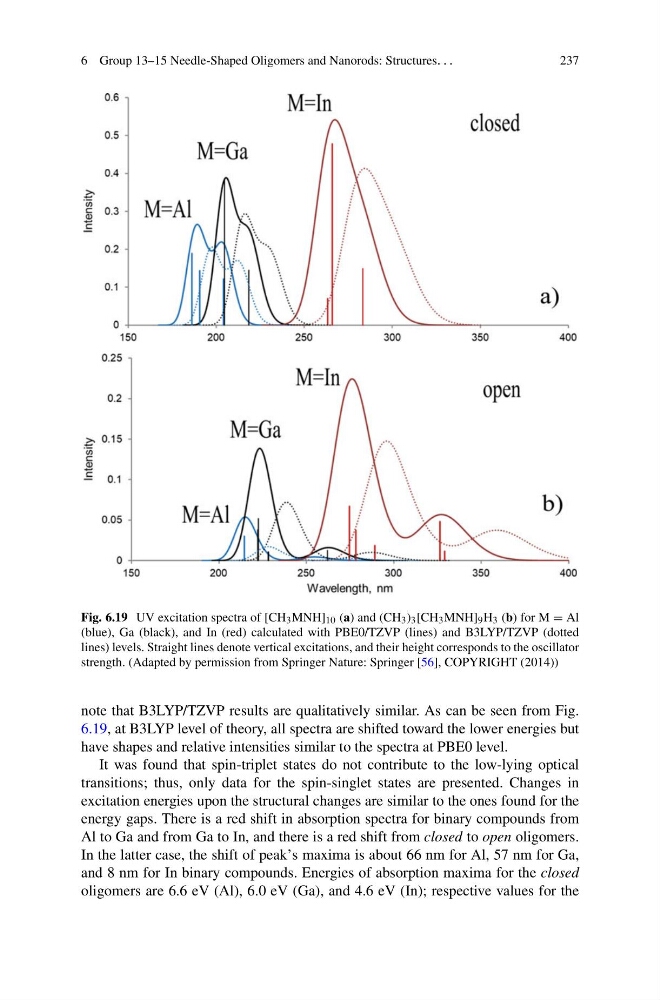
Fig. 6.19 UV excitation spectra of [CH 3 MNH] 10 (a) and (CH 3 ) 3 [CH 3 MNH] 9 H 3 (b) for M = Al
(blue), Ga (black), and In (red) calculated with PBE0/TZVP (lines) and B3LYP/TZVP (dotted
lines) levels. Straight lines denote vertical excitations, and their height corresponds to the oscillator
strength. (Adapted by permission from Springer Nature: Springer [56], COPYRIGHT (2014))
note that B3LYP/TZVP results are qualitatively similar. As can be seen from Fig.
6.19, at B3LYP level of theory, all spectra are shifted toward the lower energies but
have shapes and relative intensities similar to the spectra at PBE0 level.
It was found that spin-triplet states do not contribute to the low-lying optical
transitions; thus, only data for the spin-singlet states are presented. Changes in
excitation energies upon the structural changes are similar to the ones found for the
energy gaps. There is a red shift in absorption spectra for binary compounds from
Al to Ga and from Ga to In, and there is a red shift from closed to open oligomers.
In the latter case, the shift of peak’s maxima is about 66 nm for Al, 57 nm for Ga,
and 8 nm for In binary compounds. Energies of absorption maxima for the closed
oligomers are 6.6 eV (Al), 6.0 eV (Ga), and 4.6 eV (In); respective values for the
237
Fig. 6.19 UV excitation spectra of [CH 3 MNH] 10 (a) and (CH 3 ) 3 [CH 3 MNH] 9 H 3 (b) for M = Al
(blue), Ga (black), and In (red) calculated with PBE0/TZVP (lines) and B3LYP/TZVP (dotted
lines) levels. Straight lines denote vertical excitations, and their height corresponds to the oscillator
strength. (Adapted by permission from Springer Nature: Springer [56], COPYRIGHT (2014))
note that B3LYP/TZVP results are qualitatively similar. As can be seen from Fig.
6.19, at B3LYP level of theory, all spectra are shifted toward the lower energies but
have shapes and relative intensities similar to the spectra at PBE0 level.
It was found that spin-triplet states do not contribute to the low-lying optical
transitions; thus, only data for the spin-singlet states are presented. Changes in
excitation energies upon the structural changes are similar to the ones found for the
energy gaps. There is a red shift in absorption spectra for binary compounds from
Al to Ga and from Ga to In, and there is a red shift from closed to open oligomers.
In the latter case, the shift of peak’s maxima is about 66 nm for Al, 57 nm for Ga,
and 8 nm for In binary compounds. Energies of absorption maxima for the closed
oligomers are 6.6 eV (Al), 6.0 eV (Ga), and 4.6 eV (In); respective values for the