

6 Group 13–15 Needle-Shaped Oligomers and Nanorods: Structures. . .
235
of the first, second, and third Ga 3 N 3 rings. The rightmost side (N = 10) represents
energy values of closed and open binary Al and In oligomers. There is a monotonous
increase of the HOMO-LUMO gap with increasing the number of Al atoms and
rather sharp reduction of energy gap upon introduction of In atoms. The energies of
HOMOs increase almost linearly with increasing a number of In atoms; the effect
is more pronounced for the closed oligomers. The LUMO energies are only slightly
affected by introduction of Al atoms but significantly decrease when the Ga atoms
are replaced by In atoms.
To get insight into this behavior, let us consider the nature of the HOMOs
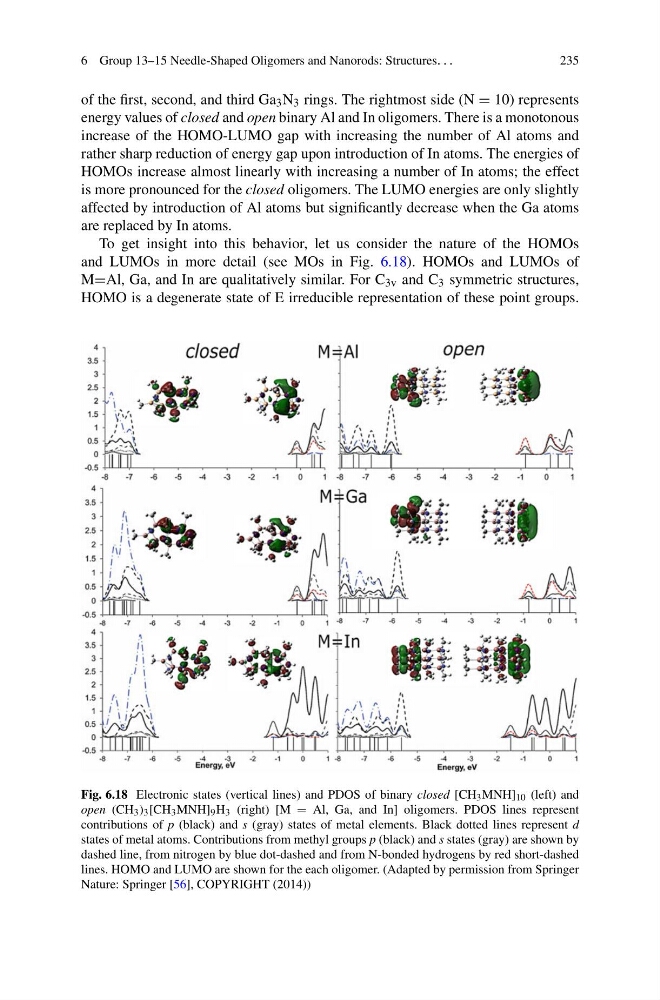
and LUMOs in more detail (see MOs in Fig. 6.18). HOMOs and LUMOs of
M=Al, Ga, and In are qualitatively similar. For C 3v and C 3 symmetric structures,
HOMO is a degenerate state of E irreducible representation of these point groups.
Fig. 6.18 Electronic states (vertical lines) and PDOS of binary closed [CH 3 MNH] 10 (left) and
open (CH 3 ) 3 [CH 3 MNH] 9 H 3 (right) [M = Al, Ga, and In] oligomers. PDOS lines represent
contributions of p (black) and s (gray) states of metal elements. Black dotted lines represent d
states of metal atoms. Contributions from methyl groups p (black) and s states (gray) are shown by
dashed line, from nitrogen by blue dot-dashed and from N-bonded hydrogens by red short-dashed
lines. HOMO and LUMO are shown for the each oligomer. (Adapted by permission from Springer
Nature: Springer [56], COPYRIGHT (2014))
235
of the first, second, and third Ga 3 N 3 rings. The rightmost side (N = 10) represents
energy values of closed and open binary Al and In oligomers. There is a monotonous
increase of the HOMO-LUMO gap with increasing the number of Al atoms and
rather sharp reduction of energy gap upon introduction of In atoms. The energies of
HOMOs increase almost linearly with increasing a number of In atoms; the effect
is more pronounced for the closed oligomers. The LUMO energies are only slightly
affected by introduction of Al atoms but significantly decrease when the Ga atoms
are replaced by In atoms.
To get insight into this behavior, let us consider the nature of the HOMOs
and LUMOs in more detail (see MOs in Fig. 6.18). HOMOs and LUMOs of
M=Al, Ga, and In are qualitatively similar. For C 3v and C 3 symmetric structures,
HOMO is a degenerate state of E irreducible representation of these point groups.
Fig. 6.18 Electronic states (vertical lines) and PDOS of binary closed [CH 3 MNH] 10 (left) and
open (CH 3 ) 3 [CH 3 MNH] 9 H 3 (right) [M = Al, Ga, and In] oligomers. PDOS lines represent
contributions of p (black) and s (gray) states of metal elements. Black dotted lines represent d
states of metal atoms. Contributions from methyl groups p (black) and s states (gray) are shown by
dashed line, from nitrogen by blue dot-dashed and from N-bonded hydrogens by red short-dashed
lines. HOMO and LUMO are shown for the each oligomer. (Adapted by permission from Springer
Nature: Springer [56], COPYRIGHT (2014))