

6 Group 13–15 Needle-Shaped Oligomers and Nanorods: Structures. . .
233
H-N-H scissoring in the terminal ring. The characteristic frequencies are similar
for M=Al, Ga, and In. The values are 1556 and 1575 cm −1 for M=Al, 1554
and 1571 cm −1 for M=Ga, and 1546 and 1559 cm −1 for M=In. On the other
hand, NH-M deformation frequencies on the end’s rings of closed oligomer give
intensive bands at 845 and 880 cm −1 for M=Al; 814 and 856 cm −1 for M=Ga;
803, 863, and 880 cm −1 for M=In. IR spectrum of the open oligomer has a
clear gap in this region. Additional difference is observed in the highest frequency
modes. Stretching of NH bonds of the middle ring of the open oligomer makes
contributions to the intense modes near 3420, 3465, and 3453 cm −1 for M=Al,
Ga, and In, respectively. The intensive peaks near 1200–1500 cm −1 and 2800–
3300 cm −1 are similar for closed and open oligomers and related to the different
methyl group vibrations (stretching and bending). Similar differences in IR spectra
of open and closed oligomers are observed for the other related binary and mixed
metal compounds. Thus, computations suggest the IR spectroscopy may be useful
to distinguish between open and closed oligomers.
6.3.3.2 Effect of Group 13 Metal on the Electronic Structure of Mixed
Metal Oligomers
Group 13 nitride bulk semiconductors have direct band gaps, ranging from 0.7 eV
(InN) to 6.2 eV (AlN) with 3.4 eV for Ga-N. Our computations reveal that closed
oligomer compounds [CH 3 MNH] 10 have HOMO-LUMO gaps of 6.79, 6.30, and
4.95 eV for Al, Ga, and In, respectively. These results are in line with earlier results
obtained for the heptamer clusters [113] at B3LYP/6−311+G* level of theory. Open
oligomers exhibit significantly narrow gaps: 5.19, 5.00, and 4.12 eV or Al, Ga, and
In, respectively. Effect of subsequent substitution of Ga by Al and In atoms on the
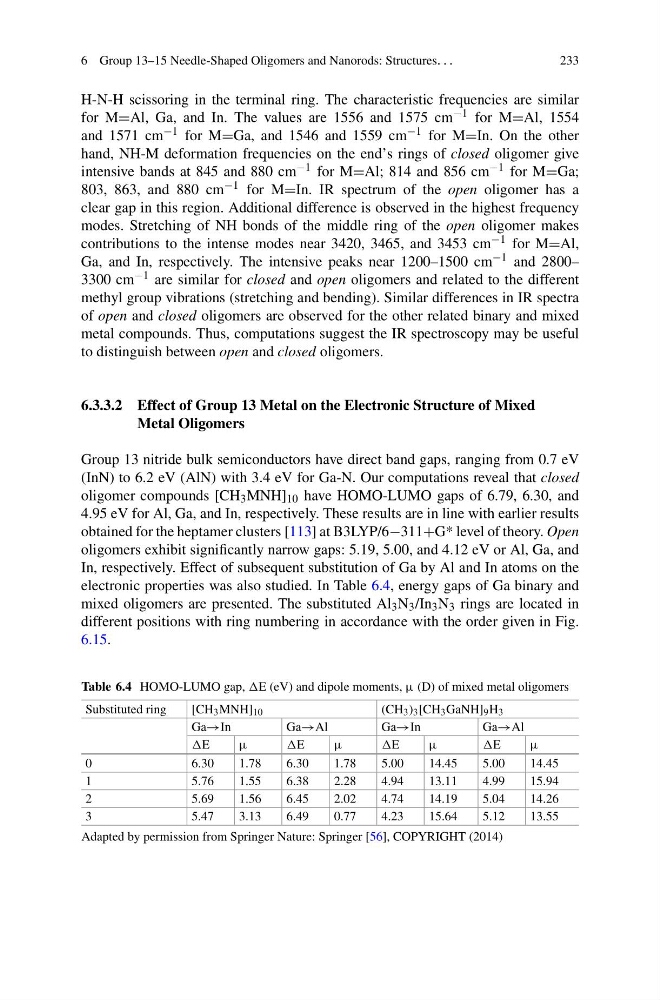
electronic properties was also studied. In Table 6.4, energy gaps of Ga binary and
mixed oligomers are presented. The substituted Al 3 N 3 /In 3 N 3 rings are located in
different positions with ring numbering in accordance with the order given in Fig.
6.15.
Table 6.4 HOMO-LUMO gap, E (eV) and dipole moments, μ (D) of mixed metal oligomers
Substituted ring
[CH 3 MNH] 10
(CH 3 ) 3 [CH 3 GaNH] 9 H 3
Ga→In
Ga→Al
Ga→In
Ga→Al
E
μ
E
μ
E
μ
E
μ
0
6.30
1.78
6.30
1.78
5.00
14.45
5.00
14.45
1
5.76
1.55
6.38
2.28
4.94
13.11
4.99
15.94
2
5.69
1.56
6.45
2.02
4.74
14.19
5.04
14.26
3
5.47
3.13
6.49
0.77
4.23
15.64
5.12
13.55
Adapted by permission from Springer Nature: Springer [56], COPYRIGHT (2014)
233
H-N-H scissoring in the terminal ring. The characteristic frequencies are similar
for M=Al, Ga, and In. The values are 1556 and 1575 cm −1 for M=Al, 1554
and 1571 cm −1 for M=Ga, and 1546 and 1559 cm −1 for M=In. On the other
hand, NH-M deformation frequencies on the end’s rings of closed oligomer give
intensive bands at 845 and 880 cm −1 for M=Al; 814 and 856 cm −1 for M=Ga;
803, 863, and 880 cm −1 for M=In. IR spectrum of the open oligomer has a
clear gap in this region. Additional difference is observed in the highest frequency
modes. Stretching of NH bonds of the middle ring of the open oligomer makes
contributions to the intense modes near 3420, 3465, and 3453 cm −1 for M=Al,
Ga, and In, respectively. The intensive peaks near 1200–1500 cm −1 and 2800–
3300 cm −1 are similar for closed and open oligomers and related to the different
methyl group vibrations (stretching and bending). Similar differences in IR spectra
of open and closed oligomers are observed for the other related binary and mixed
metal compounds. Thus, computations suggest the IR spectroscopy may be useful
to distinguish between open and closed oligomers.
6.3.3.2 Effect of Group 13 Metal on the Electronic Structure of Mixed
Metal Oligomers
Group 13 nitride bulk semiconductors have direct band gaps, ranging from 0.7 eV
(InN) to 6.2 eV (AlN) with 3.4 eV for Ga-N. Our computations reveal that closed
oligomer compounds [CH 3 MNH] 10 have HOMO-LUMO gaps of 6.79, 6.30, and
4.95 eV for Al, Ga, and In, respectively. These results are in line with earlier results
obtained for the heptamer clusters [113] at B3LYP/6−311+G* level of theory. Open
oligomers exhibit significantly narrow gaps: 5.19, 5.00, and 4.12 eV or Al, Ga, and
In, respectively. Effect of subsequent substitution of Ga by Al and In atoms on the
electronic properties was also studied. In Table 6.4, energy gaps of Ga binary and
mixed oligomers are presented. The substituted Al 3 N 3 /In 3 N 3 rings are located in
different positions with ring numbering in accordance with the order given in Fig.
6.15.
Table 6.4 HOMO-LUMO gap, E (eV) and dipole moments, μ (D) of mixed metal oligomers
Substituted ring
[CH 3 MNH] 10
(CH 3 ) 3 [CH 3 GaNH] 9 H 3
Ga→In
Ga→Al
Ga→In
Ga→Al
E
μ
E
μ
E
μ
E
μ
0
6.30
1.78
6.30
1.78
5.00
14.45
5.00
14.45
1
5.76
1.55
6.38
2.28
4.94
13.11
4.99
15.94
2
5.69
1.56
6.45
2.02
4.74
14.19
5.04
14.26
3
5.47
3.13
6.49
0.77
4.23
15.64
5.12
13.55
Adapted by permission from Springer Nature: Springer [56], COPYRIGHT (2014)