

6 Group 13–15 Needle-Shaped Oligomers and Nanorods: Structures. . .
223
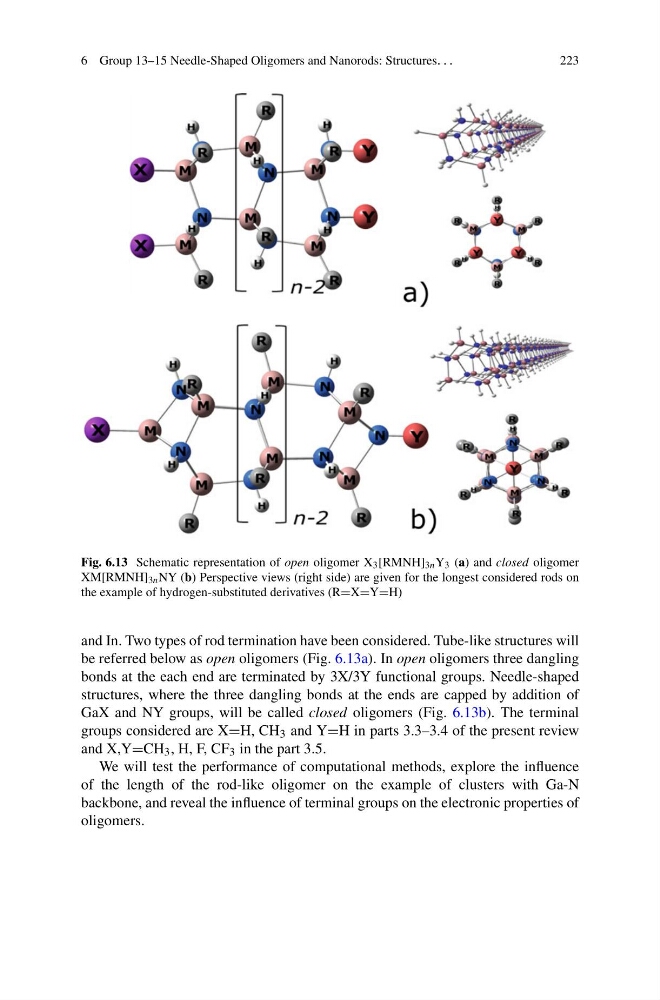
Fig. 6.13 Schematic representation of open oligomer X 3 [RMNH] 3n Y 3 (a) and closed oligomer
XM[RMNH] 3n NY (b) Perspective views (right side) are given for the longest considered rods on
the example of hydrogen-substituted derivatives (R=X=Y=H)
and In. Two types of rod termination have been considered. Tube-like structures will
be referred below as open oligomers (Fig. 6.13a). In open oligomers three dangling
bonds at the each end are terminated by 3X/3Y functional groups. Needle-shaped
structures, where the three dangling bonds at the ends are capped by addition of
GaX and NY groups, will be called closed oligomers (Fig. 6.13b). The terminal
groups considered are X=H, CH 3 and Y=H in parts 3.3–3.4 of the present review
and X,Y=CH 3 , H, F, CF 3 in the part 3.5.
We will test the performance of computational methods, explore the influence
of the length of the rod-like oligomer on the example of clusters with Ga-N
backbone, and reveal the influence of terminal groups on the electronic properties of
oligomers.
223
Fig. 6.13 Schematic representation of open oligomer X 3 [RMNH] 3n Y 3 (a) and closed oligomer
XM[RMNH] 3n NY (b) Perspective views (right side) are given for the longest considered rods on
the example of hydrogen-substituted derivatives (R=X=Y=H)
and In. Two types of rod termination have been considered. Tube-like structures will
be referred below as open oligomers (Fig. 6.13a). In open oligomers three dangling
bonds at the each end are terminated by 3X/3Y functional groups. Needle-shaped
structures, where the three dangling bonds at the ends are capped by addition of
GaX and NY groups, will be called closed oligomers (Fig. 6.13b). The terminal
groups considered are X=H, CH 3 and Y=H in parts 3.3–3.4 of the present review
and X,Y=CH 3 , H, F, CF 3 in the part 3.5.
We will test the performance of computational methods, explore the influence
of the length of the rod-like oligomer on the example of clusters with Ga-N
backbone, and reveal the influence of terminal groups on the electronic properties of
oligomers.