

6 Group 13–15 Needle-Shaped Oligomers and Nanorods: Structures. . .
221
+188
+136
+137
TS5a
-82
-117
-117
+67
+29
+28 -148
-170
-170
+16
-13
-14 -203
-217
-220
-48
-67
-70
-267
-271
-281
-114
-121
-135
-328
-320
-337
-208
-198
-220
-370
-348
-369
0
5
1a
TS6a
6
7
TS7
8
TS8
9
TS9
10
TS10
2
0
100
200
300
-400
-100
-200
-300
ΔE 0 , kJ mol -1
-500
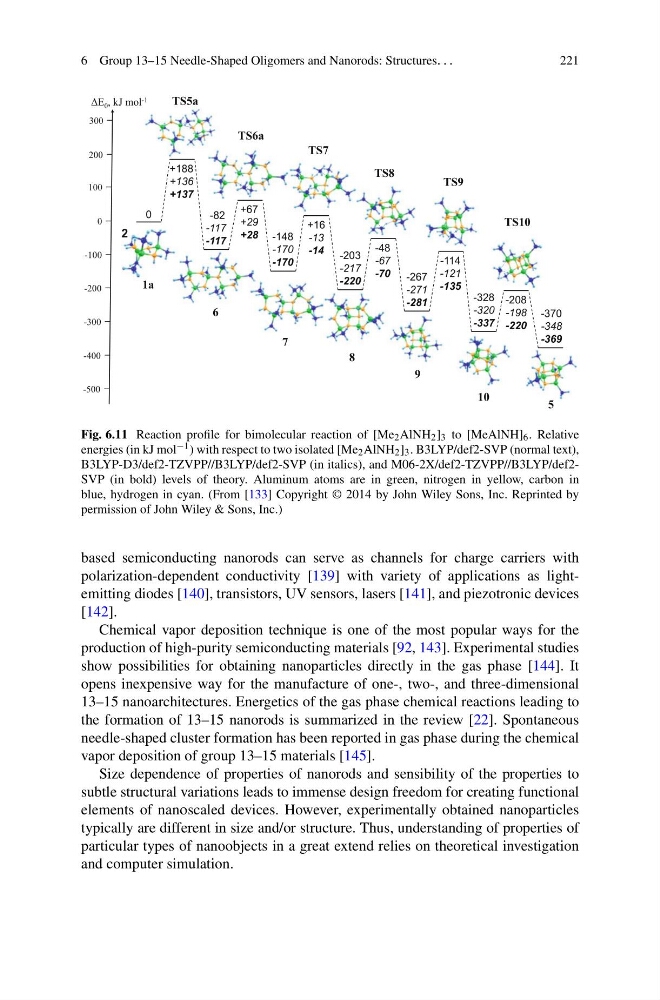
Fig. 6.11 Reaction profile for bimolecular reaction of [Me 2 AlNH 2 ] 3 to [MeAlNH] 6 . Relative
energies (in kJ mol −1 ) with respect to two isolated [Me 2 AlNH 2 ] 3 . B3LYP/def2-SVP (normal text),
B3LYP-D3/def2-TZVPP//B3LYP/def2-SVP (in italics), and M06-2X/def2-TZVPP//B3LYP/def2SVP (in bold) levels of theory. Aluminum atoms are in green, nitrogen in yellow, carbon in
blue, hydrogen in cyan. (From [133] Copyright © 2014 by John Wiley Sons, Inc. Reprinted by
permission of John Wiley & Sons, Inc.)
based semiconducting nanorods can serve as channels for charge carriers with
polarization-dependent conductivity [139] with variety of applications as lightemitting diodes [140], transistors, UV sensors, lasers [141], and piezotronic devices
[142].
Chemical vapor deposition technique is one of the most popular ways for the
production of high-purity semiconducting materials [92, 143]. Experimental studies
show possibilities for obtaining nanoparticles directly in the gas phase [144]. It
opens inexpensive way for the manufacture of one-, two-, and three-dimensional
13–15 nanoarchitectures. Energetics of the gas phase chemical reactions leading to
the formation of 13–15 nanorods is summarized in the review [22]. Spontaneous
needle-shaped cluster formation has been reported in gas phase during the chemical
vapor deposition of group 13–15 materials [145].
Size dependence of properties of nanorods and sensibility of the properties to
subtle structural variations leads to immense design freedom for creating functional
elements of nanÑscaled devices. However, experimentally obtained nanoparticles
typically are different in size and/or structure. Thus, understanding of properties of
particular types of nanoobjects in a great extend relies on theoretical investigation
and computer simulation.
221
+188
+136
+137
TS5a
-82
-117
-117
+67
+29
+28 -148
-170
-170
+16
-13
-14 -203
-217
-220
-48
-67
-70
-267
-271
-281
-114
-121
-135
-328
-320
-337
-208
-198
-220
-370
-348
-369
0
5
1a
TS6a
6
7
TS7
8
TS8
9
TS9
10
TS10
2
0
100
200
300
-400
-100
-200
-300
ΔE 0 , kJ mol -1
-500
Fig. 6.11 Reaction profile for bimolecular reaction of [Me 2 AlNH 2 ] 3 to [MeAlNH] 6 . Relative
energies (in kJ mol −1 ) with respect to two isolated [Me 2 AlNH 2 ] 3 . B3LYP/def2-SVP (normal text),
B3LYP-D3/def2-TZVPP//B3LYP/def2-SVP (in italics), and M06-2X/def2-TZVPP//B3LYP/def2SVP (in bold) levels of theory. Aluminum atoms are in green, nitrogen in yellow, carbon in
blue, hydrogen in cyan. (From [133] Copyright © 2014 by John Wiley Sons, Inc. Reprinted by
permission of John Wiley & Sons, Inc.)
based semiconducting nanorods can serve as channels for charge carriers with
polarization-dependent conductivity [139] with variety of applications as lightemitting diodes [140], transistors, UV sensors, lasers [141], and piezotronic devices
[142].
Chemical vapor deposition technique is one of the most popular ways for the
production of high-purity semiconducting materials [92, 143]. Experimental studies
show possibilities for obtaining nanoparticles directly in the gas phase [144]. It
opens inexpensive way for the manufacture of one-, two-, and three-dimensional
13–15 nanoarchitectures. Energetics of the gas phase chemical reactions leading to
the formation of 13–15 nanorods is summarized in the review [22]. Spontaneous
needle-shaped cluster formation has been reported in gas phase during the chemical
vapor deposition of group 13–15 materials [145].
Size dependence of properties of nanorods and sensibility of the properties to
subtle structural variations leads to immense design freedom for creating functional
elements of nanÑscaled devices. However, experimentally obtained nanoparticles
typically are different in size and/or structure. Thus, understanding of properties of
particular types of nanoobjects in a great extend relies on theoretical investigation
and computer simulation.