

6 Group 13–15 Needle-Shaped Oligomers and Nanorods: Structures. . .
219
0
+200
+198
+202
+187
+183
+183
+76
+77
+83
TS1a
TS1c
2
+235
+235
+244
TS2a
3
+91
+88
+87
+228
+230
+245
TS3a
4
+84
+83
+104
5
-185
-174
-185
+7
+11
+12
1b
1a
1/2
0
100
200
300
400
-100
-200
-300
ΔE 0 , kJ mol -1
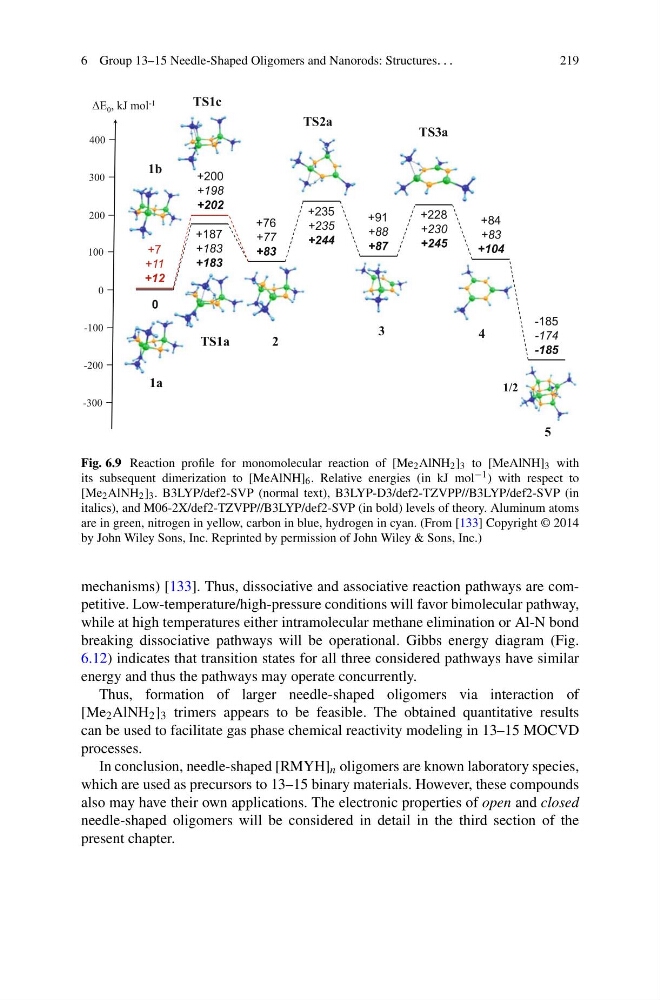
Fig. 6.9 Reaction profile for monomolecular reaction of [Me 2 AlNH 2 ] 3 to [MeAlNH] 3 with
its subsequent dimerization to [MeAlNH] 6 . Relative energies (in kJ mol −1 ) with respect to
[Me 2 AlNH 2 ] 3 . B3LYP/def2-SVP (normal text), B3LYP-D3/def2-TZVPP//B3LYP/def2-SVP (in
italics), and M06-2X/def2-TZVPP//B3LYP/def2-SVP (in bold) levels of theory. Aluminum atoms
are in green, nitrogen in yellow, carbon in blue, hydrogen in cyan. (From [133] Copyright © 2014
by John Wiley Sons, Inc. Reprinted by permission of John Wiley & Sons, Inc.)
mechanisms) [133]. Thus, dissociative and associative reaction pathways are competitive. Low-temperature/high-pressure conditions will favor bimolecular pathway,
while at high temperatures either intramolecular methane elimination or Al-N bond
breaking dissociative pathways will be operational. Gibbs energy diagram (Fig.
6.12) indicates that transition states for all three considered pathways have similar
energy and thus the pathways may operate concurrently.
Thus, formation of larger needle-shaped oligomers via interaction of
[Me 2 AlNH 2 ] 3 trimers appears to be feasible. The obtained quantitative results
can be used to facilitate gas phase chemical reactivity modeling in 13–15 MOCVD
processes.
In conclusion, needle-shaped [RMYH] n oligomers are known laboratory species,
which are used as precursors to 13–15 binary materials. However, these compounds
also may have their own applications. The electronic properties of open and closed
needle-shaped oligomers will be considered in detail in the third section of the
present chapter.
219
0
+200
+198
+202
+187
+183
+183
+76
+77
+83
TS1a
TS1c
2
+235
+235
+244
TS2a
3
+91
+88
+87
+228
+230
+245
TS3a
4
+84
+83
+104
5
-185
-174
-185
+7
+11
+12
1b
1a
1/2
0
100
200
300
400
-100
-200
-300
ΔE 0 , kJ mol -1
Fig. 6.9 Reaction profile for monomolecular reaction of [Me 2 AlNH 2 ] 3 to [MeAlNH] 3 with
its subsequent dimerization to [MeAlNH] 6 . Relative energies (in kJ mol −1 ) with respect to
[Me 2 AlNH 2 ] 3 . B3LYP/def2-SVP (normal text), B3LYP-D3/def2-TZVPP//B3LYP/def2-SVP (in
italics), and M06-2X/def2-TZVPP//B3LYP/def2-SVP (in bold) levels of theory. Aluminum atoms
are in green, nitrogen in yellow, carbon in blue, hydrogen in cyan. (From [133] Copyright © 2014
by John Wiley Sons, Inc. Reprinted by permission of John Wiley & Sons, Inc.)
mechanisms) [133]. Thus, dissociative and associative reaction pathways are competitive. Low-temperature/high-pressure conditions will favor bimolecular pathway,
while at high temperatures either intramolecular methane elimination or Al-N bond
breaking dissociative pathways will be operational. Gibbs energy diagram (Fig.
6.12) indicates that transition states for all three considered pathways have similar
energy and thus the pathways may operate concurrently.
Thus, formation of larger needle-shaped oligomers via interaction of
[Me 2 AlNH 2 ] 3 trimers appears to be feasible. The obtained quantitative results
can be used to facilitate gas phase chemical reactivity modeling in 13–15 MOCVD
processes.
In conclusion, needle-shaped [RMYH] n oligomers are known laboratory species,
which are used as precursors to 13–15 binary materials. However, these compounds
also may have their own applications. The electronic properties of open and closed
needle-shaped oligomers will be considered in detail in the third section of the
present chapter.