

214
A. V. Pomogaeva and A. Y. Timoshkin
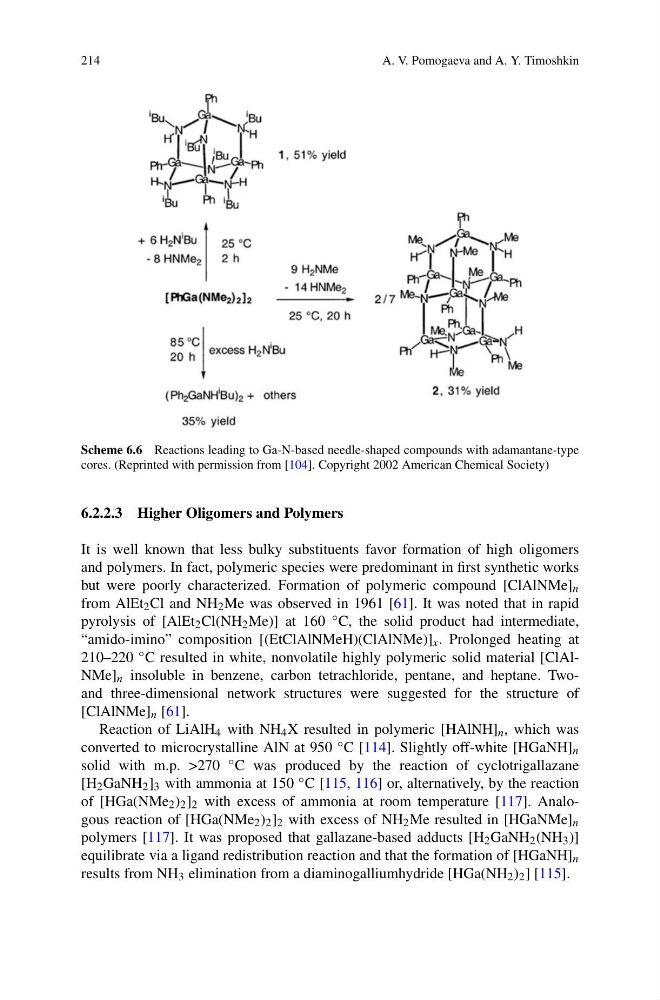
Scheme 6.6 Reactions leading to Ga-N-based needle-shaped compounds with adamantane-type
cores. (Reprinted with permission from [104]. Copyright 2002 American Chemical Society)
6.2.2.3 Higher Oligomers and Polymers
It is well known that less bulky substituents favor formation of high oligomers
and polymers. In fact, polymeric species were predominant in first synthetic works
but were poorly characterized. Formation of polymeric compound [ClAlNMe] n
from AlEt 2 Cl and NH 2 Me was observed in 1961 [61]. It was noted that in rapid
pyrolysis of [AlEt 2 Cl(NH 2 Me)] at 160 ◦ C, the solid product had intermediate,
“amido-imino” composition [(EtClAlNMeH)(ClAlNMe)] x . Prolonged heating at
210–220 ◦ C resulted in white, nonvolatile highly polymeric solid material [ClAlNMe] n insoluble in benzene, carbon tetrachloride, pentane, and heptane. Twoand three-dimensional network structures were suggested for the structure of
[ClAlNMe] n [61].
Reaction of LiAlH 4 with NH 4 X resulted in polymeric [HAlNH] n , which was
converted to microcrystalline AlN at 950 ◦ C [114]. Slightly off-white [HGaNH] n
solid with m.p. >270 ◦ C was produced by the reaction of cyclotrigallazane
[H 2 GaNH 2 ] 3 with ammonia at 150 ◦ C [115, 116] or, alternatively, by the reaction
of [HGa(NMe 2 ) 2 ] 2 with excess of ammonia at room temperature [117]. Analogous reaction of [HGa(NMe 2 ) 2 ] 2 with excess of NH 2 Me resulted in [HGaNMe] n
polymers [117]. It was proposed that gallazane-based adducts [H 2 GaNH 2 (NH 3 )]
equilibrate via a ligand redistribution reaction and that the formation of [HGaNH] n
results from NH 3 elimination from a diaminogalliumhydride [HGa(NH 2 ) 2 ] [115].
A. V. Pomogaeva and A. Y. Timoshkin
Scheme 6.6 Reactions leading to Ga-N-based needle-shaped compounds with adamantane-type
cores. (Reprinted with permission from [104]. Copyright 2002 American Chemical Society)
6.2.2.3 Higher Oligomers and Polymers
It is well known that less bulky substituents favor formation of high oligomers
and polymers. In fact, polymeric species were predominant in first synthetic works
but were poorly characterized. Formation of polymeric compound [ClAlNMe] n
from AlEt 2 Cl and NH 2 Me was observed in 1961 [61]. It was noted that in rapid
pyrolysis of [AlEt 2 Cl(NH 2 Me)] at 160 ◦ C, the solid product had intermediate,
“amido-imino” composition [(EtClAlNMeH)(ClAlNMe)] x . Prolonged heating at
210–220 ◦ C resulted in white, nonvolatile highly polymeric solid material [ClAlNMe] n insoluble in benzene, carbon tetrachloride, pentane, and heptane. Twoand three-dimensional network structures were suggested for the structure of
[ClAlNMe] n [61].
Reaction of LiAlH 4 with NH 4 X resulted in polymeric [HAlNH] n , which was
converted to microcrystalline AlN at 950 ◦ C [114]. Slightly off-white [HGaNH] n
solid with m.p. >270 ◦ C was produced by the reaction of cyclotrigallazane
[H 2 GaNH 2 ] 3 with ammonia at 150 ◦ C [115, 116] or, alternatively, by the reaction
of [HGa(NMe 2 ) 2 ] 2 with excess of ammonia at room temperature [117]. Analogous reaction of [HGa(NMe 2 ) 2 ] 2 with excess of NH 2 Me resulted in [HGaNMe] n
polymers [117]. It was proposed that gallazane-based adducts [H 2 GaNH 2 (NH 3 )]
equilibrate via a ligand redistribution reaction and that the formation of [HGaNH] n
results from NH 3 elimination from a diaminogalliumhydride [HGa(NH 2 ) 2 ] [115].