

212
A. V. Pomogaeva and A. Y. Timoshkin
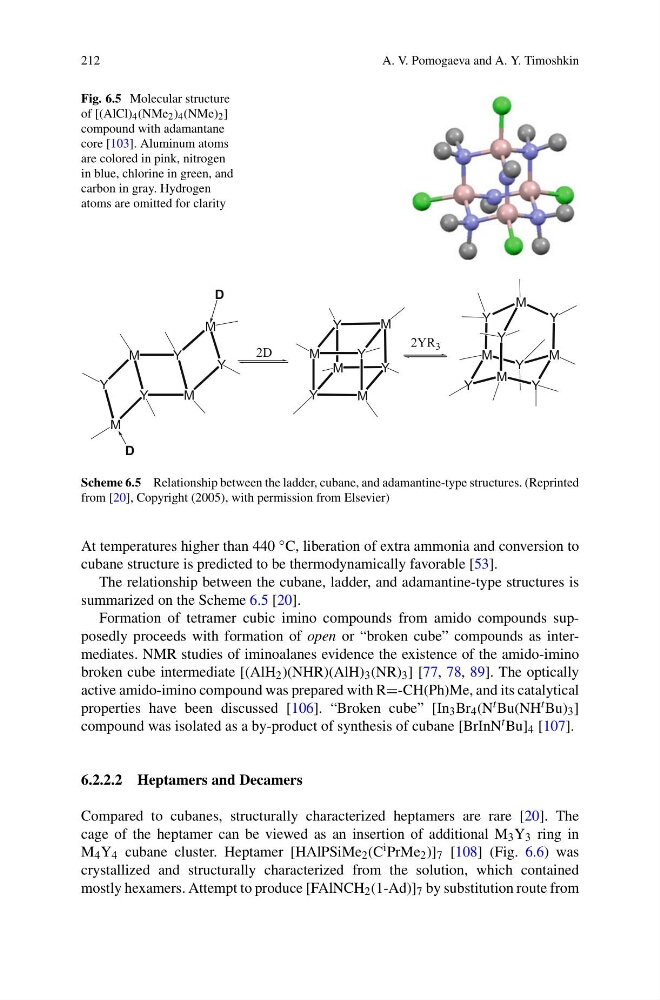
Fig. 6.5 Molecular structure
of [(AlCl) 4 (NMe 2 ) 4 (NMe) 2 ]
compound with adamantane
core [103]. Aluminum atoms
are colored in pink, nitrogen
in blue, chlorine in green, and
carbon in gray. Hydrogen
atoms are omitted for clarity
M
Y
Y
Y
M
M
M
Y
Y
M
Y
Y
M
Y
M
Y
M
Y
2YR 3
2D
Y
M
Y
M
Y
M
M
Y
D
D
Scheme 6.5 Relationship between the ladder, cubane, and adamantine-type structures. (Reprinted
from [20], Copyright (2005), with permission from Elsevier)
At temperatures higher than 440 ◦ C, liberation of extra ammonia and conversion to
cubane structure is predicted to be thermodynamically favorable [53].
The relationship between the cubane, ladder, and adamantine-type structures is
summarized on the Scheme 6.5 [20].
Formation of tetramer cubic imino compounds from amido compounds supposedly proceeds with formation of open or “broken cube” compounds as intermediates. NMR studies of iminoalanes evidence the existence of the amido-imino
broken cube intermediate [(AlH 2 )(NHR)(AlH) 3 (NR) 3 ] [77, 78, 89]. The optically
active amido-imino compound was prepared with R=-CH(Ph)Me, and its catalytical
properties have been discussed [106]. “Broken cube” [In 3 Br 4 (N t Bu(NH t Bu) 3 ]
compound was isolated as a by-product of synthesis of cubane [BrInN t Bu] 4 [107].
6.2.2.2 Heptamers and Decamers
Compared to cubanes, structurally characterized heptamers are rare [20]. The
cage of the heptamer can be viewed as an insertion of additional M 3 Y 3 ring in
M 4 Y 4 cubane cluster. Heptamer [HAlPSiMe 2 (C i PrMe 2 )] 7 [108] (Fig. 6.6) was
crystallized and structurally characterized from the solution, which contained
mostly hexamers. Attempt to produce [FAlNCH 2 (1-Ad)] 7 by substitution route from
A. V. Pomogaeva and A. Y. Timoshkin
Fig. 6.5 Molecular structure
of [(AlCl) 4 (NMe 2 ) 4 (NMe) 2 ]
compound with adamantane
core [103]. Aluminum atoms
are colored in pink, nitrogen
in blue, chlorine in green, and
carbon in gray. Hydrogen
atoms are omitted for clarity
M
Y
Y
Y
M
M
M
Y
Y
M
Y
Y
M
Y
M
Y
M
Y
2YR 3
2D
Y
M
Y
M
Y
M
M
Y
D
D
Scheme 6.5 Relationship between the ladder, cubane, and adamantine-type structures. (Reprinted
from [20], Copyright (2005), with permission from Elsevier)
At temperatures higher than 440 ◦ C, liberation of extra ammonia and conversion to
cubane structure is predicted to be thermodynamically favorable [53].
The relationship between the cubane, ladder, and adamantine-type structures is
summarized on the Scheme 6.5 [20].
Formation of tetramer cubic imino compounds from amido compounds supposedly proceeds with formation of open or “broken cube” compounds as intermediates. NMR studies of iminoalanes evidence the existence of the amido-imino
broken cube intermediate [(AlH 2 )(NHR)(AlH) 3 (NR) 3 ] [77, 78, 89]. The optically
active amido-imino compound was prepared with R=-CH(Ph)Me, and its catalytical
properties have been discussed [106]. “Broken cube” [In 3 Br 4 (N t Bu(NH t Bu) 3 ]
compound was isolated as a by-product of synthesis of cubane [BrInN t Bu] 4 [107].
6.2.2.2 Heptamers and Decamers
Compared to cubanes, structurally characterized heptamers are rare [20]. The
cage of the heptamer can be viewed as an insertion of additional M 3 Y 3 ring in
M 4 Y 4 cubane cluster. Heptamer [HAlPSiMe 2 (C i PrMe 2 )] 7 [108] (Fig. 6.6) was
crystallized and structurally characterized from the solution, which contained
mostly hexamers. Attempt to produce [FAlNCH 2 (1-Ad)] 7 by substitution route from