

210
A. V. Pomogaeva and A. Y. Timoshkin
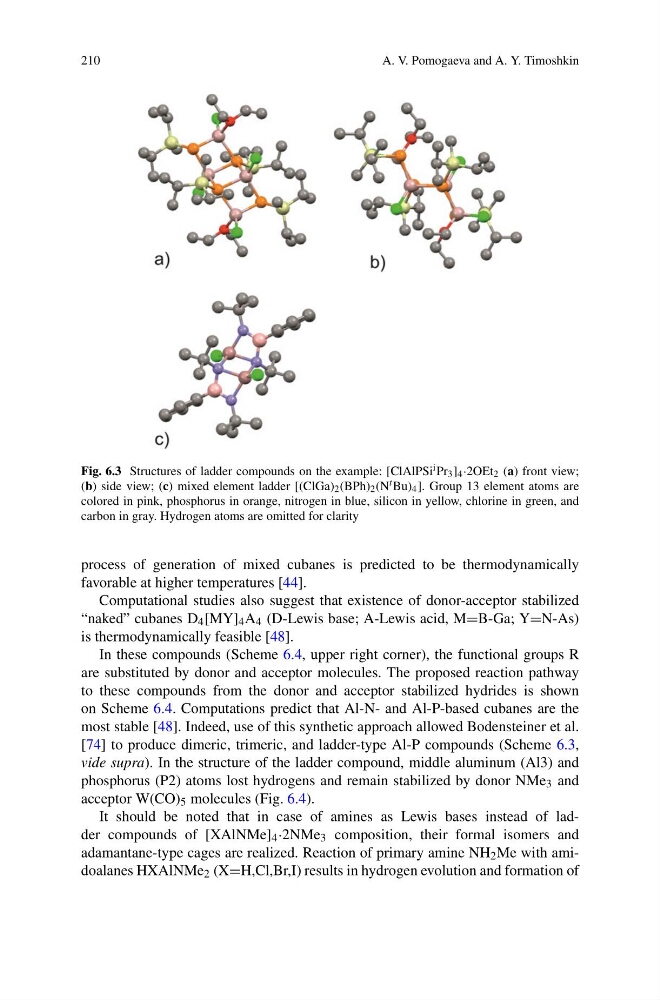
Fig. 6.3 Structures of ladder compounds on the example: [ClAlPSi i Pr 3 ] 4 ·2OEt 2 (a) front view;
(b) side view; (c) mixed element ladder [(ClGa) 2 (BPh) 2 (N t Bu) 4 ]. Group 13 element atoms are
colored in pink, phosphorus in orange, nitrogen in blue, silicon in yellow, chlorine in green, and
carbon in gray. Hydrogen atoms are omitted for clarity
process of generation of mixed cubanes is predicted to be thermodynamically
favorable at higher temperatures [44].
Computational studies also suggest that existence of donor-acceptor stabilized
“naked” cubanes D 4 [MY] 4 A 4 (D-Lewis base; A-Lewis acid, M=B-Ga; Y=N-As)
is thermodynamically feasible [48].
In these compounds (Scheme 6.4, upper right corner), the functional groups R
are substituted by donor and acceptor molecules. The proposed reaction pathway
to these compounds from the donor and acceptor stabilized hydrides is shown
on Scheme 6.4. Computations predict that Al-N- and Al-P-based cubanes are the
most stable [48]. Indeed, use of this synthetic approach allowed Bodensteiner et al.
[74] to produce dimeric, trimeric, and ladder-type Al-P compounds (Scheme 6.3,
vide supra). In the structure of the ladder compound, middle aluminum (Al3) and
phosphorus (P2) atoms lost hydrogens and remain stabilized by donor NMe 3 and
acceptor W(CO) 5 molecules (Fig. 6.4).
It should be noted that in case of amines as Lewis bases instead of ladder compounds of [XAlNMe] 4 ·2NMe 3 composition, their formal isomers and
adamantane-type cages are realized. Reaction of primary amine NH 2 Me with amidoalanes HXAlNMe 2 (X=H,Cl,Br,I) results in hydrogen evolution and formation of
A. V. Pomogaeva and A. Y. Timoshkin
Fig. 6.3 Structures of ladder compounds on the example: [ClAlPSi i Pr 3 ] 4 ·2OEt 2 (a) front view;
(b) side view; (c) mixed element ladder [(ClGa) 2 (BPh) 2 (N t Bu) 4 ]. Group 13 element atoms are
colored in pink, phosphorus in orange, nitrogen in blue, silicon in yellow, chlorine in green, and
carbon in gray. Hydrogen atoms are omitted for clarity
process of generation of mixed cubanes is predicted to be thermodynamically
favorable at higher temperatures [44].
Computational studies also suggest that existence of donor-acceptor stabilized
“naked” cubanes D 4 [MY] 4 A 4 (D-Lewis base; A-Lewis acid, M=B-Ga; Y=N-As)
is thermodynamically feasible [48].
In these compounds (Scheme 6.4, upper right corner), the functional groups R
are substituted by donor and acceptor molecules. The proposed reaction pathway
to these compounds from the donor and acceptor stabilized hydrides is shown
on Scheme 6.4. Computations predict that Al-N- and Al-P-based cubanes are the
most stable [48]. Indeed, use of this synthetic approach allowed Bodensteiner et al.
[74] to produce dimeric, trimeric, and ladder-type Al-P compounds (Scheme 6.3,
vide supra). In the structure of the ladder compound, middle aluminum (Al3) and
phosphorus (P2) atoms lost hydrogens and remain stabilized by donor NMe 3 and
acceptor W(CO) 5 molecules (Fig. 6.4).
It should be noted that in case of amines as Lewis bases instead of ladder compounds of [XAlNMe] 4 ·2NMe 3 composition, their formal isomers and
adamantane-type cages are realized. Reaction of primary amine NH 2 Me with amidoalanes HXAlNMe 2 (X=H,Cl,Br,I) results in hydrogen evolution and formation of