

154
S. Taioli
Nevertheless, even if the computational cost of DFT calculations is much lower
with respect to nonadiabatic molecular dynamics, the comparatively large time scale
on which atomic rearrangement is expected to take place, typically of the order of
seconds, is still prohibitive for first-principles simulations. In order to speed up the
calculation, we thus use enhanced sampled techniques, such as metadynamics, or
multiscale approaches, such as kinetic Monte Carlo (KMC) [50, 54]. In particular,
we introduce a fictitious force coupled to a collective coordinate describing the
number of carbon-carbon bonds that drives the system towards the formation of a
carbon net, if clustering is energetically favourable. To carry out these calculations,
we used the Vienna Ab initio Simulation Package (VASP) [55, 56]. Long-time
metadynamics simulations provide a clear indication that the system, after cage
rupture, tends to rearrange towards the formation of graphene. Furthermore, we
were able to show that formation mechanisms are effective only above a critical
carbon atom density on the surface, as shown in Fig. 5.10c.
Still, the time scale of graphene growth is much longer than can be modelled by
metadynamics, in which electronic motion is explicitly included. Furthermore, by
adopting this approach, we lose information on the actual time frame, as common
in accelerated molecular dynamics methods. In this respect, the very long time
scale dynamics, of the order of seconds, leading to graphene island formation and
merging, is most effectively studied by means of KMC simulations [50]. Within
this approach, nudged-elastic band simulations (NEB) using BO ground state DFT
at RT are performed to calculate reaction activation energies and relevant transition
rates (assuming Boltzmann-distributed occupation of the states) for carbon atom
diffusion between adsorption sites on the copper surface, as well as the energy
variation upon carbon-carbon bond formation. Once the rates and energies of all
possible reactions and site jumps occurring on the copper surface are known, the
KMC method is capable to follow the various stages leading to graphene production.
Figure 5.10d shows the progressive creation and clustering of graphene flakes on
the Cu surface after diffusion and merging of initially separated carbon atoms. This
multiscale study pointed out the existence of a critical carbon density on the surface
for successful graphene growth, in good agreement with our BO-DFT simulations
of the early growth stages (see Fig. 5.10c) [50].
Finally, we notice that the kinetic energy threshold for projectile breaking can
in principle be estimated also by a continuum mechanical model (CM) [57]. The
kinetic energy threshold for projectile breaking in a CM is assumed proportional
to the object volume V , where the proportionality constant is the product of the
mechanical strength of the projectile and the ratio of the projectile and target
densities. The threshold velocity for breakup at temperature T would then be given
by:
1
2
Mv
2
+
1
2
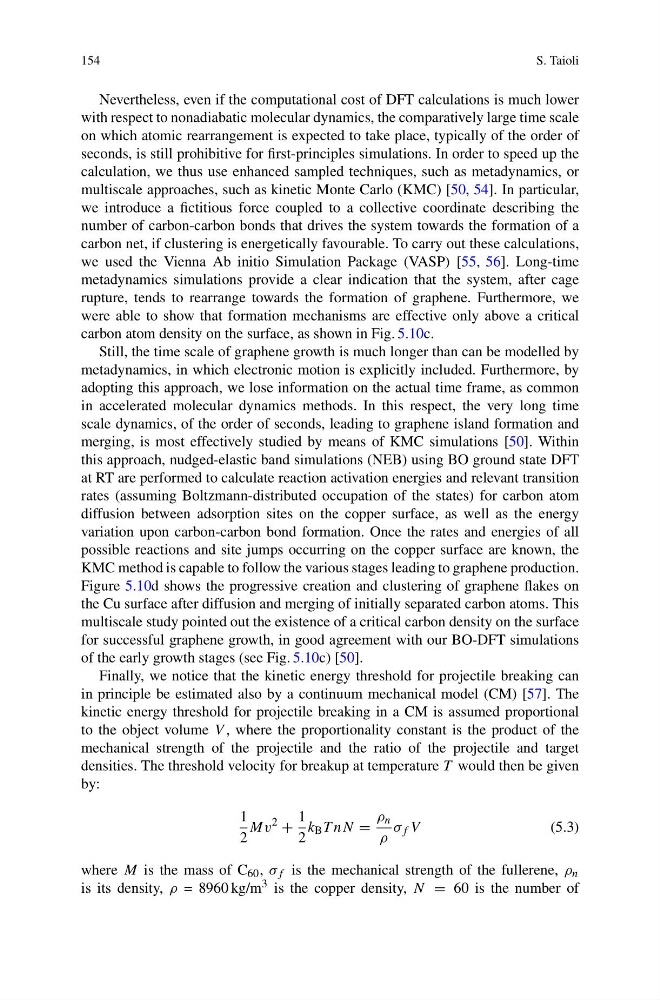
k B T nN =
ρ n
ρ
σ f V
(5.3)
where M is the mass of C 60 , σ f is the mechanical strength of the fullerene, ρ n
is its density, ρ = 8960 kg/m 3 is the copper density, N = 60 is the number of
S. Taioli
Nevertheless, even if the computational cost of DFT calculations is much lower
with respect to nonadiabatic molecular dynamics, the comparatively large time scale
on which atomic rearrangement is expected to take place, typically of the order of
seconds, is still prohibitive for first-principles simulations. In order to speed up the
calculation, we thus use enhanced sampled techniques, such as metadynamics, or
multiscale approaches, such as kinetic Monte Carlo (KMC) [50, 54]. In particular,
we introduce a fictitious force coupled to a collective coordinate describing the
number of carbon-carbon bonds that drives the system towards the formation of a
carbon net, if clustering is energetically favourable. To carry out these calculations,
we used the Vienna Ab initio Simulation Package (VASP) [55, 56]. Long-time
metadynamics simulations provide a clear indication that the system, after cage
rupture, tends to rearrange towards the formation of graphene. Furthermore, we
were able to show that formation mechanisms are effective only above a critical
carbon atom density on the surface, as shown in Fig. 5.10c.
Still, the time scale of graphene growth is much longer than can be modelled by
metadynamics, in which electronic motion is explicitly included. Furthermore, by
adopting this approach, we lose information on the actual time frame, as common
in accelerated molecular dynamics methods. In this respect, the very long time
scale dynamics, of the order of seconds, leading to graphene island formation and
merging, is most effectively studied by means of KMC simulations [50]. Within
this approach, nudged-elastic band simulations (NEB) using BO ground state DFT
at RT are performed to calculate reaction activation energies and relevant transition
rates (assuming Boltzmann-distributed occupation of the states) for carbon atom
diffusion between adsorption sites on the copper surface, as well as the energy
variation upon carbon-carbon bond formation. Once the rates and energies of all
possible reactions and site jumps occurring on the copper surface are known, the
KMC method is capable to follow the various stages leading to graphene production.
Figure 5.10d shows the progressive creation and clustering of graphene flakes on
the Cu surface after diffusion and merging of initially separated carbon atoms. This
multiscale study pointed out the existence of a critical carbon density on the surface
for successful graphene growth, in good agreement with our BO-DFT simulations
of the early growth stages (see Fig. 5.10c) [50].
Finally, we notice that the kinetic energy threshold for projectile breaking can
in principle be estimated also by a continuum mechanical model (CM) [57]. The
kinetic energy threshold for projectile breaking in a CM is assumed proportional
to the object volume V , where the proportionality constant is the product of the
mechanical strength of the projectile and the ratio of the projectile and target
densities. The threshold velocity for breakup at temperature T would then be given
by:
1
2
Mv
2
+
1
2
k B T nN =
ρ n
ρ
σ f V
(5.3)
where M is the mass of C 60 , σ f is the mechanical strength of the fullerene, ρ n
is its density, ρ = 8960 kg/m 3 is the copper density, N = 60 is the number of