

144
S. Taioli
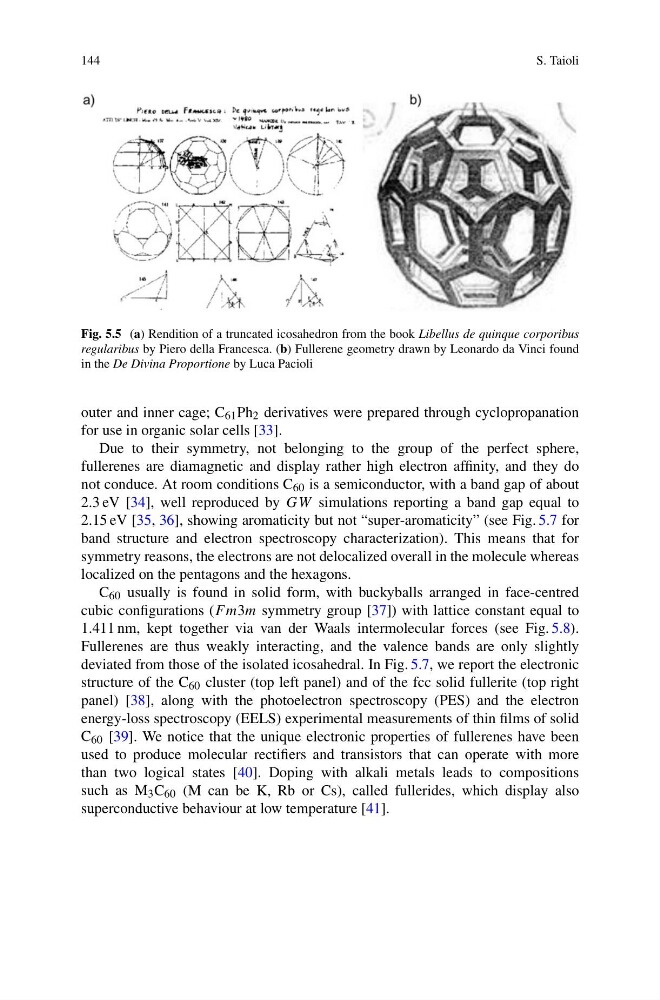
Fig. 5.5 (a) Rendition of a truncated icosahedron from the book Libellus de quinque corporibus
regularibus by Piero della Francesca. (b) Fullerene geometry drawn by Leonardo da Vinci found
in the De Divina Proportione by Luca Pacioli
outer and inner cage; C 61 Ph 2 derivatives were prepared through cyclopropanation
for use in organic solar cells [33].
Due to their symmetry, not belonging to the group of the perfect sphere,
fullerenes are diamagnetic and display rather high electron affinity, and they do
not conduce. At room conditions C 60 is a semiconductor, with a band gap of about
2.3 eV [34], well reproduced by GW simulations reporting a band gap equal to
2.15 eV [35, 36], showing aromaticity but not “super-aromaticity” (see Fig. 5.7 for
band structure and electron spectroscopy characterization). This means that for
symmetry reasons, the electrons are not delocalized overall in the molecule whereas
localized on the pentagons and the hexagons.
C 60 usually is found in solid form, with buckyballs arranged in face-centred
cubic configurations (F m3m symmetry group [37]) with lattice constant equal to
1.411 nm, kept together via van der Waals intermolecular forces (see Fig. 5.8).
Fullerenes are thus weakly interacting, and the valence bands are only slightly
deviated from those of the isolated icosahedral. In Fig. 5.7, we report the electronic
structure of the C 60 cluster (top left panel) and of the fcc solid fullerite (top right
panel) [38], along with the photoelectron spectroscopy (PES) and the electron
energy-loss spectroscopy (EELS) experimental measurements of thin films of solid
C 60 [39]. We notice that the unique electronic properties of fullerenes have been
used to produce molecular rectifiers and transistors that can operate with more
than two logical states [40]. Doping with alkali metals leads to compositions
such as M 3 C 60 (M can be K, Rb or Cs), called fullerides, which display also
superconductive behaviour at low temperature [41].
S. Taioli
Fig. 5.5 (a) Rendition of a truncated icosahedron from the book Libellus de quinque corporibus
regularibus by Piero della Francesca. (b) Fullerene geometry drawn by Leonardo da Vinci found
in the De Divina Proportione by Luca Pacioli
outer and inner cage; C 61 Ph 2 derivatives were prepared through cyclopropanation
for use in organic solar cells [33].
Due to their symmetry, not belonging to the group of the perfect sphere,
fullerenes are diamagnetic and display rather high electron affinity, and they do
not conduce. At room conditions C 60 is a semiconductor, with a band gap of about
2.3 eV [34], well reproduced by GW simulations reporting a band gap equal to
2.15 eV [35, 36], showing aromaticity but not “super-aromaticity” (see Fig. 5.7 for
band structure and electron spectroscopy characterization). This means that for
symmetry reasons, the electrons are not delocalized overall in the molecule whereas
localized on the pentagons and the hexagons.
C 60 usually is found in solid form, with buckyballs arranged in face-centred
cubic configurations (F m3m symmetry group [37]) with lattice constant equal to
1.411 nm, kept together via van der Waals intermolecular forces (see Fig. 5.8).
Fullerenes are thus weakly interacting, and the valence bands are only slightly
deviated from those of the isolated icosahedral. In Fig. 5.7, we report the electronic
structure of the C 60 cluster (top left panel) and of the fcc solid fullerite (top right
panel) [38], along with the photoelectron spectroscopy (PES) and the electron
energy-loss spectroscopy (EELS) experimental measurements of thin films of solid
C 60 [39]. We notice that the unique electronic properties of fullerenes have been
used to produce molecular rectifiers and transistors that can operate with more
than two logical states [40]. Doping with alkali metals leads to compositions
such as M 3 C 60 (M can be K, Rb or Cs), called fullerides, which display also
superconductive behaviour at low temperature [41].