

[27]. Among the various anti-Stokes optical processes, both multiphoton absorption
and upconversion mechanisms have been given much attention in recent years.
Transition metal-doped semiconductor nanoparticles can exhibit high
multiphoton light absorption. In particular, three-photon imaging can effectively
reduce the out-of-focus excitation and background autofluorescence; thus, in a recent
study by Hyeon and coworkers, manganese-doped ZnS QDs (ZnS:Mn QDs) were
developed to exhibit a large three-photon cross section (1.3 (Æ0.5) Â 10
À79 cm
6 s
2
photon
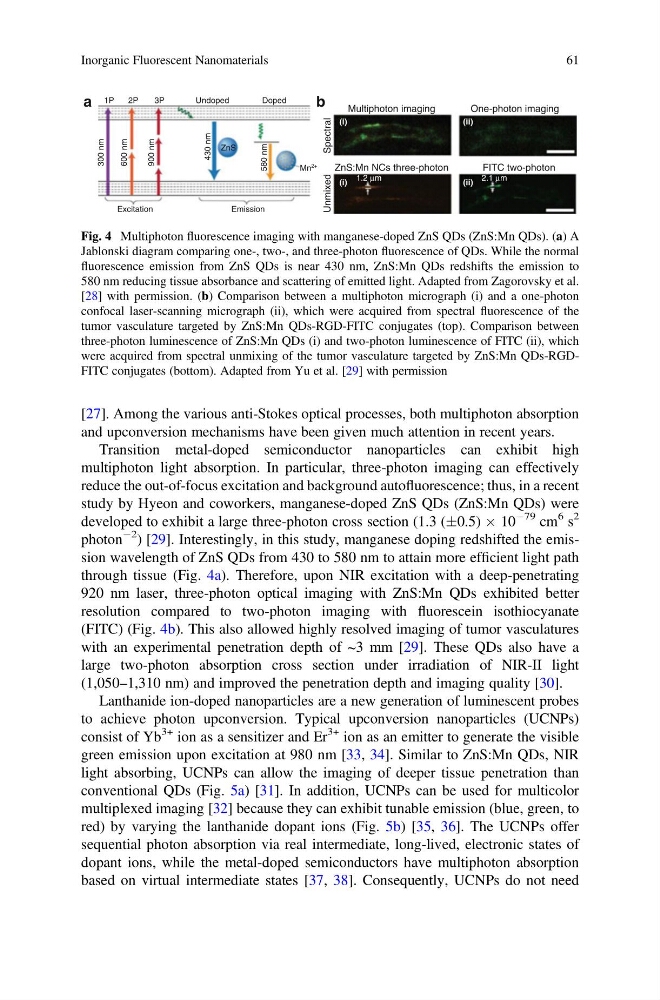
À2 ) [29]. Interestingly, in this study, manganese doping redshifted the emission wavelength of ZnS QDs from 430 to 580 nm to attain more efficient light path
through tissue (Fig. 4a). Therefore, upon NIR excitation with a deep-penetrating
920 nm laser, three-photon optical imaging with ZnS:Mn QDs exhibited better
resolution compared to two-photon imaging with fluorescein isothiocyanate
(FITC) (Fig. 4b). This also allowed highly resolved imaging of tumor vasculatures
with an experimental penetration depth of ~3 mm [29]. These QDs also have a
large two-photon absorption cross section under irradiation of NIR-II light
(1,050–1,310 nm) and improved the penetration depth and imaging quality [30].
Lanthanide ion-doped nanoparticles are a new generation of luminescent probes
to achieve photon upconversion. Typical upconversion nanoparticles (UCNPs)
consist of Yb
3+ ion as a sensitizer and Er
3+ ion as an emitter to generate the visible
green emission upon excitation at 980 nm [33, 34]. Similar to ZnS:Mn QDs, NIR
light absorbing, UCNPs can allow the imaging of deeper tissue penetration than
conventional QDs (Fig. 5a) [31]. In addition, UCNPs can be used for multicolor
multiplexed imaging [32] because they can exhibit tunable emission (blue, green, to
red) by varying the lanthanide dopant ions (Fig. 5b) [35, 36]. The UCNPs offer
sequential photon absorption via real intermediate, long-lived, electronic states of
dopant ions, while the metal-doped semiconductors have multiphoton absorption
based on virtual intermediate states [37, 38]. Consequently, UCNPs do not need
a
b
1P
300 nm
600 nm
900 nm
430 nm
580 nm
2P
3P
Undoped
Excitation
Emission
Multiphoton imaging
ZnS:Mn NCs three-photon
(i)
(i)
(ii)
(ii)
2.1 µm
1.2 µm
FITC two-photon
Unmixed
Spectral
One-photon imaging
ZnS
Mn 2+
Doped
Fig. 4 Multiphoton fluorescence imaging with manganese-doped ZnS QDs (ZnS:Mn QDs). (a) A
Jablonski diagram comparing one-, two-, and three-photon fluorescence of QDs. While the normal
fluorescence emission from ZnS QDs is near 430 nm, ZnS:Mn QDs redshifts the emission to
580 nm reducing tissue absorbance and scattering of emitted light. Adapted from Zagorovsky et al.
[28] with permission. (b) Comparison between a multiphoton micrograph (i) and a one-photon
confocal laser-scanning micrograph (ii), which were acquired from spectral fluorescence of the
tumor vasculature targeted by ZnS:Mn QDs-RGD-FITC conjugates (top). Comparison between
three-photon luminescence of ZnS:Mn QDs (i) and two-photon luminescence of FITC (ii), which
were acquired from spectral unmixing of the tumor vasculature targeted by ZnS:Mn QDs-RGDFITC conjugates (bottom). Adapted from Yu et al. [29] with permission
Inorganic Fluorescent Nanomaterials
61
and upconversion mechanisms have been given much attention in recent years.
Transition metal-doped semiconductor nanoparticles can exhibit high
multiphoton light absorption. In particular, three-photon imaging can effectively
reduce the out-of-focus excitation and background autofluorescence; thus, in a recent
study by Hyeon and coworkers, manganese-doped ZnS QDs (ZnS:Mn QDs) were
developed to exhibit a large three-photon cross section (1.3 (Æ0.5) Â 10
À79 cm
6 s
2
photon
À2 ) [29]. Interestingly, in this study, manganese doping redshifted the emission wavelength of ZnS QDs from 430 to 580 nm to attain more efficient light path
through tissue (Fig. 4a). Therefore, upon NIR excitation with a deep-penetrating
920 nm laser, three-photon optical imaging with ZnS:Mn QDs exhibited better
resolution compared to two-photon imaging with fluorescein isothiocyanate
(FITC) (Fig. 4b). This also allowed highly resolved imaging of tumor vasculatures
with an experimental penetration depth of ~3 mm [29]. These QDs also have a
large two-photon absorption cross section under irradiation of NIR-II light
(1,050–1,310 nm) and improved the penetration depth and imaging quality [30].
Lanthanide ion-doped nanoparticles are a new generation of luminescent probes
to achieve photon upconversion. Typical upconversion nanoparticles (UCNPs)
consist of Yb
3+ ion as a sensitizer and Er
3+ ion as an emitter to generate the visible
green emission upon excitation at 980 nm [33, 34]. Similar to ZnS:Mn QDs, NIR
light absorbing, UCNPs can allow the imaging of deeper tissue penetration than
conventional QDs (Fig. 5a) [31]. In addition, UCNPs can be used for multicolor
multiplexed imaging [32] because they can exhibit tunable emission (blue, green, to
red) by varying the lanthanide dopant ions (Fig. 5b) [35, 36]. The UCNPs offer
sequential photon absorption via real intermediate, long-lived, electronic states of
dopant ions, while the metal-doped semiconductors have multiphoton absorption
based on virtual intermediate states [37, 38]. Consequently, UCNPs do not need
a
b
1P
300 nm
600 nm
900 nm
430 nm
580 nm
2P
3P
Undoped
Excitation
Emission
Multiphoton imaging
ZnS:Mn NCs three-photon
(i)
(i)
(ii)
(ii)
2.1 µm
1.2 µm
FITC two-photon
Unmixed
Spectral
One-photon imaging
ZnS
Mn 2+
Doped
Fig. 4 Multiphoton fluorescence imaging with manganese-doped ZnS QDs (ZnS:Mn QDs). (a) A
Jablonski diagram comparing one-, two-, and three-photon fluorescence of QDs. While the normal
fluorescence emission from ZnS QDs is near 430 nm, ZnS:Mn QDs redshifts the emission to
580 nm reducing tissue absorbance and scattering of emitted light. Adapted from Zagorovsky et al.
[28] with permission. (b) Comparison between a multiphoton micrograph (i) and a one-photon
confocal laser-scanning micrograph (ii), which were acquired from spectral fluorescence of the
tumor vasculature targeted by ZnS:Mn QDs-RGD-FITC conjugates (top). Comparison between
three-photon luminescence of ZnS:Mn QDs (i) and two-photon luminescence of FITC (ii), which
were acquired from spectral unmixing of the tumor vasculature targeted by ZnS:Mn QDs-RGDFITC conjugates (bottom). Adapted from Yu et al. [29] with permission
Inorganic Fluorescent Nanomaterials
61