

at the wavelength of around 830 nm. Thirty-eight patients undergoing surgery were
included and 107 grafts were analyzed. ICG-based SPY system was shown to be
easy to handle with minimal adverse effects.
2.2 5-Aminolevulinic Acid (5-ALA)
5-ALA is a precursor for the heme biosynthesis. After taking up cells, 5-ALA
produces a photoactive protoporphyrin IX (PpIX), which is preferentially accumulated in cancer cells [24–26]. 5-Aminolevulinic acid (5-ALA) has been used for
intraoperative mapping and monitoring the efficiency of complete resection of
enhancing tumor (CRET) and gross total resection (GTR). Schucht et al. have
used 5-ALA-induced fluorescence as guidance during tumor resection. 20 mg/kg
G
H
I
J
A
B
C
D
E
F
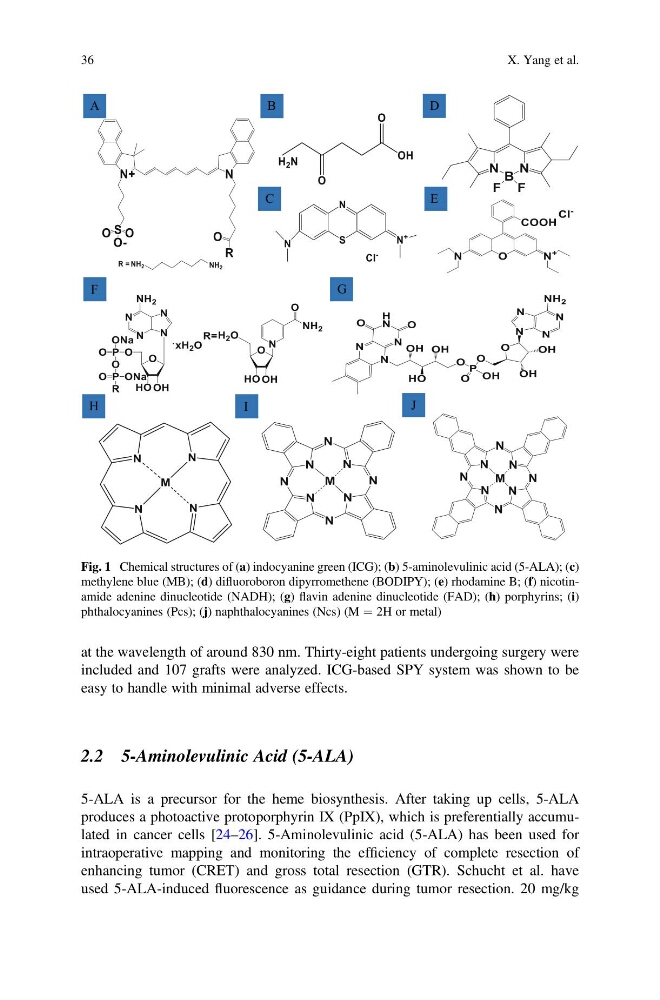
Fig. 1 Chemical structures of (a) indocyanine green (ICG); (b) 5-aminolevulinic acid (5-ALA); (c)
methylene blue (MB); (d) difluoroboron dipyrromethene (BODIPY); (e) rhodamine B; (f) nicotinamide adenine dinucleotide (NADH); (g) flavin adenine dinucleotide (FAD); (h) porphyrins; (i)
phthalocyanines (Pcs); (j) naphthalocyanines (Ncs) (M ¼ 2H or metal)
36
X. Yang et al.
included and 107 grafts were analyzed. ICG-based SPY system was shown to be
easy to handle with minimal adverse effects.
2.2 5-Aminolevulinic Acid (5-ALA)
5-ALA is a precursor for the heme biosynthesis. After taking up cells, 5-ALA
produces a photoactive protoporphyrin IX (PpIX), which is preferentially accumulated in cancer cells [24–26]. 5-Aminolevulinic acid (5-ALA) has been used for
intraoperative mapping and monitoring the efficiency of complete resection of
enhancing tumor (CRET) and gross total resection (GTR). Schucht et al. have
used 5-ALA-induced fluorescence as guidance during tumor resection. 20 mg/kg
G
H
I
J
A
B
C
D
E
F
Fig. 1 Chemical structures of (a) indocyanine green (ICG); (b) 5-aminolevulinic acid (5-ALA); (c)
methylene blue (MB); (d) difluoroboron dipyrromethene (BODIPY); (e) rhodamine B; (f) nicotinamide adenine dinucleotide (NADH); (g) flavin adenine dinucleotide (FAD); (h) porphyrins; (i)
phthalocyanines (Pcs); (j) naphthalocyanines (Ncs) (M ¼ 2H or metal)
36
X. Yang et al.