

scission, hypoxia-induced activation, enzymatic reactions, photolysis, and
thermolysis [113]. Targeting ligands include folate, biotin, galactose, and RGD
(Arg-Gly-Asp) peptide sequences. Doxorubicin, camptothecin, paclitaxel,
gemcitabine, and cisplatin are commonly used chemotherapeutic agents. To date,
much effort has been devoted to develop systems that undergo cleavage under
physiological conditions. When the cleavable linkers serve to tether a fluorophore
to a prodrug in such a way that the fluorescence signal can be controlled upon
cleavage, it becomes a potential system that operates as both therapeutics and
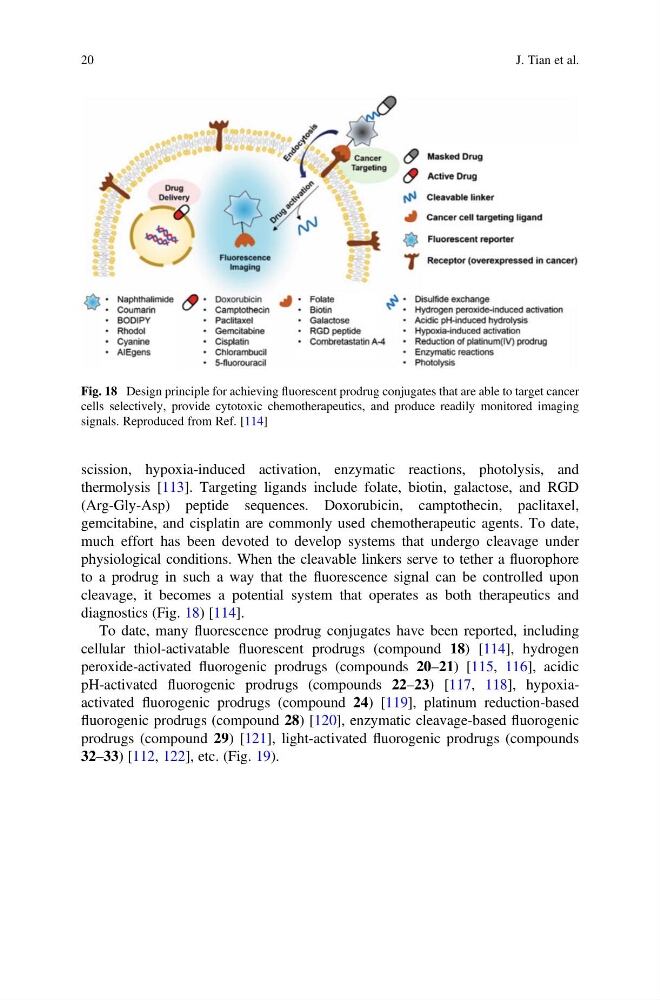
diagnostics (Fig. 18) [114].
To date, many fluorescence prodrug conjugates have been reported, including
cellular thiol-activatable fluorescent prodrugs (compound 18) [114], hydrogen
peroxide-activated fluorogenic prodrugs (compounds 20–21) [115, 116], acidic
pH-activated fluorogenic prodrugs (compounds 22–23) [117, 118], hypoxiaactivated fluorogenic prodrugs (compound 24) [119], platinum reduction-based
fluorogenic prodrugs (compound 28) [120], enzymatic cleavage-based fluorogenic
prodrugs (compound 29) [121], light-activated fluorogenic prodrugs (compounds
32–33) [112, 122], etc. (Fig. 19).
Fig. 18 Design principle for achieving fluorescent prodrug conjugates that are able to target cancer
cells selectively, provide cytotoxic chemotherapeutics, and produce readily monitored imaging
signals. Reproduced from Ref. [114]
20
J. Tian et al.
thermolysis [113]. Targeting ligands include folate, biotin, galactose, and RGD
(Arg-Gly-Asp) peptide sequences. Doxorubicin, camptothecin, paclitaxel,
gemcitabine, and cisplatin are commonly used chemotherapeutic agents. To date,
much effort has been devoted to develop systems that undergo cleavage under
physiological conditions. When the cleavable linkers serve to tether a fluorophore
to a prodrug in such a way that the fluorescence signal can be controlled upon
cleavage, it becomes a potential system that operates as both therapeutics and
diagnostics (Fig. 18) [114].
To date, many fluorescence prodrug conjugates have been reported, including
cellular thiol-activatable fluorescent prodrugs (compound 18) [114], hydrogen
peroxide-activated fluorogenic prodrugs (compounds 20–21) [115, 116], acidic
pH-activated fluorogenic prodrugs (compounds 22–23) [117, 118], hypoxiaactivated fluorogenic prodrugs (compound 24) [119], platinum reduction-based
fluorogenic prodrugs (compound 28) [120], enzymatic cleavage-based fluorogenic
prodrugs (compound 29) [121], light-activated fluorogenic prodrugs (compounds
32–33) [112, 122], etc. (Fig. 19).
Fig. 18 Design principle for achieving fluorescent prodrug conjugates that are able to target cancer
cells selectively, provide cytotoxic chemotherapeutics, and produce readily monitored imaging
signals. Reproduced from Ref. [114]
20
J. Tian et al.