

of β-gal, and some studies related to the nanomaterials for β-gal detection have also
been reported.
3.1 Thiolated Copper Nanoclusters (CuNCs) and Silica
Nanoclusters
Huang et al. [30] used glutathione (GSH) as the protecting ligand and reducing agent
to successfully synthesize thiolate-protected copper nanoclusters (CuNCs) with
aggregation-induced luminescence, which can self-assemble into dots by aluminum
cations via a coordination reaction and then emit bright red luminescence. CuNCs
are one of the most emerging luminescent materials because of their AIE properties
[31–33] and long decay times in microseconds. And unlike organic AIE dots,
thiolated CuNCs are better at avoiding the interference of autofluorescence in
biosystems for their long emission times and red/NIR emission. However, the
extremely low emission efficiency in neutral solution and poor stability to temperature, pH, and solvent greatly limit its application. Therefore, Chen et al. [34]
utilized glutathione as a protector for CuNCs allowing their good stability in not
only neutral but also weak alkaline solutions, which enabled their practicability
under physiological conditions. And aluminum cations were found to be able to
induce the dispersed CuNCs’ (only emit very faint light) assembly into red bright
luminescent dots quite effectively in water, which was probably due to the strong
coordination of aluminum ions to GSH on the surface of the CuNCs. And the
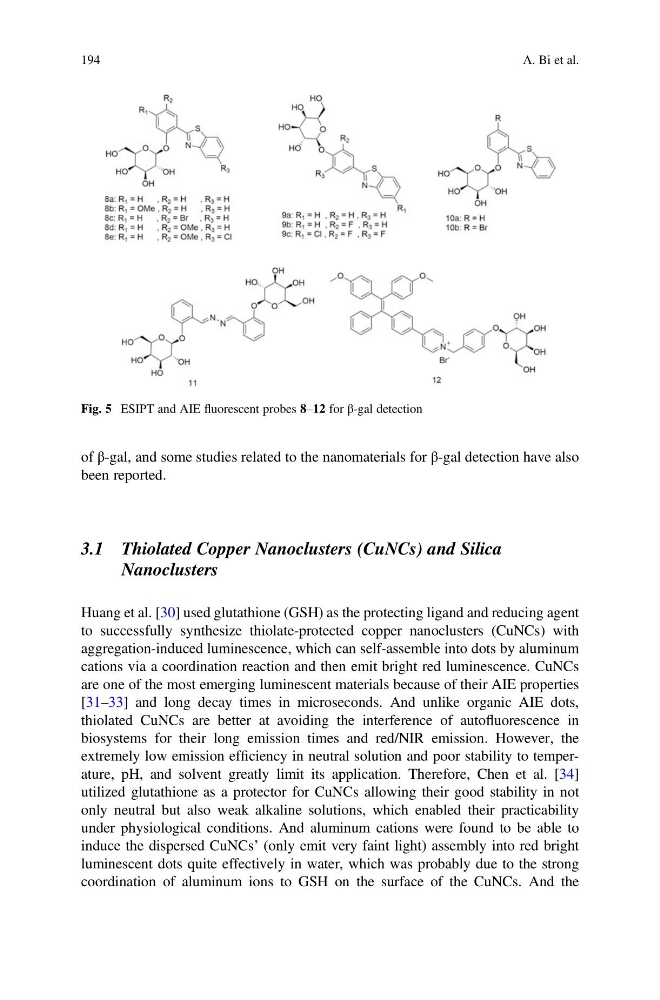
Fig. 5 ESIPT and AIE fluorescent probes 8–12 for β-gal detection
194
A. Bi et al.
been reported.
3.1 Thiolated Copper Nanoclusters (CuNCs) and Silica
Nanoclusters
Huang et al. [30] used glutathione (GSH) as the protecting ligand and reducing agent
to successfully synthesize thiolate-protected copper nanoclusters (CuNCs) with
aggregation-induced luminescence, which can self-assemble into dots by aluminum
cations via a coordination reaction and then emit bright red luminescence. CuNCs
are one of the most emerging luminescent materials because of their AIE properties
[31–33] and long decay times in microseconds. And unlike organic AIE dots,
thiolated CuNCs are better at avoiding the interference of autofluorescence in
biosystems for their long emission times and red/NIR emission. However, the
extremely low emission efficiency in neutral solution and poor stability to temperature, pH, and solvent greatly limit its application. Therefore, Chen et al. [34]
utilized glutathione as a protector for CuNCs allowing their good stability in not
only neutral but also weak alkaline solutions, which enabled their practicability
under physiological conditions. And aluminum cations were found to be able to
induce the dispersed CuNCs’ (only emit very faint light) assembly into red bright
luminescent dots quite effectively in water, which was probably due to the strong
coordination of aluminum ions to GSH on the surface of the CuNCs. And the
Fig. 5 ESIPT and AIE fluorescent probes 8–12 for β-gal detection
194
A. Bi et al.