

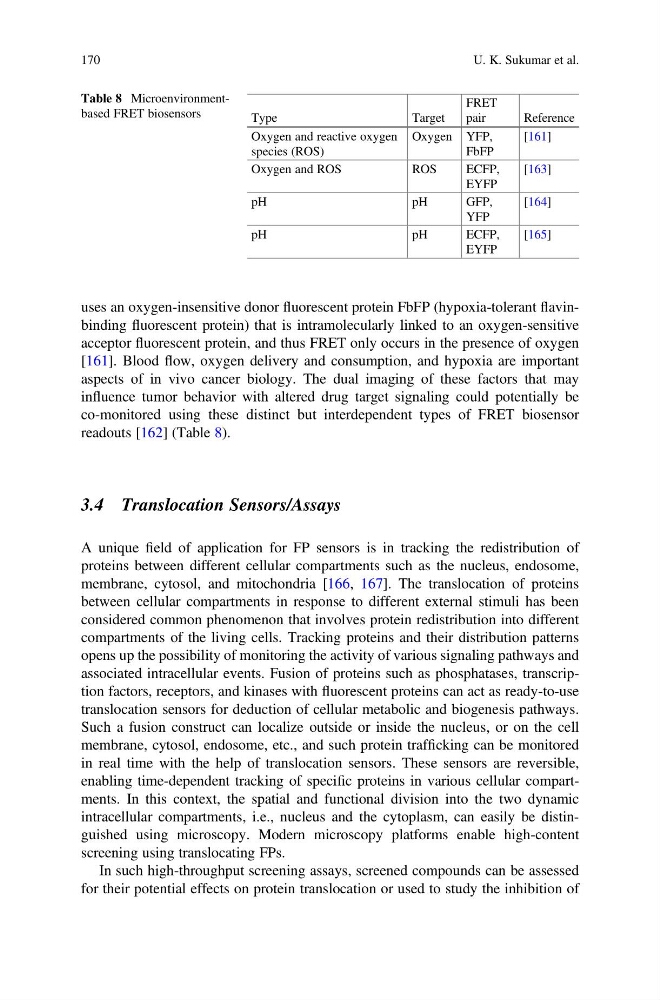
uses an oxygen-insensitive donor fluorescent protein FbFP (hypoxia-tolerant flavinbinding fluorescent protein) that is intramolecularly linked to an oxygen-sensitive
acceptor fluorescent protein, and thus FRET only occurs in the presence of oxygen
[161]. Blood flow, oxygen delivery and consumption, and hypoxia are important
aspects of in vivo cancer biology. The dual imaging of these factors that may
influence tumor behavior with altered drug target signaling could potentially be
co-monitored using these distinct but interdependent types of FRET biosensor
readouts [162] (Table 8).
3.4 Translocation Sensors/Assays
A unique field of application for FP sensors is in tracking the redistribution of
proteins between different cellular compartments such as the nucleus, endosome,
membrane, cytosol, and mitochondria [166, 167]. The translocation of proteins
between cellular compartments in response to different external stimuli has been
considered common phenomenon that involves protein redistribution into different
compartments of the living cells. Tracking proteins and their distribution patterns
opens up the possibility of monitoring the activity of various signaling pathways and
associated intracellular events. Fusion of proteins such as phosphatases, transcription factors, receptors, and kinases with fluorescent proteins can act as ready-to-use
translocation sensors for deduction of cellular metabolic and biogenesis pathways.
Such a fusion construct can localize outside or inside the nucleus, or on the cell
membrane, cytosol, endosome, etc., and such protein trafficking can be monitored
in real time with the help of translocation sensors. These sensors are reversible,
enabling time-dependent tracking of specific proteins in various cellular compartments. In this context, the spatial and functional division into the two dynamic
intracellular compartments, i.e., nucleus and the cytoplasm, can easily be distinguished using microscopy. Modern microscopy platforms enable high-content
screening using translocating FPs.
In such high-throughput screening assays, screened compounds can be assessed
for their potential effects on protein translocation or used to study the inhibition of
Table 8 Microenvironmentbased FRET biosensors
Type
Target
FRET
pair
Reference
Oxygen and reactive oxygen
species (ROS)
Oxygen YFP,
FbFP
[161]
Oxygen and ROS
ROS
ECFP,
EYFP
[163]
pH
pH
GFP,
YFP
[164]
pH
pH
ECFP,
EYFP
[165]
170
U. K. Sukumar et al.
acceptor fluorescent protein, and thus FRET only occurs in the presence of oxygen
[161]. Blood flow, oxygen delivery and consumption, and hypoxia are important
aspects of in vivo cancer biology. The dual imaging of these factors that may
influence tumor behavior with altered drug target signaling could potentially be
co-monitored using these distinct but interdependent types of FRET biosensor
readouts [162] (Table 8).
3.4 Translocation Sensors/Assays
A unique field of application for FP sensors is in tracking the redistribution of
proteins between different cellular compartments such as the nucleus, endosome,
membrane, cytosol, and mitochondria [166, 167]. The translocation of proteins
between cellular compartments in response to different external stimuli has been
considered common phenomenon that involves protein redistribution into different
compartments of the living cells. Tracking proteins and their distribution patterns
opens up the possibility of monitoring the activity of various signaling pathways and
associated intracellular events. Fusion of proteins such as phosphatases, transcription factors, receptors, and kinases with fluorescent proteins can act as ready-to-use
translocation sensors for deduction of cellular metabolic and biogenesis pathways.
Such a fusion construct can localize outside or inside the nucleus, or on the cell
membrane, cytosol, endosome, etc., and such protein trafficking can be monitored
in real time with the help of translocation sensors. These sensors are reversible,
enabling time-dependent tracking of specific proteins in various cellular compartments. In this context, the spatial and functional division into the two dynamic
intracellular compartments, i.e., nucleus and the cytoplasm, can easily be distinguished using microscopy. Modern microscopy platforms enable high-content
screening using translocating FPs.
In such high-throughput screening assays, screened compounds can be assessed
for their potential effects on protein translocation or used to study the inhibition of
Table 8 Microenvironmentbased FRET biosensors
Type
Target
FRET
pair
Reference
Oxygen and reactive oxygen
species (ROS)
Oxygen YFP,
FbFP
[161]
Oxygen and ROS
ROS
ECFP,
EYFP
[163]
pH
pH
GFP,
YFP
[164]
pH
pH
ECFP,
EYFP
[165]
170
U. K. Sukumar et al.