

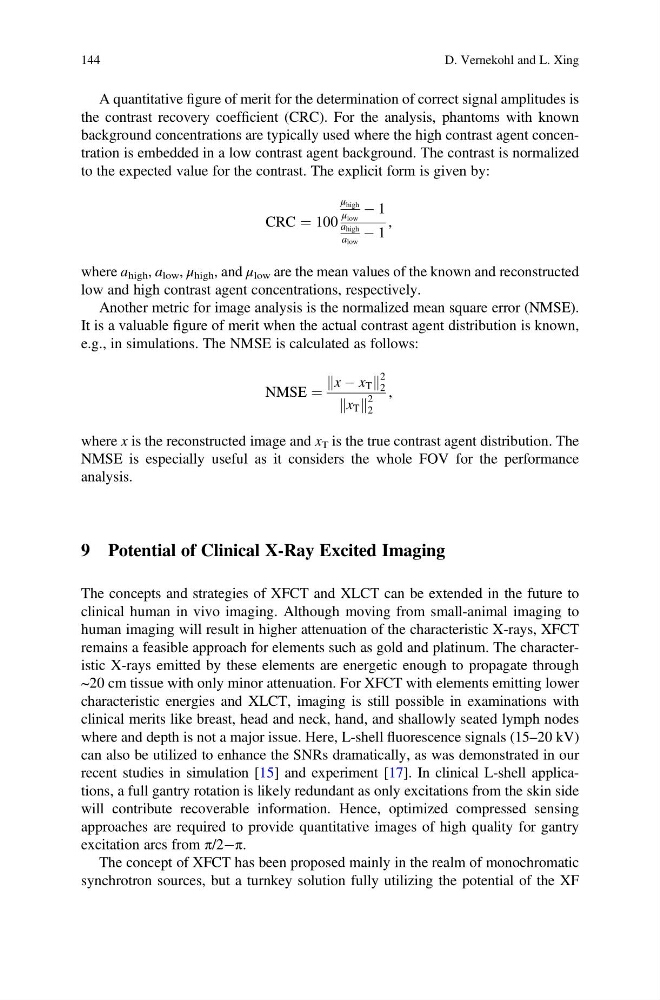
A quantitative figure of merit for the determination of correct signal amplitudes is
the contrast recovery coefficient (CRC). For the analysis, phantoms with known
background concentrations are typically used where the high contrast agent concentration is embedded in a low contrast agent background. The contrast is normalized
to the expected value for the contrast. The explicit form is given by:
CRC ¼ 100
μ high
μ low
À 1
a high
a low
À 1
,
where a high , a low , μ high , and μ low are the mean values of the known and reconstructed
low and high contrast agent concentrations, respectively.
Another metric for image analysis is the normalized mean square error (NMSE).
It is a valuable figure of merit when the actual contrast agent distribution is known,
e.g., in simulations. The NMSE is calculated as follows:
NMSE ¼
x À x T
k
k
2
2
x T
k k
2
2
,
where x is the reconstructed image and x T is the true contrast agent distribution. The
NMSE is especially useful as it considers the whole FOV for the performance
analysis.
9 Potential of Clinical X-Ray Excited Imaging
The concepts and strategies of XFCT and XLCT can be extended in the future to
clinical human in vivo imaging. Although moving from small-animal imaging to
human imaging will result in higher attenuation of the characteristic X-rays, XFCT
remains a feasible approach for elements such as gold and platinum. The characteristic X-rays emitted by these elements are energetic enough to propagate through
~20 cm tissue with only minor attenuation. For XFCT with elements emitting lower
characteristic energies and XLCT, imaging is still possible in examinations with
clinical merits like breast, head and neck, hand, and shallowly seated lymph nodes
where and depth is not a major issue. Here, L-shell fluorescence signals (15–20 kV)
can also be utilized to enhance the SNRs dramatically, as was demonstrated in our
recent studies in simulation [15] and experiment [17]. In clinical L-shell applications, a full gantry rotation is likely redundant as only excitations from the skin side
will contribute recoverable information. Hence, optimized compressed sensing
approaches are required to provide quantitative images of high quality for gantry
excitation arcs from π/2Àπ.
The concept of XFCT has been proposed mainly in the realm of monochromatic
synchrotron sources, but a turnkey solution fully utilizing the potential of the XF
144
D. Vernekohl and L. Xing
the contrast recovery coefficient (CRC). For the analysis, phantoms with known
background concentrations are typically used where the high contrast agent concentration is embedded in a low contrast agent background. The contrast is normalized
to the expected value for the contrast. The explicit form is given by:
CRC ¼ 100
μ high
μ low
À 1
a high
a low
À 1
,
where a high , a low , μ high , and μ low are the mean values of the known and reconstructed
low and high contrast agent concentrations, respectively.
Another metric for image analysis is the normalized mean square error (NMSE).
It is a valuable figure of merit when the actual contrast agent distribution is known,
e.g., in simulations. The NMSE is calculated as follows:
NMSE ¼
x À x T
k
k
2
2
x T
k k
2
2
,
where x is the reconstructed image and x T is the true contrast agent distribution. The
NMSE is especially useful as it considers the whole FOV for the performance
analysis.
9 Potential of Clinical X-Ray Excited Imaging
The concepts and strategies of XFCT and XLCT can be extended in the future to
clinical human in vivo imaging. Although moving from small-animal imaging to
human imaging will result in higher attenuation of the characteristic X-rays, XFCT
remains a feasible approach for elements such as gold and platinum. The characteristic X-rays emitted by these elements are energetic enough to propagate through
~20 cm tissue with only minor attenuation. For XFCT with elements emitting lower
characteristic energies and XLCT, imaging is still possible in examinations with
clinical merits like breast, head and neck, hand, and shallowly seated lymph nodes
where and depth is not a major issue. Here, L-shell fluorescence signals (15–20 kV)
can also be utilized to enhance the SNRs dramatically, as was demonstrated in our
recent studies in simulation [15] and experiment [17]. In clinical L-shell applications, a full gantry rotation is likely redundant as only excitations from the skin side
will contribute recoverable information. Hence, optimized compressed sensing
approaches are required to provide quantitative images of high quality for gantry
excitation arcs from π/2Àπ.
The concept of XFCT has been proposed mainly in the realm of monochromatic
synchrotron sources, but a turnkey solution fully utilizing the potential of the XF
144
D. Vernekohl and L. Xing