

The carbon rods act as electrodes which are kept at different potentials. The anode is
moved close to the cathode until an arc appears, and the electrodes are kept at the
distance of 1 mm for the whole duration of the process that takes about 1 min. After
the de-pressure and cooling of the chamber, the nanotubes can be collected. The
synthesis product yield is up to 60%. In 1995 Richard E. Smalley and his group used
laser ablation method to grow high-quality SWCNTs [84]. During the process,
intense laser pulses ablate a carbon target is heated to 1,200
C. Inert gas flow in
the chamber will carry the grown nanotubes to the copper collector. After cooling of
the chamber, the nanotubes and the by-products, like fullerenes and amorphous
carbon overcoating on the sidewalls of nanotubes, can be collected. In 1999 Richard
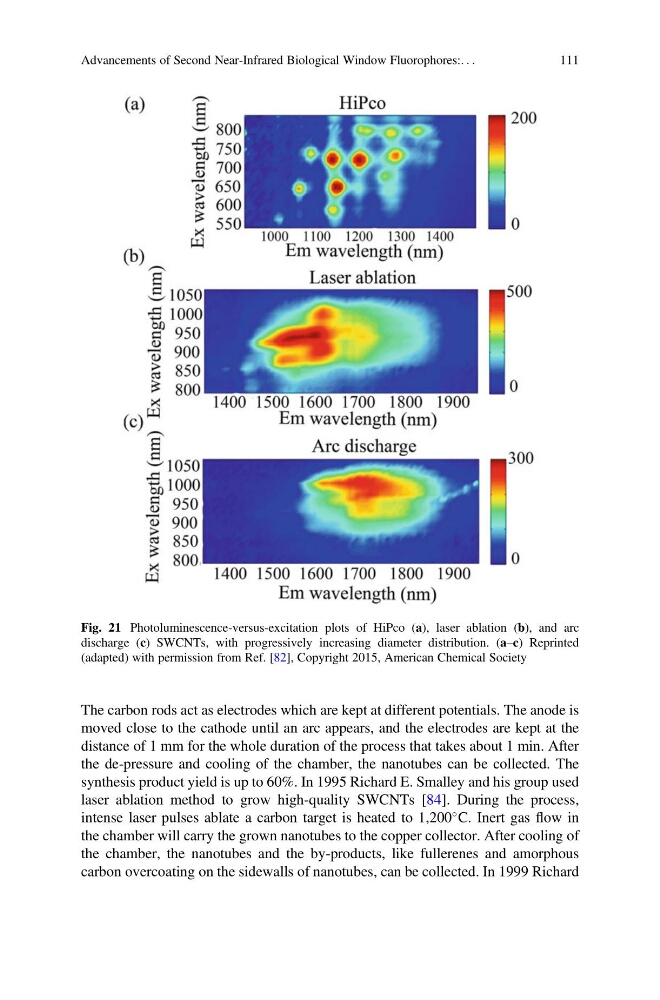
Fig. 21 Photoluminescence-versus-excitation plots of HiPco (a), laser ablation (b), and arc
discharge (c) SWCNTs, with progressively increasing diameter distribution. (a–c) Reprinted
(adapted) with permission from Ref. [82], Copyright 2015, American Chemical Society
Advancements of Second Near-Infrared Biological Window Fluorophores:. . .
111
moved close to the cathode until an arc appears, and the electrodes are kept at the
distance of 1 mm for the whole duration of the process that takes about 1 min. After
the de-pressure and cooling of the chamber, the nanotubes can be collected. The
synthesis product yield is up to 60%. In 1995 Richard E. Smalley and his group used
laser ablation method to grow high-quality SWCNTs [84]. During the process,
intense laser pulses ablate a carbon target is heated to 1,200
C. Inert gas flow in
the chamber will carry the grown nanotubes to the copper collector. After cooling of
the chamber, the nanotubes and the by-products, like fullerenes and amorphous
carbon overcoating on the sidewalls of nanotubes, can be collected. In 1999 Richard
Fig. 21 Photoluminescence-versus-excitation plots of HiPco (a), laser ablation (b), and arc
discharge (c) SWCNTs, with progressively increasing diameter distribution. (a–c) Reprinted
(adapted) with permission from Ref. [82], Copyright 2015, American Chemical Society
Advancements of Second Near-Infrared Biological Window Fluorophores:. . .
111