

5.2 Synthesis Strategy
Photoluminescence wavelengths of SWCNTs depend on the diameter of SWCNTs,
which lie on the synthetic routes such as the ranges of 900–1,400 nm for highpressure CO (HP co) decomposed SWCNTs (Fig. 21a), 1,500–1,700 nm for laser
ablation SWCNTs (Fig. 21b), and 1,600–1,900 nm for arc discharge SWCNTs
(Fig. 21c) [82].
Briefly, the arc discharge method was firstly used in synthesis of SWCNTs by
Sumio Iijima in 1991 [83]. In this process, two graphite rods are placed in an
enclosure that is filled with inert gas at low pressure (between 50 and 700 mbar).
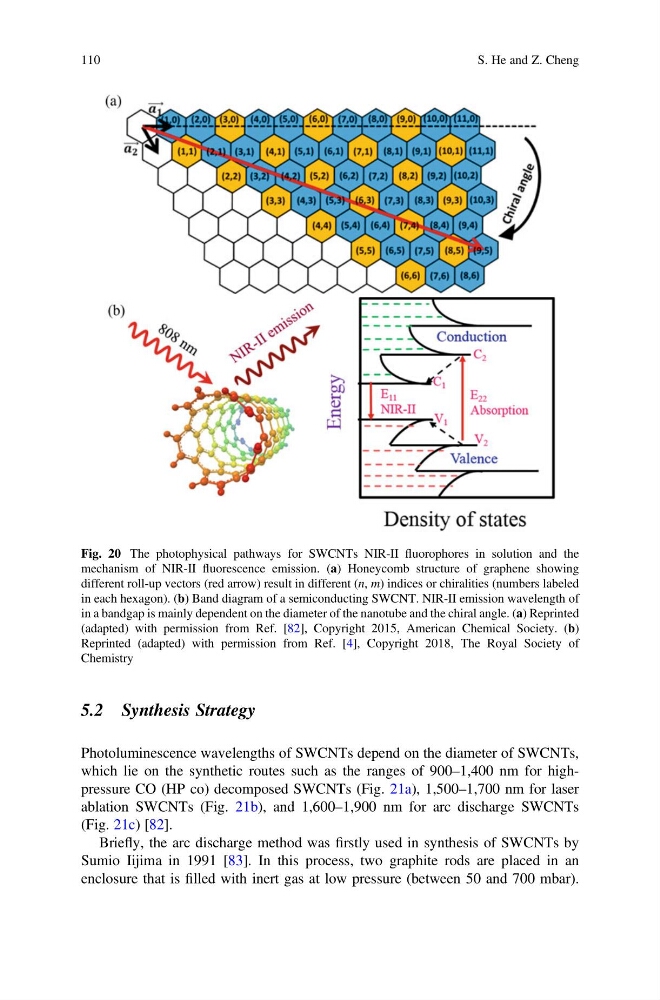
Fig. 20 The photophysical pathways for SWCNTs NIR-II fluorophores in solution and the
mechanism of NIR-II fluorescence emission. (a) Honeycomb structure of graphene showing
different roll-up vectors (red arrow) result in different (n, m) indices or chiralities (numbers labeled
in each hexagon). (b) Band diagram of a semiconducting SWCNT. NIR-II emission wavelength of
in a bandgap is mainly dependent on the diameter of the nanotube and the chiral angle. (a) Reprinted
(adapted) with permission from Ref. [82], Copyright 2015, American Chemical Society. (b)
Reprinted (adapted) with permission from Ref. [4], Copyright 2018, The Royal Society of
Chemistry
110
S. He and Z. Cheng
Photoluminescence wavelengths of SWCNTs depend on the diameter of SWCNTs,
which lie on the synthetic routes such as the ranges of 900–1,400 nm for highpressure CO (HP co) decomposed SWCNTs (Fig. 21a), 1,500–1,700 nm for laser
ablation SWCNTs (Fig. 21b), and 1,600–1,900 nm for arc discharge SWCNTs
(Fig. 21c) [82].
Briefly, the arc discharge method was firstly used in synthesis of SWCNTs by
Sumio Iijima in 1991 [83]. In this process, two graphite rods are placed in an
enclosure that is filled with inert gas at low pressure (between 50 and 700 mbar).
Fig. 20 The photophysical pathways for SWCNTs NIR-II fluorophores in solution and the
mechanism of NIR-II fluorescence emission. (a) Honeycomb structure of graphene showing
different roll-up vectors (red arrow) result in different (n, m) indices or chiralities (numbers labeled
in each hexagon). (b) Band diagram of a semiconducting SWCNT. NIR-II emission wavelength of
in a bandgap is mainly dependent on the diameter of the nanotube and the chiral angle. (a) Reprinted
(adapted) with permission from Ref. [82], Copyright 2015, American Chemical Society. (b)
Reprinted (adapted) with permission from Ref. [4], Copyright 2018, The Royal Society of
Chemistry
110
S. He and Z. Cheng