

Fig. 15
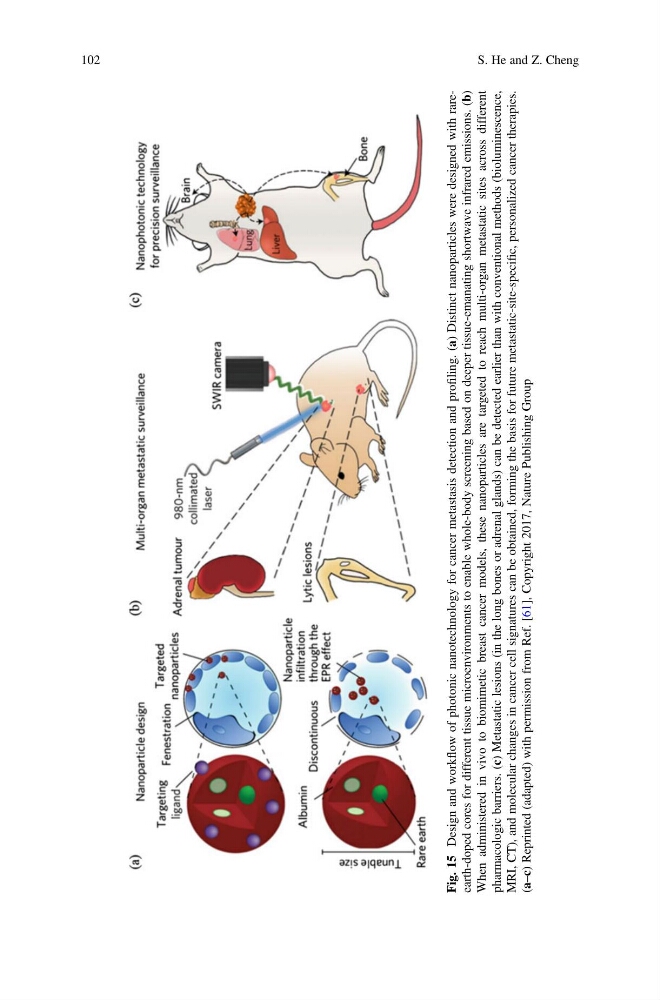
Design and workflow of photonic nanotechnology for cancer metastasis detection and profiling. (a) Distinct nanoparticles were designed with rareearth-doped cores for different tissue microenvironments to enable whole-body screening based on deeper tissue-emanating shortwave infrared emissions. (b)
When administered in vivo to biomimetic breast cancer models, these nanoparticles are targeted to reach multi-organ metastatic sites across different
pharmacologic barriers. (c) Metastatic lesions (in the long bones or adrenal glands) can be detected earlier than with conventional methods (bioluminescence,
MRI, CT), and molecular changes in cancer cell signatures can be obtained, forming the basis for future metastatic-site-specific, personalized cancer therapies.
(a–c) Reprinted (adapted) with permission from Ref. [61], Copyright 2017, Nature Publishing Group
102
S. He and Z. Cheng
Design and workflow of photonic nanotechnology for cancer metastasis detection and profiling. (a) Distinct nanoparticles were designed with rareearth-doped cores for different tissue microenvironments to enable whole-body screening based on deeper tissue-emanating shortwave infrared emissions. (b)
When administered in vivo to biomimetic breast cancer models, these nanoparticles are targeted to reach multi-organ metastatic sites across different
pharmacologic barriers. (c) Metastatic lesions (in the long bones or adrenal glands) can be detected earlier than with conventional methods (bioluminescence,
MRI, CT), and molecular changes in cancer cell signatures can be obtained, forming the basis for future metastatic-site-specific, personalized cancer therapies.
(a–c) Reprinted (adapted) with permission from Ref. [61], Copyright 2017, Nature Publishing Group
102
S. He and Z. Cheng