

the responsible disposal and recycling of their products (koushal et al. 2014). In
order to reduce this pressure, recycling rate should be increased by 20%, as a result
of which If the recycling rate becomes 20%, means 150 million tonnes of the plastic
is going to the landfill (Fitch et al. 2012).
Today the use of the plastics has increased to a great extent and thus it contribute
maximum to the municipal waste problem. In order to decrease this production, the
biodegradability of the plastics should be improved by the use of the nanotechnology. For example, (1) Nanocomposites are used as the improved biodegradable
plastic wrap for food (Zhao et al. 2008) and this leads to cause a reduction in waste
measures. (2) Scandium which is produced from the waste soot is reused again and
again for the nanomaterial synthesis process (Wynne et al. 2008). (3) By recycling
process, some metal ion wastes are converted into nanoparticles with the help of
some plants (Chefetz et al. 2005).
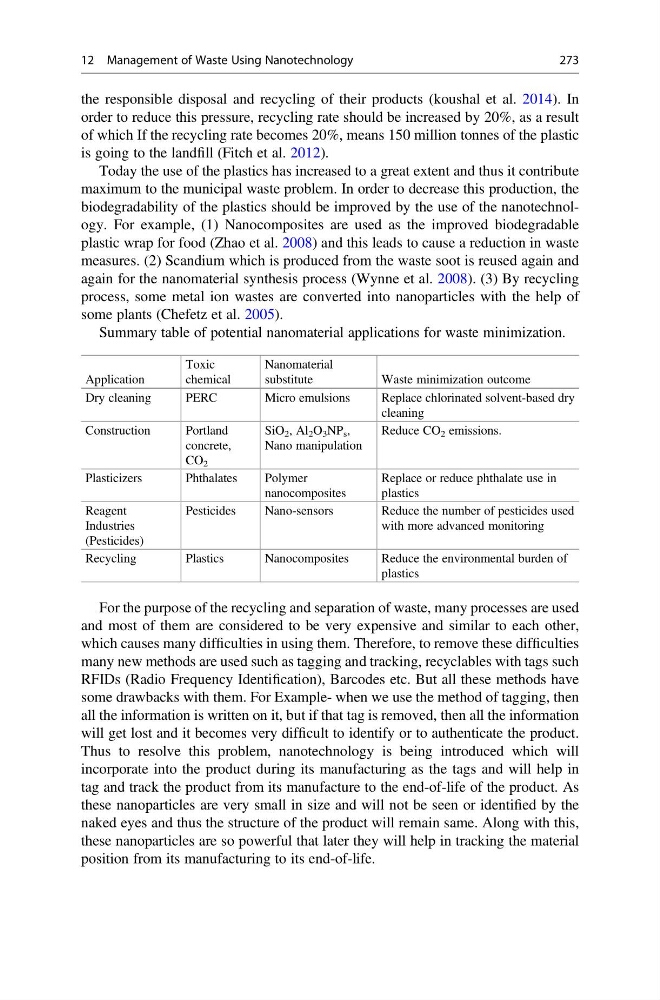
Summary table of potential nanomaterial applications for waste minimization.
Application
Toxic
chemical
Nanomaterial
substitute
Waste minimization outcome
Dry cleaning
PERC
Micro emulsions
Replace chlorinated solvent-based dry
cleaning
Construction
Portland
concrete,
CO 2
SiO 2 , Al 2 O 3 NP s ,
Nano manipulation
Reduce CO 2 emissions.
Plasticizers
Phthalates
Polymer
nanocomposites
Replace or reduce phthalate use in
plastics
Reagent
Industries
(Pesticides)
Pesticides
Nano-sensors
Reduce the number of pesticides used
with more advanced monitoring
Recycling
Plastics
Nanocomposites
Reduce the environmental burden of
plastics
For the purpose of the recycling and separation of waste, many processes are used
and most of them are considered to be very expensive and similar to each other,
which causes many difficulties in using them. Therefore, to remove these difficulties
many new methods are used such as tagging and tracking, recyclables with tags such
RFIDs (Radio Frequency Identification), Barcodes etc. But all these methods have
some drawbacks with them. For Example- when we use the method of tagging, then
all the information is written on it, but if that tag is removed, then all the information
will get lost and it becomes very difficult to identify or to authenticate the product.
Thus to resolve this problem, nanotechnology is being introduced which will
incorporate into the product during its manufacturing as the tags and will help in
tag and track the product from its manufacture to the end-of-life of the product. As
these nanoparticles are very small in size and will not be seen or identified by the
naked eyes and thus the structure of the product will remain same. Along with this,
these nanoparticles are so powerful that later they will help in tracking the material
position from its manufacturing to its end-of-life.
12 Management of Waste Using Nanotechnology
273
order to reduce this pressure, recycling rate should be increased by 20%, as a result
of which If the recycling rate becomes 20%, means 150 million tonnes of the plastic
is going to the landfill (Fitch et al. 2012).
Today the use of the plastics has increased to a great extent and thus it contribute
maximum to the municipal waste problem. In order to decrease this production, the
biodegradability of the plastics should be improved by the use of the nanotechnology. For example, (1) Nanocomposites are used as the improved biodegradable
plastic wrap for food (Zhao et al. 2008) and this leads to cause a reduction in waste
measures. (2) Scandium which is produced from the waste soot is reused again and
again for the nanomaterial synthesis process (Wynne et al. 2008). (3) By recycling
process, some metal ion wastes are converted into nanoparticles with the help of
some plants (Chefetz et al. 2005).
Summary table of potential nanomaterial applications for waste minimization.
Application
Toxic
chemical
Nanomaterial
substitute
Waste minimization outcome
Dry cleaning
PERC
Micro emulsions
Replace chlorinated solvent-based dry
cleaning
Construction
Portland
concrete,
CO 2
SiO 2 , Al 2 O 3 NP s ,
Nano manipulation
Reduce CO 2 emissions.
Plasticizers
Phthalates
Polymer
nanocomposites
Replace or reduce phthalate use in
plastics
Reagent
Industries
(Pesticides)
Pesticides
Nano-sensors
Reduce the number of pesticides used
with more advanced monitoring
Recycling
Plastics
Nanocomposites
Reduce the environmental burden of
plastics
For the purpose of the recycling and separation of waste, many processes are used
and most of them are considered to be very expensive and similar to each other,
which causes many difficulties in using them. Therefore, to remove these difficulties
many new methods are used such as tagging and tracking, recyclables with tags such
RFIDs (Radio Frequency Identification), Barcodes etc. But all these methods have
some drawbacks with them. For Example- when we use the method of tagging, then
all the information is written on it, but if that tag is removed, then all the information
will get lost and it becomes very difficult to identify or to authenticate the product.
Thus to resolve this problem, nanotechnology is being introduced which will
incorporate into the product during its manufacturing as the tags and will help in
tag and track the product from its manufacture to the end-of-life of the product. As
these nanoparticles are very small in size and will not be seen or identified by the
naked eyes and thus the structure of the product will remain same. Along with this,
these nanoparticles are so powerful that later they will help in tracking the material
position from its manufacturing to its end-of-life.
12 Management of Waste Using Nanotechnology
273