

12.3 Various Characteristics of Nanosystems
12.3.1 Approaches in Nanotechnology
Two main approaches are used to synthesize nanoparticles (Saif et al. 2016) referred
to as the:
(a) Top ! Down.
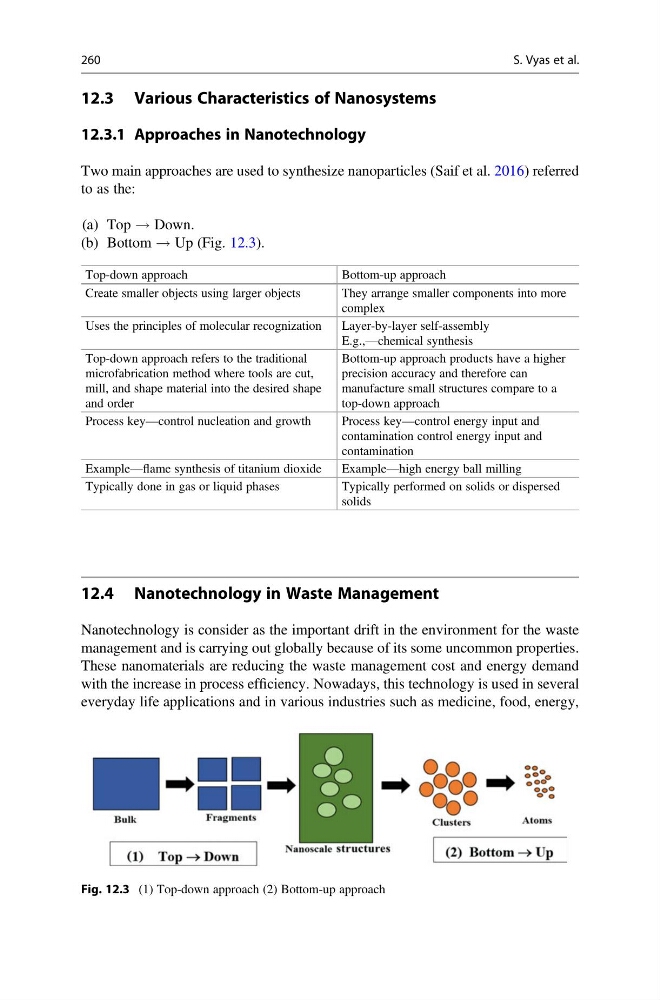
(b) Bottom ! Up (Fig. 12.3).
Top-down approach
Bottom-up approach
Create smaller objects using larger objects
They arrange smaller components into more
complex
Uses the principles of molecular recognization
Layer-by-layer self-assembly
E.g.,—chemical synthesis
Top-down approach refers to the traditional
microfabrication method where tools are cut,
mill, and shape material into the desired shape
and order
Bottom-up approach products have a higher
precision accuracy and therefore can
manufacture small structures compare to a
top-down approach
Process key—control nucleation and growth
Process key—control energy input and
contamination control energy input and
contamination
Example—flame synthesis of titanium dioxide
Example—high energy ball milling
Typically done in gas or liquid phases
Typically performed on solids or dispersed
solids
12.4 Nanotechnology in Waste Management
Nanotechnology is consider as the important drift in the environment for the waste
management and is carrying out globally because of its some uncommon properties.
These nanomaterials are reducing the waste management cost and energy demand
with the increase in process efficiency. Nowadays, this technology is used in several
everyday life applications and in various industries such as medicine, food, energy,
Fig. 12.3 (1) Top-down approach (2) Bottom-up approach
260
S. Vyas et al.
12.3.1 Approaches in Nanotechnology
Two main approaches are used to synthesize nanoparticles (Saif et al. 2016) referred
to as the:
(a) Top ! Down.
(b) Bottom ! Up (Fig. 12.3).
Top-down approach
Bottom-up approach
Create smaller objects using larger objects
They arrange smaller components into more
complex
Uses the principles of molecular recognization
Layer-by-layer self-assembly
E.g.,—chemical synthesis
Top-down approach refers to the traditional
microfabrication method where tools are cut,
mill, and shape material into the desired shape
and order
Bottom-up approach products have a higher
precision accuracy and therefore can
manufacture small structures compare to a
top-down approach
Process key—control nucleation and growth
Process key—control energy input and
contamination control energy input and
contamination
Example—flame synthesis of titanium dioxide
Example—high energy ball milling
Typically done in gas or liquid phases
Typically performed on solids or dispersed
solids
12.4 Nanotechnology in Waste Management
Nanotechnology is consider as the important drift in the environment for the waste
management and is carrying out globally because of its some uncommon properties.
These nanomaterials are reducing the waste management cost and energy demand
with the increase in process efficiency. Nowadays, this technology is used in several
everyday life applications and in various industries such as medicine, food, energy,
Fig. 12.3 (1) Top-down approach (2) Bottom-up approach
260
S. Vyas et al.