

are either lost in the environment or unable to reach the target area required for
effective pest control. Around 20–30% of pesticides are lost through emissions, but
this can potentially increase to 50% of the total amount applied.
Nanotechnology is the fascinating science of controlling and production of
materials at the nanoscale dimension. The distinctive properties of the nanomaterials
are due to the increase in the surface area and quantum effects associated with
nanoscale dimension of the material. The increase in the atomic densities on the total
surface area of the nanomaterials, confer difference in the reactivity, surface composition, and physical state of nanomaterials (Nair et al. 2010; Ciancio and Mukerji
2007; Chinnamuthu and Boopathi 2009; Rodrigues 2017; Chaudhari and Castle
2011). Researchers are currently designing formulations similar to conventional
formulations, but with improved features, that is, more soluble, slower releasing,
and not prematurely degradable using the benefits of materials at nanoscale.
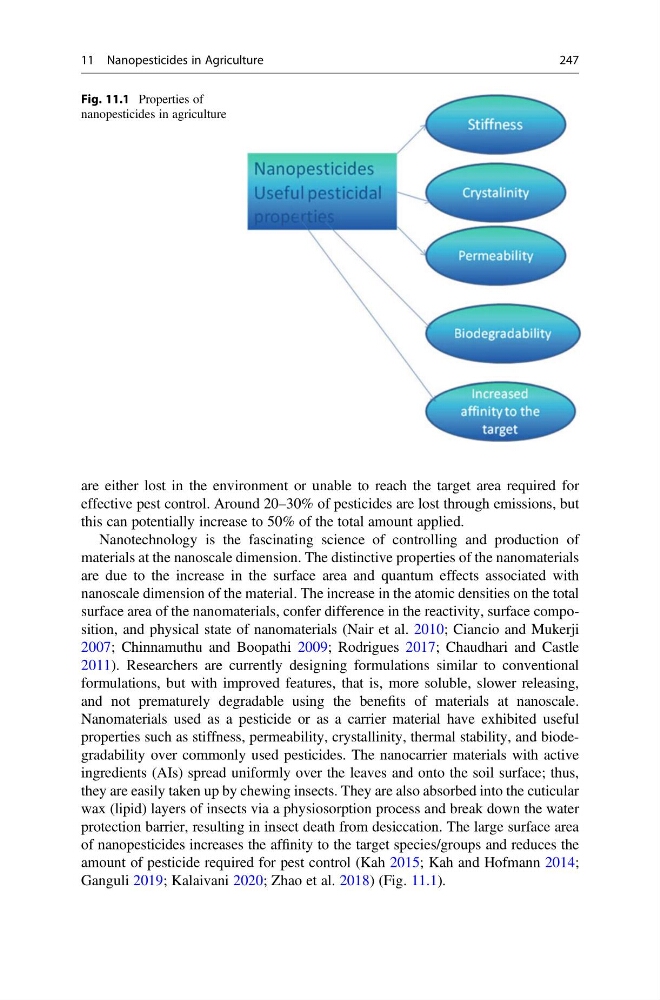
Nanomaterials used as a pesticide or as a carrier material have exhibited useful
properties such as stiffness, permeability, crystallinity, thermal stability, and biodegradability over commonly used pesticides. The nanocarrier materials with active
ingredients (AIs) spread uniformly over the leaves and onto the soil surface; thus,
they are easily taken up by chewing insects. They are also absorbed into the cuticular
wax (lipid) layers of insects via a physiosorption process and break down the water
protection barrier, resulting in insect death from desiccation. The large surface area
of nanopesticides increases the affinity to the target species/groups and reduces the
amount of pesticide required for pest control (Kah 2015; Kah and Hofmann 2014;
Ganguli 2019; Kalaivani 2020; Zhao et al. 2018) (Fig. 11.1).
Fig. 11.1 Properties of
nanopesticides in agriculture
11 Nanopesticides in Agriculture
247
effective pest control. Around 20–30% of pesticides are lost through emissions, but
this can potentially increase to 50% of the total amount applied.
Nanotechnology is the fascinating science of controlling and production of
materials at the nanoscale dimension. The distinctive properties of the nanomaterials
are due to the increase in the surface area and quantum effects associated with
nanoscale dimension of the material. The increase in the atomic densities on the total
surface area of the nanomaterials, confer difference in the reactivity, surface composition, and physical state of nanomaterials (Nair et al. 2010; Ciancio and Mukerji
2007; Chinnamuthu and Boopathi 2009; Rodrigues 2017; Chaudhari and Castle
2011). Researchers are currently designing formulations similar to conventional
formulations, but with improved features, that is, more soluble, slower releasing,
and not prematurely degradable using the benefits of materials at nanoscale.
Nanomaterials used as a pesticide or as a carrier material have exhibited useful
properties such as stiffness, permeability, crystallinity, thermal stability, and biodegradability over commonly used pesticides. The nanocarrier materials with active
ingredients (AIs) spread uniformly over the leaves and onto the soil surface; thus,
they are easily taken up by chewing insects. They are also absorbed into the cuticular
wax (lipid) layers of insects via a physiosorption process and break down the water
protection barrier, resulting in insect death from desiccation. The large surface area
of nanopesticides increases the affinity to the target species/groups and reduces the
amount of pesticide required for pest control (Kah 2015; Kah and Hofmann 2014;
Ganguli 2019; Kalaivani 2020; Zhao et al. 2018) (Fig. 11.1).
Fig. 11.1 Properties of
nanopesticides in agriculture
11 Nanopesticides in Agriculture
247