

can also be reported as parts per million (ppm), even for readily soluble
compounds. Generally more the value of water solubilty more easily the active
indregient dissolve.
2. Partition coefficient (K ow ): The octanol–water partition coefficient indicates how
a chemical is distributed at equilibrium between organic (octanol) and aqueous
(water) phases. This coefficient is primarily used in predicting the environmental
fate of organic chemicals such as pesticides. The higher the coefficient is, the
greater the propensity for the chemical to be partitioned to organic phases. This
means the chemical will tend to adhere to the organic matter in the soil. Commonly used pesticides are greatly limited in their application due to a number of
problems associated with them. The nontarget action of pesticides on the natural
predators of pests will increase the levels of pest community, but it may also
accumulate in the fat in human body.
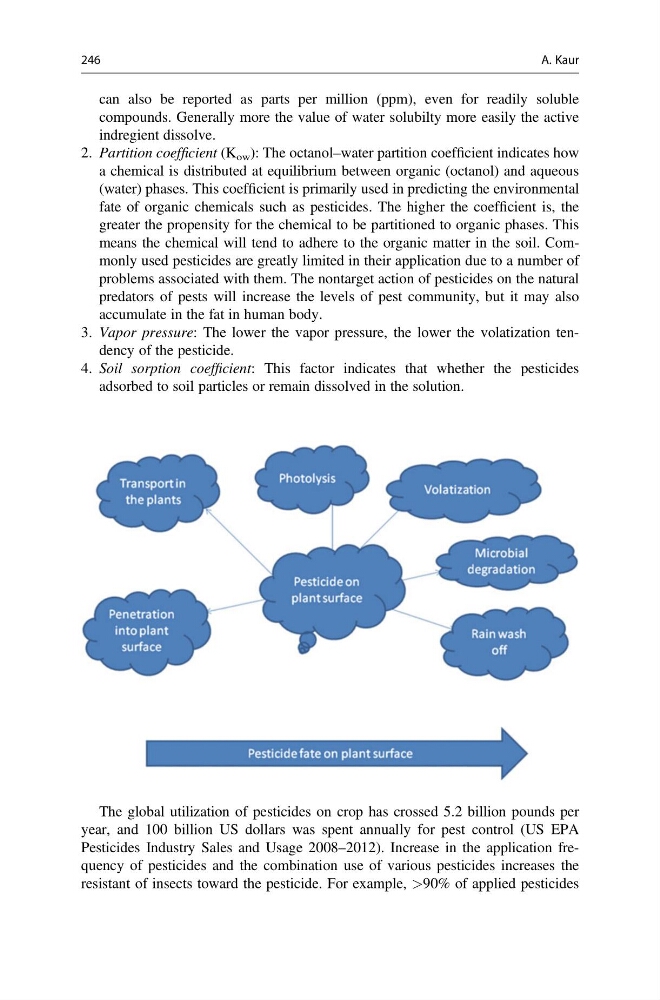
3. Vapor pressure: The lower the vapor pressure, the lower the volatization tendency of the pesticide.
4. Soil sorption coefficient: This factor indicates that whether the pesticides
adsorbed to soil particles or remain dissolved in the solution.
The global utilization of pesticides on crop has crossed 5.2 billion pounds per
year, and 100 billion US dollars was spent annually for pest control (US EPA
Pesticides Industry Sales and Usage 2008–2012). Increase in the application frequency of pesticides and the combination use of various pesticides increases the
resistant of insects toward the pesticide. For example, >90% of applied pesticides
246
A. Kaur
compounds. Generally more the value of water solubilty more easily the active
indregient dissolve.
2. Partition coefficient (K ow ): The octanol–water partition coefficient indicates how
a chemical is distributed at equilibrium between organic (octanol) and aqueous
(water) phases. This coefficient is primarily used in predicting the environmental
fate of organic chemicals such as pesticides. The higher the coefficient is, the
greater the propensity for the chemical to be partitioned to organic phases. This
means the chemical will tend to adhere to the organic matter in the soil. Commonly used pesticides are greatly limited in their application due to a number of
problems associated with them. The nontarget action of pesticides on the natural
predators of pests will increase the levels of pest community, but it may also
accumulate in the fat in human body.
3. Vapor pressure: The lower the vapor pressure, the lower the volatization tendency of the pesticide.
4. Soil sorption coefficient: This factor indicates that whether the pesticides
adsorbed to soil particles or remain dissolved in the solution.
The global utilization of pesticides on crop has crossed 5.2 billion pounds per
year, and 100 billion US dollars was spent annually for pest control (US EPA
Pesticides Industry Sales and Usage 2008–2012). Increase in the application frequency of pesticides and the combination use of various pesticides increases the
resistant of insects toward the pesticide. For example, >90% of applied pesticides
246
A. Kaur