

7.1
Introduction
Water is one of the prime requirements for the existence of life on the earth. Being
one of the essential components, water has also been used for carrying out various
activities in household and industrial fronts. The necessity of water for the crop
production is well known to us (Shoueir et al. 2019; Muthuraman and Moon 2012).
However, the rapid industrialization and urbanization have produced major treat to
these water resources. Out of diverse ranges of water pollutants, water dyes are
identified as one of the major sources of the water pollution (Zhao et al. 2020; Tian
et al. 2018). Current era has witness that the usage of dyes has reached its all-time
high in due to their multifunctional applications in different industries like textile,
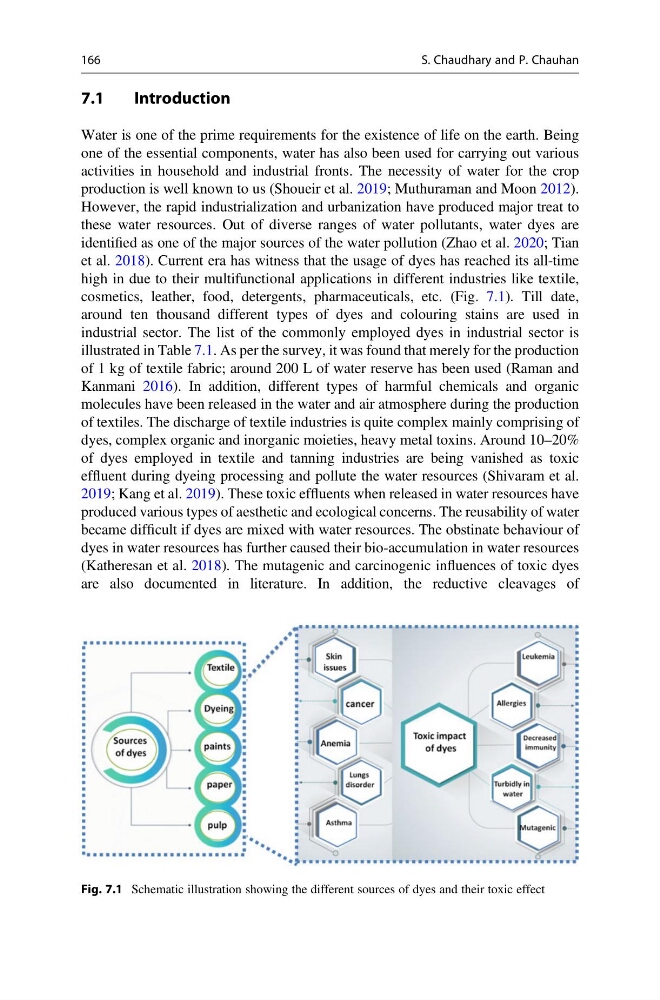
cosmetics, leather, food, detergents, pharmaceuticals, etc. (Fig. 7.1). Till date,
around ten thousand different types of dyes and colouring stains are used in
industrial sector. The list of the commonly employed dyes in industrial sector is
illustrated in Table 7.1. As per the survey, it was found that merely for the production
of 1 kg of textile fabric; around 200 L of water reserve has been used (Raman and
Kanmani 2016). In addition, different types of harmful chemicals and organic
molecules have been released in the water and air atmosphere during the production
of textiles. The discharge of textile industries is quite complex mainly comprising of
dyes, complex organic and inorganic moieties, heavy metal toxins. Around 10–20%
of dyes employed in textile and tanning industries are being vanished as toxic
effluent during dyeing processing and pollute the water resources (Shivaram et al.
2019; Kang et al. 2019). These toxic effluents when released in water resources have
produced various types of aesthetic and ecological concerns. The reusability of water
became difficult if dyes are mixed with water resources. The obstinate behaviour of
dyes in water resources has further caused their bio-accumulation in water resources
(Katheresan et al. 2018). The mutagenic and carcinogenic influences of toxic dyes
are also documented in literature. In addition, the reductive cleavages of
Fig. 7.1 Schematic illustration showing the different sources of dyes and their toxic effect
166
S. Chaudhary and P. Chauhan
Introduction
Water is one of the prime requirements for the existence of life on the earth. Being
one of the essential components, water has also been used for carrying out various
activities in household and industrial fronts. The necessity of water for the crop
production is well known to us (Shoueir et al. 2019; Muthuraman and Moon 2012).
However, the rapid industrialization and urbanization have produced major treat to
these water resources. Out of diverse ranges of water pollutants, water dyes are
identified as one of the major sources of the water pollution (Zhao et al. 2020; Tian
et al. 2018). Current era has witness that the usage of dyes has reached its all-time
high in due to their multifunctional applications in different industries like textile,
cosmetics, leather, food, detergents, pharmaceuticals, etc. (Fig. 7.1). Till date,
around ten thousand different types of dyes and colouring stains are used in
industrial sector. The list of the commonly employed dyes in industrial sector is
illustrated in Table 7.1. As per the survey, it was found that merely for the production
of 1 kg of textile fabric; around 200 L of water reserve has been used (Raman and
Kanmani 2016). In addition, different types of harmful chemicals and organic
molecules have been released in the water and air atmosphere during the production
of textiles. The discharge of textile industries is quite complex mainly comprising of
dyes, complex organic and inorganic moieties, heavy metal toxins. Around 10–20%
of dyes employed in textile and tanning industries are being vanished as toxic
effluent during dyeing processing and pollute the water resources (Shivaram et al.
2019; Kang et al. 2019). These toxic effluents when released in water resources have
produced various types of aesthetic and ecological concerns. The reusability of water
became difficult if dyes are mixed with water resources. The obstinate behaviour of
dyes in water resources has further caused their bio-accumulation in water resources
(Katheresan et al. 2018). The mutagenic and carcinogenic influences of toxic dyes
are also documented in literature. In addition, the reductive cleavages of
Fig. 7.1 Schematic illustration showing the different sources of dyes and their toxic effect
166
S. Chaudhary and P. Chauhan