

1.2.3 Soil Pollution
Contamination of soil with inconsistent concentrations of heavy metals makes the
environment harmful to human beings and other living organisms. The root cause of
soil pollution is agriculture by the use of pesticides, excessive industrial activity,
poor management or inefficient disposal of waste which are challenges with the
greater requirement of remediation (Chibuike and Obiora 2014). The presence of
substances in soil so called as xenobiotic which are carcinogenic and may accumulate in the environment causing toxic effects to humans primarily through food,
inhalation or drinking water, affect the mobility and biological impact of these toxins
(Giller et al. 1998).
The large quantity of xenobiotic compounds in soil has been increased rigorously
by the accelerated rate of extraction of minerals and fossil fuels and by highly
technological industrial processes (Adham et al. 2011) and not all soil pollutants
are xenobiotic compounds. Crop production problems in agriculture are encountered
when excess salinity salt accumulation occurs in soils in arid climates where the rate
of evaporation exceeds the rate of precipitation. As the soil dries, ions released by
mineral weathering or introduced by saline ground water tend to accumulate in the
form of carbonate, sulfate, chloride, and clay minerals (Li et al. 2014; Lim et al.
2008).
The sustained use of water resources for irrigating agricultural land in an arid
region requires that the applied water not damage the soil environment. Crop
utilization of water and fertilizers has the effect of concentrating salts in the soil;
consequently, without careful management irrigated soils can become saline or
develop toxicity (Zhao et al. 2012).
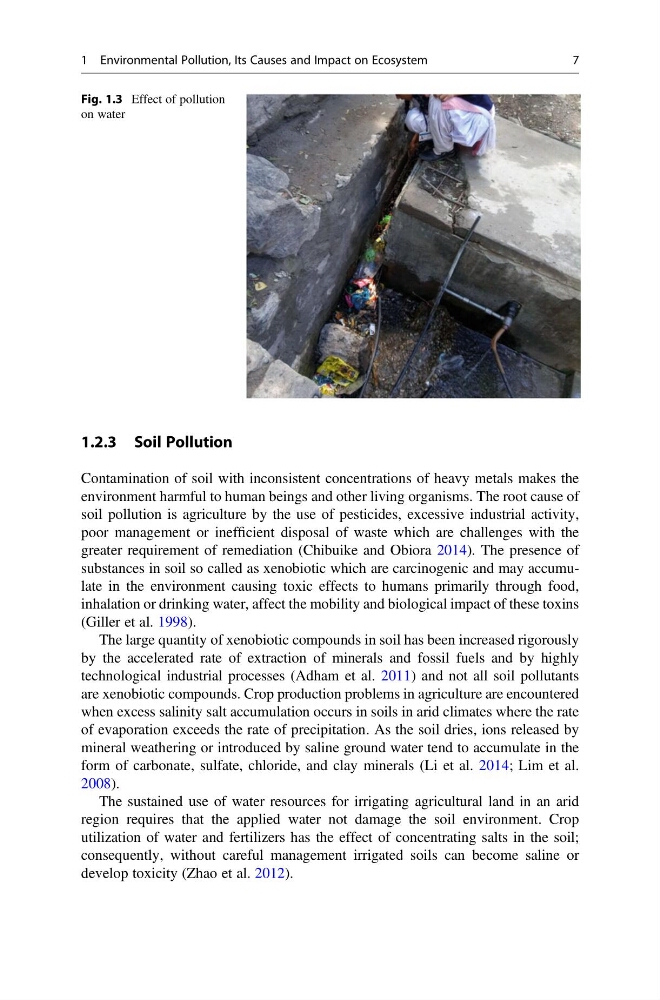
Fig. 1.3 Effect of pollution
on water
1 Environmental Pollution, Its Causes and Impact on Ecosystem
7
Contamination of soil with inconsistent concentrations of heavy metals makes the
environment harmful to human beings and other living organisms. The root cause of
soil pollution is agriculture by the use of pesticides, excessive industrial activity,
poor management or inefficient disposal of waste which are challenges with the
greater requirement of remediation (Chibuike and Obiora 2014). The presence of
substances in soil so called as xenobiotic which are carcinogenic and may accumulate in the environment causing toxic effects to humans primarily through food,
inhalation or drinking water, affect the mobility and biological impact of these toxins
(Giller et al. 1998).
The large quantity of xenobiotic compounds in soil has been increased rigorously
by the accelerated rate of extraction of minerals and fossil fuels and by highly
technological industrial processes (Adham et al. 2011) and not all soil pollutants
are xenobiotic compounds. Crop production problems in agriculture are encountered
when excess salinity salt accumulation occurs in soils in arid climates where the rate
of evaporation exceeds the rate of precipitation. As the soil dries, ions released by
mineral weathering or introduced by saline ground water tend to accumulate in the
form of carbonate, sulfate, chloride, and clay minerals (Li et al. 2014; Lim et al.
2008).
The sustained use of water resources for irrigating agricultural land in an arid
region requires that the applied water not damage the soil environment. Crop
utilization of water and fertilizers has the effect of concentrating salts in the soil;
consequently, without careful management irrigated soils can become saline or
develop toxicity (Zhao et al. 2012).
Fig. 1.3 Effect of pollution
on water
1 Environmental Pollution, Its Causes and Impact on Ecosystem
7