

64
M. Haumann
In 2017, the reduction of toxic mercury compounds from vinyl chloride monomer
(VCM) production was reported. High-valent Au(III) complexes have been immobilized in 1-propyl-3-methylimidazolium chloride [C 3 C 1 im][Cl] supported on activated carbon [42]. In order to suppress reduction of the active Au(III) species to
metallic Au
0 , addition of CuCl 2 to the ionic liquid was found to be beneficial. Both
metals were highly dispersed on the carbon surface, since no Au or Cu particles were
detected by means of XRD and TEM in combination with EDS.
The as-prepared Au-SILP catalysts were tested in the gas-phase hydrochlorination
of acetylene (see Scheme 3.7) in a tubular fixed-bed reactor at 180 °C and ambient
pressure. While the pure Au/activated carbon (AC) and Cu/AC catalysts showed
almost no activity, 40% acetylene conversion was observed for the Au-SILP system.
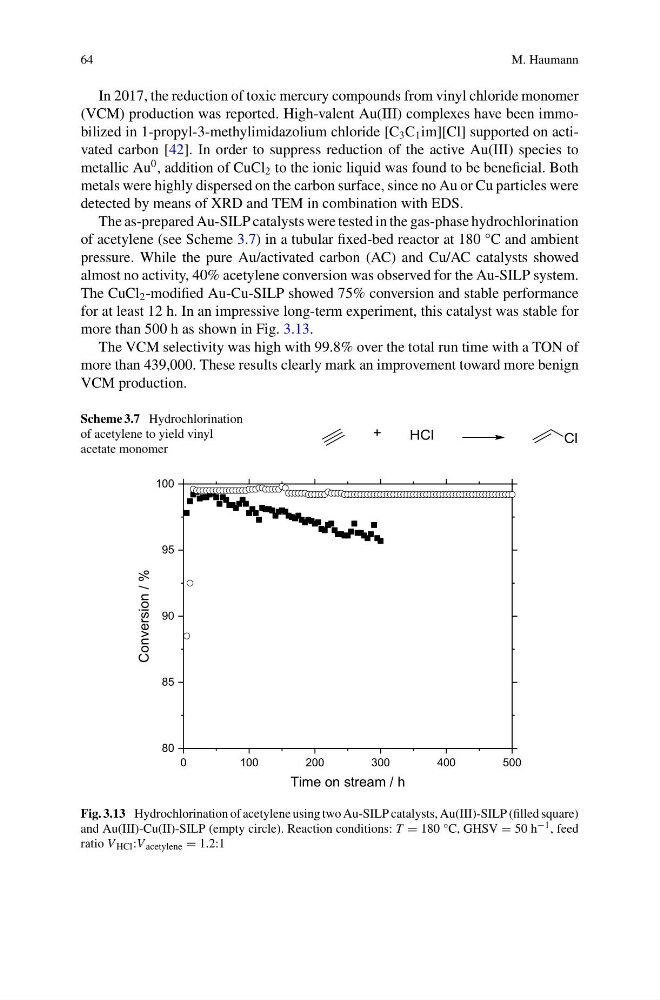
The CuCl 2 -modified Au-Cu-SILP showed 75% conversion and stable performance
for at least 12 h. In an impressive long-term experiment, this catalyst was stable for
more than 500 h as shown in Fig. 3.13.
The VCM selectivity was high with 99.8% over the total run time with a TON of
more than 439,000. These results clearly mark an improvement toward more benign
VCM production.
Scheme 3.7 Hydrochlorination
of acetylene to yield vinyl
acetate monomer
HCl
+
Cl
0
100
200
300
400
500
80
85
90
95
100
Conversion / %
Time on stream / h
Fig. 3.13 Hydrochlorination of acetylene using two Au-SILP catalysts, Au(III)-SILP (filled square)
and Au(III)-Cu(II)-SILP (empty circle). Reaction conditions: T = 180 °C, GHSV = 50 h −1 , feed
ratio V HCl :V acetylene = 1.2:1
M. Haumann
In 2017, the reduction of toxic mercury compounds from vinyl chloride monomer
(VCM) production was reported. High-valent Au(III) complexes have been immobilized in 1-propyl-3-methylimidazolium chloride [C 3 C 1 im][Cl] supported on activated carbon [42]. In order to suppress reduction of the active Au(III) species to
metallic Au
0 , addition of CuCl 2 to the ionic liquid was found to be beneficial. Both
metals were highly dispersed on the carbon surface, since no Au or Cu particles were
detected by means of XRD and TEM in combination with EDS.
The as-prepared Au-SILP catalysts were tested in the gas-phase hydrochlorination
of acetylene (see Scheme 3.7) in a tubular fixed-bed reactor at 180 °C and ambient
pressure. While the pure Au/activated carbon (AC) and Cu/AC catalysts showed
almost no activity, 40% acetylene conversion was observed for the Au-SILP system.
The CuCl 2 -modified Au-Cu-SILP showed 75% conversion and stable performance
for at least 12 h. In an impressive long-term experiment, this catalyst was stable for
more than 500 h as shown in Fig. 3.13.
The VCM selectivity was high with 99.8% over the total run time with a TON of
more than 439,000. These results clearly mark an improvement toward more benign
VCM production.
Scheme 3.7 Hydrochlorination
of acetylene to yield vinyl
acetate monomer
HCl
+
Cl
0
100
200
300
400
500
80
85
90
95
100
Conversion / %
Time on stream / h
Fig. 3.13 Hydrochlorination of acetylene using two Au-SILP catalysts, Au(III)-SILP (filled square)
and Au(III)-Cu(II)-SILP (empty circle). Reaction conditions: T = 180 °C, GHSV = 50 h −1 , feed
ratio V HCl :V acetylene = 1.2:1