

56
M. Haumann
reaction
separation
support structure
membrane layer
ionic liquid film (+ catalyst)
products
products
feed
feed
(1-X)feed
(1-X)feed
products
products
(a)
(b)
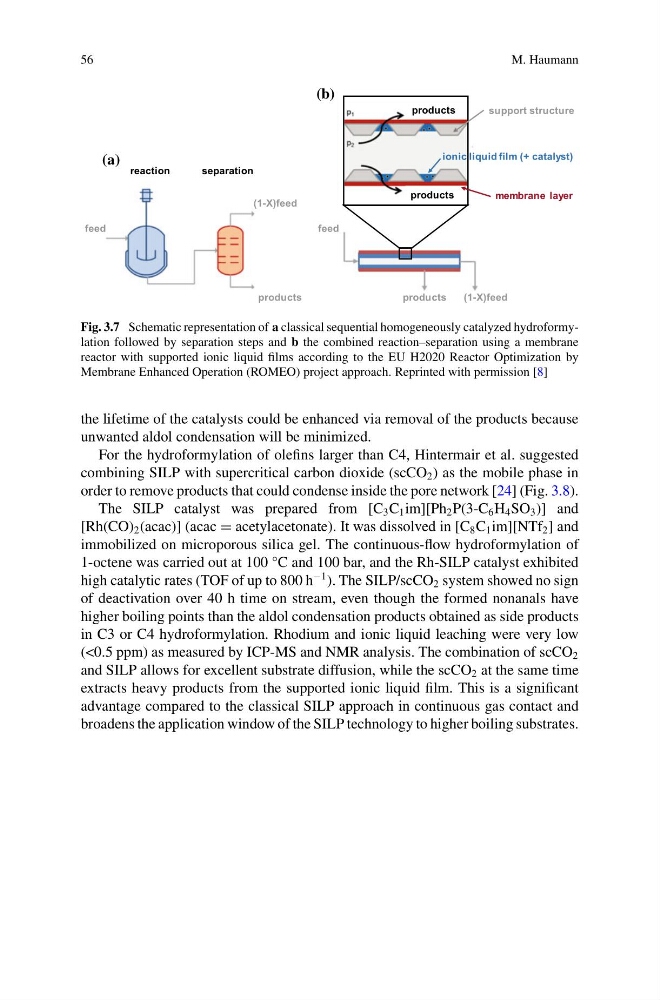
Fig. 3.7 Schematic representation of a classical sequential homogeneously catalyzed hydroformylation followed by separation steps and b the combined reaction–separation using a membrane
reactor with supported ionic liquid films according to the EU H2020 Reactor Optimization by
Membrane Enhanced Operation (ROMEO) project approach. Reprinted with permission [8]
the lifetime of the catalysts could be enhanced via removal of the products because
unwanted aldol condensation will be minimized.
For the hydroformylation of olefins larger than C4, Hintermair et al. suggested
combining SILP with supercritical carbon dioxide (scCO 2 ) as the mobile phase in
order to remove products that could condense inside the pore network [24] (Fig. 3.8).
The SILP catalyst was prepared from [C 3 C 1 im][Ph 2 P(3-C 6 H 4 SO 3 )] and
[Rh(CO) 2 (acac)] (acac = acetylacetonate). It was dissolved in [C 8 C 1 im][NTf 2 ] and
immobilized on microporous silica gel. The continuous-flow hydroformylation of
1-octene was carried out at 100 °C and 100 bar, and the Rh-SILP catalyst exhibited
high catalytic rates (TOF of up to 800 h
−1 ). The SILP/scCO 2 system showed no sign
of deactivation over 40 h time on stream, even though the formed nonanals have
higher boiling points than the aldol condensation products obtained as side products
in C3 or C4 hydroformylation. Rhodium and ionic liquid leaching were very low
(<0.5 ppm) as measured by ICP-MS and NMR analysis. The combination of scCO 2
and SILP allows for excellent substrate diffusion, while the scCO 2 at the same time
extracts heavy products from the supported ionic liquid film. This is a significant
advantage compared to the classical SILP approach in continuous gas contact and
broadens the application window of the SILP technology to higher boiling substrates.
M. Haumann
reaction
separation
support structure
membrane layer
ionic liquid film (+ catalyst)
products
products
feed
feed
(1-X)feed
(1-X)feed
products
products
(a)
(b)
Fig. 3.7 Schematic representation of a classical sequential homogeneously catalyzed hydroformylation followed by separation steps and b the combined reaction–separation using a membrane
reactor with supported ionic liquid films according to the EU H2020 Reactor Optimization by
Membrane Enhanced Operation (ROMEO) project approach. Reprinted with permission [8]
the lifetime of the catalysts could be enhanced via removal of the products because
unwanted aldol condensation will be minimized.
For the hydroformylation of olefins larger than C4, Hintermair et al. suggested
combining SILP with supercritical carbon dioxide (scCO 2 ) as the mobile phase in
order to remove products that could condense inside the pore network [24] (Fig. 3.8).
The SILP catalyst was prepared from [C 3 C 1 im][Ph 2 P(3-C 6 H 4 SO 3 )] and
[Rh(CO) 2 (acac)] (acac = acetylacetonate). It was dissolved in [C 8 C 1 im][NTf 2 ] and
immobilized on microporous silica gel. The continuous-flow hydroformylation of
1-octene was carried out at 100 °C and 100 bar, and the Rh-SILP catalyst exhibited
high catalytic rates (TOF of up to 800 h
−1 ). The SILP/scCO 2 system showed no sign
of deactivation over 40 h time on stream, even though the formed nonanals have
higher boiling points than the aldol condensation products obtained as side products
in C3 or C4 hydroformylation. Rhodium and ionic liquid leaching were very low
(<0.5 ppm) as measured by ICP-MS and NMR analysis. The combination of scCO 2
and SILP allows for excellent substrate diffusion, while the scCO 2 at the same time
extracts heavy products from the supported ionic liquid film. This is a significant
advantage compared to the classical SILP approach in continuous gas contact and
broadens the application window of the SILP technology to higher boiling substrates.