

50
M. Haumann
A
B
Ionic liquid
Pore
Support
B
A
Reactor
m
Pellet
mm - µm
Thin film
nm
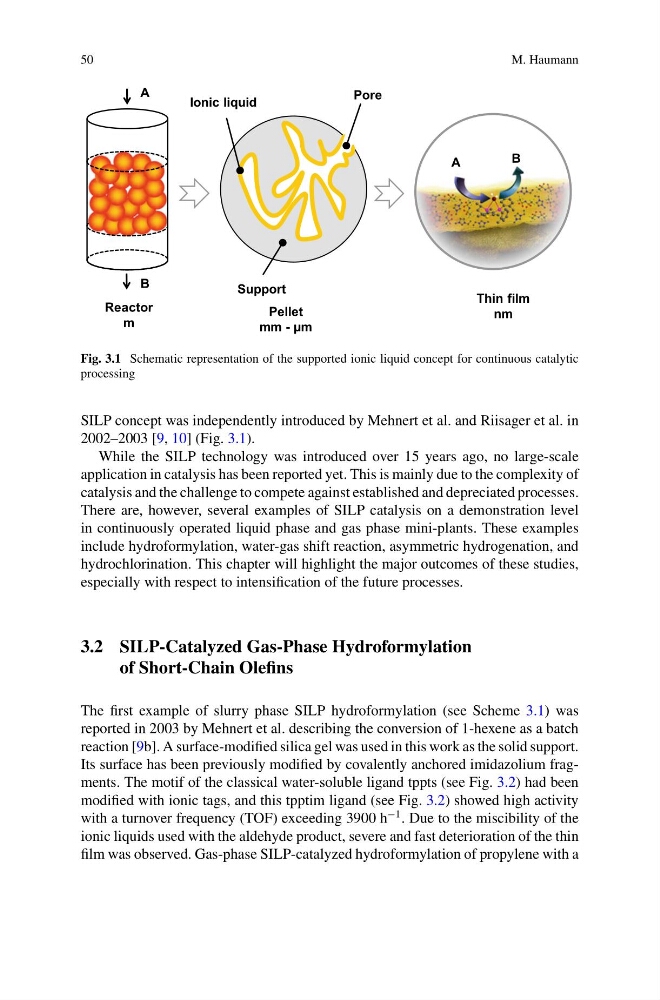
Fig. 3.1 Schematic representation of the supported ionic liquid concept for continuous catalytic
processing
SILP concept was independently introduced by Mehnert et al. and Riisager et al. in
2002–2003 [9, 10] (Fig. 3.1).
While the SILP technology was introduced over 15 years ago, no large-scale
application in catalysis has been reported yet. This is mainly due to the complexity of
catalysis and the challenge to compete against established and depreciated processes.
There are, however, several examples of SILP catalysis on a demonstration level
in continuously operated liquid phase and gas phase mini-plants. These examples
include hydroformylation, water-gas shift reaction, asymmetric hydrogenation, and
hydrochlorination. This chapter will highlight the major outcomes of these studies,
especially with respect to intensification of the future processes.
3.2 SILP-Catalyzed Gas-Phase Hydroformylation
of Short-Chain Olefins
The first example of slurry phase SILP hydroformylation (see Scheme 3.1) was
reported in 2003 by Mehnert et al. describing the conversion of 1-hexene as a batch
reaction [9b]. A surface-modified silica gel was used in this work as the solid support.
Its surface has been previously modified by covalently anchored imidazolium fragments. The motif of the classical water-soluble ligand tppts (see Fig. 3.2) had been
modified with ionic tags, and this tpptim ligand (see Fig. 3.2) showed high activity
with a turnover frequency (TOF) exceeding 3900 h
−1 . Due to the miscibility of the
ionic liquids used with the aldehyde product, severe and fast deterioration of the thin
film was observed. Gas-phase SILP-catalyzed hydroformylation of propylene with a
M. Haumann
A
B
Ionic liquid
Pore
Support
B
A
Reactor
m
Pellet
mm - µm
Thin film
nm
Fig. 3.1 Schematic representation of the supported ionic liquid concept for continuous catalytic
processing
SILP concept was independently introduced by Mehnert et al. and Riisager et al. in
2002–2003 [9, 10] (Fig. 3.1).
While the SILP technology was introduced over 15 years ago, no large-scale
application in catalysis has been reported yet. This is mainly due to the complexity of
catalysis and the challenge to compete against established and depreciated processes.
There are, however, several examples of SILP catalysis on a demonstration level
in continuously operated liquid phase and gas phase mini-plants. These examples
include hydroformylation, water-gas shift reaction, asymmetric hydrogenation, and
hydrochlorination. This chapter will highlight the major outcomes of these studies,
especially with respect to intensification of the future processes.
3.2 SILP-Catalyzed Gas-Phase Hydroformylation
of Short-Chain Olefins
The first example of slurry phase SILP hydroformylation (see Scheme 3.1) was
reported in 2003 by Mehnert et al. describing the conversion of 1-hexene as a batch
reaction [9b]. A surface-modified silica gel was used in this work as the solid support.
Its surface has been previously modified by covalently anchored imidazolium fragments. The motif of the classical water-soluble ligand tppts (see Fig. 3.2) had been
modified with ionic tags, and this tpptim ligand (see Fig. 3.2) showed high activity
with a turnover frequency (TOF) exceeding 3900 h
−1 . Due to the miscibility of the
ionic liquids used with the aldehyde product, severe and fast deterioration of the thin
film was observed. Gas-phase SILP-catalyzed hydroformylation of propylene with a