

42
H. K. Timken et al.
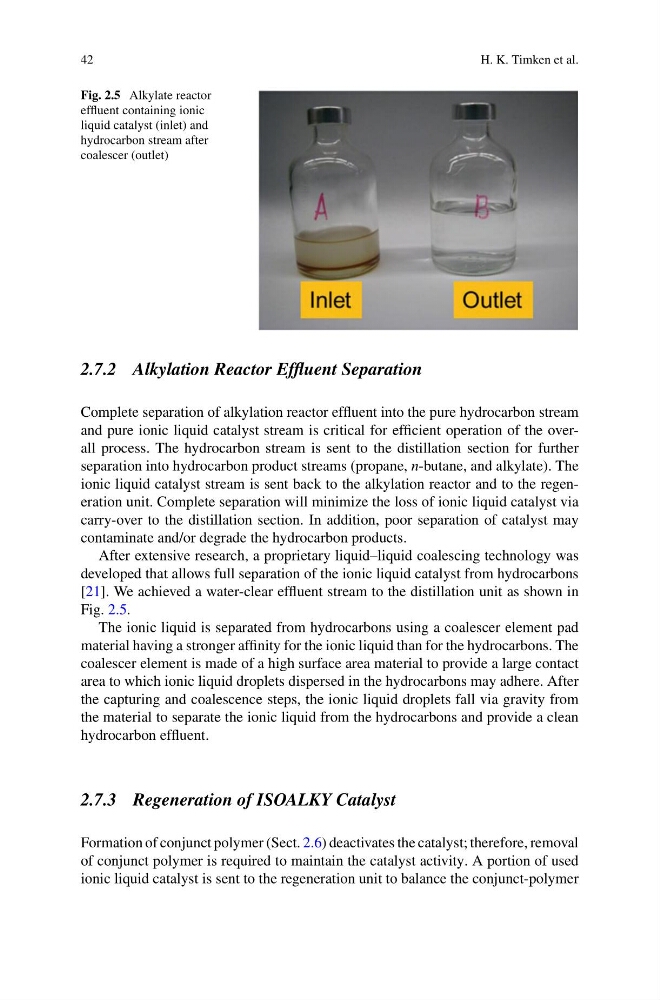
Fig. 2.5 Alkylate reactor
effluent containing ionic
liquid catalyst (inlet) and
hydrocarbon stream after
coalescer (outlet)
2.7.2 Alkylation Reactor Effluent Separation
Complete separation of alkylation reactor effluent into the pure hydrocarbon stream
and pure ionic liquid catalyst stream is critical for efficient operation of the overall process. The hydrocarbon stream is sent to the distillation section for further
separation into hydrocarbon product streams (propane, n-butane, and alkylate). The
ionic liquid catalyst stream is sent back to the alkylation reactor and to the regeneration unit. Complete separation will minimize the loss of ionic liquid catalyst via
carry-over to the distillation section. In addition, poor separation of catalyst may
contaminate and/or degrade the hydrocarbon products.
After extensive research, a proprietary liquid–liquid coalescing technology was
developed that allows full separation of the ionic liquid catalyst from hydrocarbons
[21]. We achieved a water-clear effluent stream to the distillation unit as shown in
Fig. 2.5.
The ionic liquid is separated from hydrocarbons using a coalescer element pad
material having a stronger affinity for the ionic liquid than for the hydrocarbons. The
coalescer element is made of a high surface area material to provide a large contact
area to which ionic liquid droplets dispersed in the hydrocarbons may adhere. After
the capturing and coalescence steps, the ionic liquid droplets fall via gravity from
the material to separate the ionic liquid from the hydrocarbons and provide a clean
hydrocarbon effluent.
2.7.3 Regeneration of ISOALKY Catalyst
Formation of conjunct polymer (Sect. 2.6) deactivates the catalyst; therefore, removal
of conjunct polymer is required to maintain the catalyst activity. A portion of used
ionic liquid catalyst is sent to the regeneration unit to balance the conjunct-polymer
H. K. Timken et al.
Fig. 2.5 Alkylate reactor
effluent containing ionic
liquid catalyst (inlet) and
hydrocarbon stream after
coalescer (outlet)
2.7.2 Alkylation Reactor Effluent Separation
Complete separation of alkylation reactor effluent into the pure hydrocarbon stream
and pure ionic liquid catalyst stream is critical for efficient operation of the overall process. The hydrocarbon stream is sent to the distillation section for further
separation into hydrocarbon product streams (propane, n-butane, and alkylate). The
ionic liquid catalyst stream is sent back to the alkylation reactor and to the regeneration unit. Complete separation will minimize the loss of ionic liquid catalyst via
carry-over to the distillation section. In addition, poor separation of catalyst may
contaminate and/or degrade the hydrocarbon products.
After extensive research, a proprietary liquid–liquid coalescing technology was
developed that allows full separation of the ionic liquid catalyst from hydrocarbons
[21]. We achieved a water-clear effluent stream to the distillation unit as shown in
Fig. 2.5.
The ionic liquid is separated from hydrocarbons using a coalescer element pad
material having a stronger affinity for the ionic liquid than for the hydrocarbons. The
coalescer element is made of a high surface area material to provide a large contact
area to which ionic liquid droplets dispersed in the hydrocarbons may adhere. After
the capturing and coalescence steps, the ionic liquid droplets fall via gravity from
the material to separate the ionic liquid from the hydrocarbons and provide a clean
hydrocarbon effluent.
2.7.3 Regeneration of ISOALKY Catalyst
Formation of conjunct polymer (Sect. 2.6) deactivates the catalyst; therefore, removal
of conjunct polymer is required to maintain the catalyst activity. A portion of used
ionic liquid catalyst is sent to the regeneration unit to balance the conjunct-polymer