

40
H. K. Timken et al.
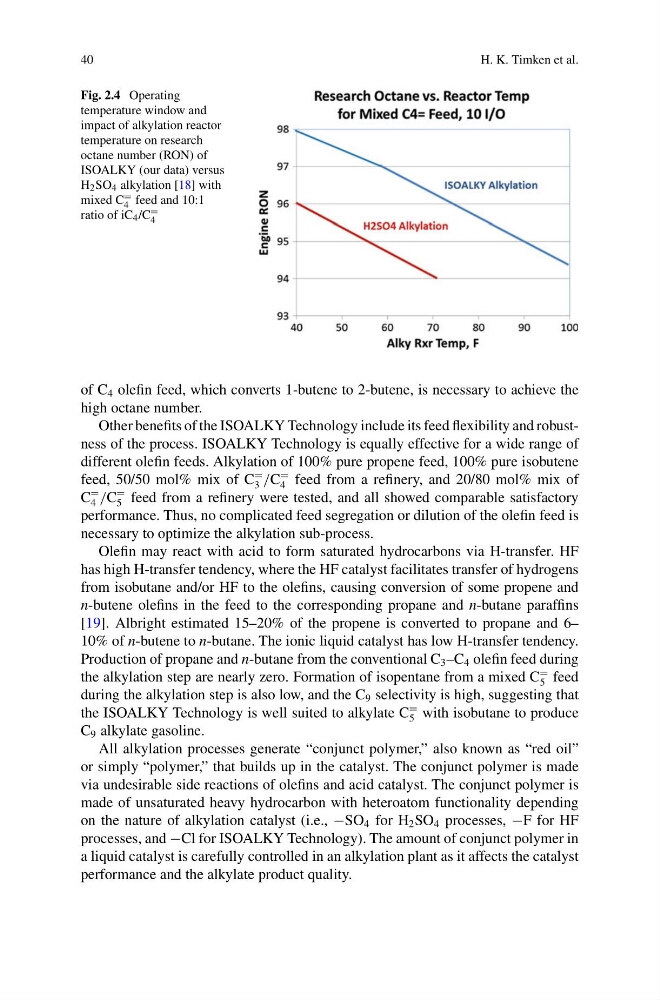
Fig. 2.4 Operating
temperature window and
impact of alkylation reactor
temperature on research
octane number (RON) of
ISOALKY (our data) versus
H 2 SO 4 alkylation [18] with
mixed C =
4 feed and 10:1
ratio of iC 4 /C =
4
of C 4 olefin feed, which converts 1-butene to 2-butene, is necessary to achieve the
high octane number.
Other benefits of the ISOALKY Technology include its feed flexibility and robustness of the process. ISOALKY Technology is equally effective for a wide range of
different olefin feeds. Alkylation of 100% pure propene feed, 100% pure isobutene
feed, 50/50 mol% mix of C
=
3 /C
=
4 feed from a refinery, and 20/80 mol% mix of
C
=
4 /C
=
5 feed from a refinery were tested, and all showed comparable satisfactory
performance. Thus, no complicated feed segregation or dilution of the olefin feed is
necessary to optimize the alkylation sub-process.
Olefin may react with acid to form saturated hydrocarbons via H-transfer. HF
has high H-transfer tendency, where the HF catalyst facilitates transfer of hydrogens
from isobutane and/or HF to the olefins, causing conversion of some propene and
n-butene olefins in the feed to the corresponding propane and n-butane paraffins
[19]. Albright estimated 15–20% of the propene is converted to propane and 6–
10% of n-butene to n-butane. The ionic liquid catalyst has low H-transfer tendency.
Production of propane and n-butane from the conventional C 3 –C 4 olefin feed during
the alkylation step are nearly zero. Formation of isopentane from a mixed C
=
5 feed
during the alkylation step is also low, and the C 9 selectivity is high, suggesting that
the ISOALKY Technology is well suited to alkylate C
=
5 with isobutane to produce
C 9 alkylate gasoline.
All alkylation processes generate “conjunct polymer,” also known as “red oil”
or simply “polymer,” that builds up in the catalyst. The conjunct polymer is made
via undesirable side reactions of olefins and acid catalyst. The conjunct polymer is
made of unsaturated heavy hydrocarbon with heteroatom functionality depending
on the nature of alkylation catalyst (i.e., −SO 4 for H 2 SO 4 processes, −F for HF
processes, and −Cl for ISOALKY Technology). The amount of conjunct polymer in
a liquid catalyst is carefully controlled in an alkylation plant as it affects the catalyst
performance and the alkylate product quality.
H. K. Timken et al.
Fig. 2.4 Operating
temperature window and
impact of alkylation reactor
temperature on research
octane number (RON) of
ISOALKY (our data) versus
H 2 SO 4 alkylation [18] with
mixed C =
4 feed and 10:1
ratio of iC 4 /C =
4
of C 4 olefin feed, which converts 1-butene to 2-butene, is necessary to achieve the
high octane number.
Other benefits of the ISOALKY Technology include its feed flexibility and robustness of the process. ISOALKY Technology is equally effective for a wide range of
different olefin feeds. Alkylation of 100% pure propene feed, 100% pure isobutene
feed, 50/50 mol% mix of C
=
3 /C
=
4 feed from a refinery, and 20/80 mol% mix of
C
=
4 /C
=
5 feed from a refinery were tested, and all showed comparable satisfactory
performance. Thus, no complicated feed segregation or dilution of the olefin feed is
necessary to optimize the alkylation sub-process.
Olefin may react with acid to form saturated hydrocarbons via H-transfer. HF
has high H-transfer tendency, where the HF catalyst facilitates transfer of hydrogens
from isobutane and/or HF to the olefins, causing conversion of some propene and
n-butene olefins in the feed to the corresponding propane and n-butane paraffins
[19]. Albright estimated 15–20% of the propene is converted to propane and 6–
10% of n-butene to n-butane. The ionic liquid catalyst has low H-transfer tendency.
Production of propane and n-butane from the conventional C 3 –C 4 olefin feed during
the alkylation step are nearly zero. Formation of isopentane from a mixed C
=
5 feed
during the alkylation step is also low, and the C 9 selectivity is high, suggesting that
the ISOALKY Technology is well suited to alkylate C
=
5 with isobutane to produce
C 9 alkylate gasoline.
All alkylation processes generate “conjunct polymer,” also known as “red oil”
or simply “polymer,” that builds up in the catalyst. The conjunct polymer is made
via undesirable side reactions of olefins and acid catalyst. The conjunct polymer is
made of unsaturated heavy hydrocarbon with heteroatom functionality depending
on the nature of alkylation catalyst (i.e., −SO 4 for H 2 SO 4 processes, −F for HF
processes, and −Cl for ISOALKY Technology). The amount of conjunct polymer in
a liquid catalyst is carefully controlled in an alkylation plant as it affects the catalyst
performance and the alkylate product quality.