

262
R. S. Kalb
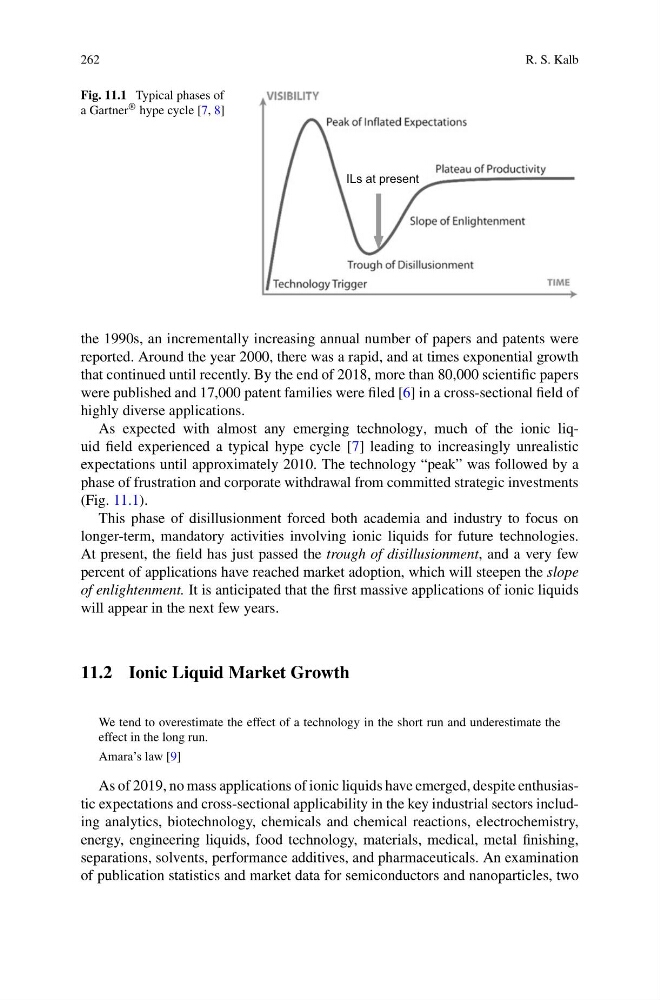
Fig. 11.1 Typical phases of
a Gartner ® hype cycle [7, 8]
ILs at present
the 1990s, an incrementally increasing annual number of papers and patents were
reported. Around the year 2000, there was a rapid, and at times exponential growth
that continued until recently. By the end of 2018, more than 80,000 scientific papers
were published and 17,000 patent families were filed [6] in a cross-sectional field of
highly diverse applications.
As expected with almost any emerging technology, much of the ionic liquid field experienced a typical hype cycle [7] leading to increasingly unrealistic
expectations until approximately 2010. The technology “peak” was followed by a
phase of frustration and corporate withdrawal from committed strategic investments
(Fig. 11.1).
This phase of disillusionment forced both academia and industry to focus on
longer-term, mandatory activities involving ionic liquids for future technologies.
At present, the field has just passed the trough of disillusionment, and a very few
percent of applications have reached market adoption, which will steepen the slope
of enlightenment. It is anticipated that the first massive applications of ionic liquids
will appear in the next few years.
11.2 Ionic Liquid Market Growth
We tend to overestimate the effect of a technology in the short run and underestimate the
effect in the long run.
Amara’s law [9]
As of 2019, no mass applications of ionic liquids have emerged, despite enthusiastic expectations and cross-sectional applicability in the key industrial sectors including analytics, biotechnology, chemicals and chemical reactions, electrochemistry,
energy, engineering liquids, food technology, materials, medical, metal finishing,
separations, solvents, performance additives, and pharmaceuticals. An examination
of publication statistics and market data for semiconductors and nanoparticles, two
R. S. Kalb
Fig. 11.1 Typical phases of
a Gartner ® hype cycle [7, 8]
ILs at present
the 1990s, an incrementally increasing annual number of papers and patents were
reported. Around the year 2000, there was a rapid, and at times exponential growth
that continued until recently. By the end of 2018, more than 80,000 scientific papers
were published and 17,000 patent families were filed [6] in a cross-sectional field of
highly diverse applications.
As expected with almost any emerging technology, much of the ionic liquid field experienced a typical hype cycle [7] leading to increasingly unrealistic
expectations until approximately 2010. The technology “peak” was followed by a
phase of frustration and corporate withdrawal from committed strategic investments
(Fig. 11.1).
This phase of disillusionment forced both academia and industry to focus on
longer-term, mandatory activities involving ionic liquids for future technologies.
At present, the field has just passed the trough of disillusionment, and a very few
percent of applications have reached market adoption, which will steepen the slope
of enlightenment. It is anticipated that the first massive applications of ionic liquids
will appear in the next few years.
11.2 Ionic Liquid Market Growth
We tend to overestimate the effect of a technology in the short run and underestimate the
effect in the long run.
Amara’s law [9]
As of 2019, no mass applications of ionic liquids have emerged, despite enthusiastic expectations and cross-sectional applicability in the key industrial sectors including analytics, biotechnology, chemicals and chemical reactions, electrochemistry,
energy, engineering liquids, food technology, materials, medical, metal finishing,
separations, solvents, performance additives, and pharmaceuticals. An examination
of publication statistics and market data for semiconductors and nanoparticles, two